Heart Work / Breaking The Cycle of Math Anxiety / Part 1
Breaking the Cycle of Math Anxiety
Part 1
In this first episode, Lauren finds herself in an unlikely situation that forces her to confront a belief she’s carried for as long as she can remember: that she’s not a math person. But what does that actually mean, and where does that belief begin? Join her as she starts the journey to find out. Featuring My Mathematical Mind founder Dr. Deborah Peart Crayton and curriculum specialist Sam Murro Shea.
Transcript
From Imagine Learning, I’m Lauren Keeling and you’re listening to Heart Work — an honest profile of America’s educators.
Michelle: It made me question how I was an A student for so long. Why would I be struggling now?
There’s five words that almost every educator has heard.
Christopher: I felt that I wasn’t good enough.
I’m not a math person.
Karen: I hated it. You should know this, or you’re not going to move from the kitchen table until you get it.
Five words that reflect a belief passed from one generation to the next: that they’re incapable.
Hillary: I did not feel like I was coming into a space where I could succeed. I was just wrong
But once that belief sets in, it has the power to shape an entire life.
Michelle: Maybe I wasn’t as good as I thought I was.
And the only way to make a difference for the next generation…
Winter: I’d get upset when I wouldn’t understand it. I’m just behind everybody else.
Is to break the cycle of math anxiety once and for all.
Student: I want to be a teacher when I grow up. If you don’t know math, you won’t be able to teach students how to understand math.
It’s October of 2025, and I’m standing in the middle of a convention center in Atlanta, Georgia. Thousands of teachers have flown here for the annual National Council of Teachers of Mathematics conference. NCTM. The biggest math conference in the country.
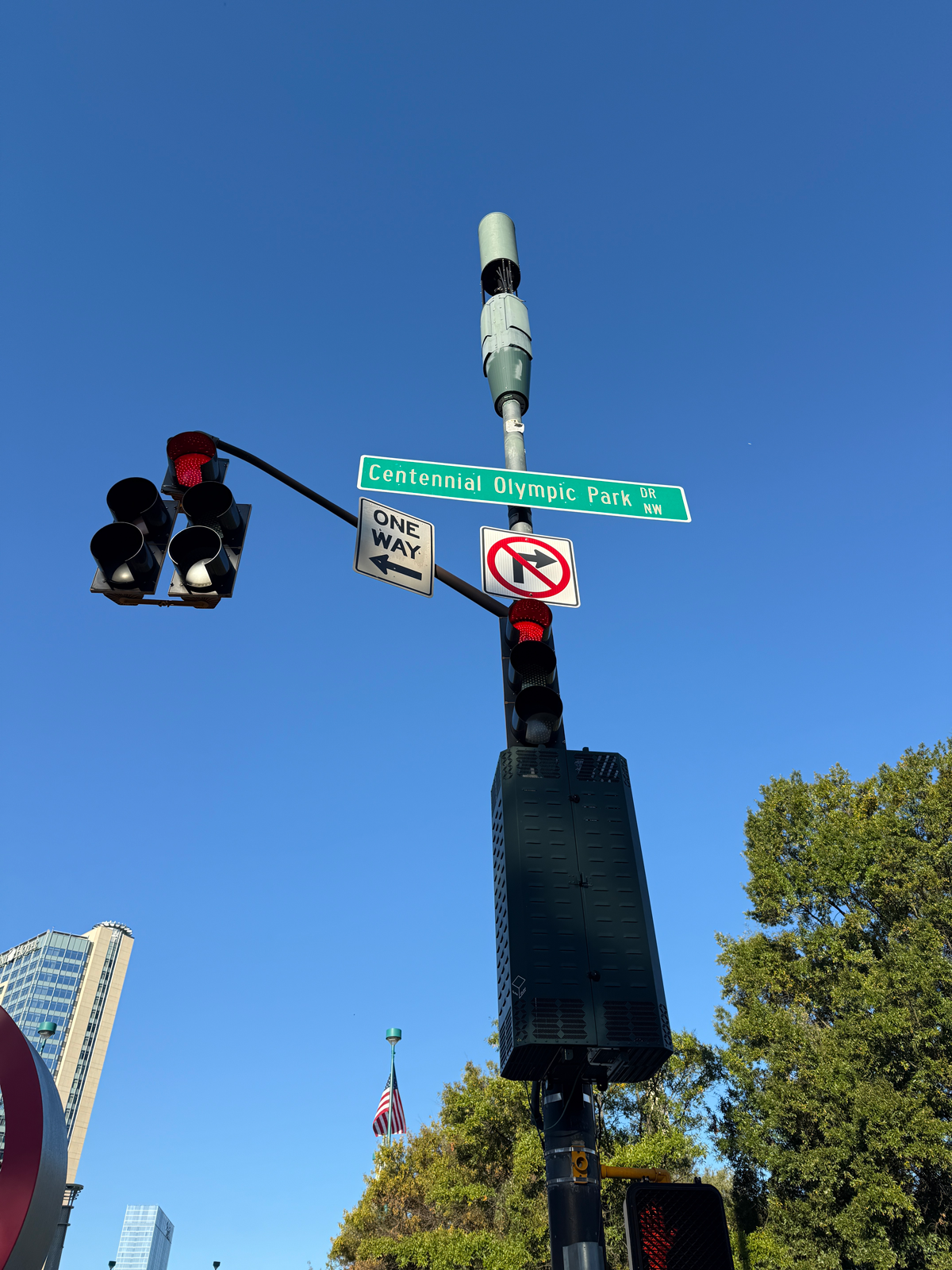
Centennial Olympic Park, Atlanta, GA

NCTM 2025 Annual Meeting and Exposition
I’m Lauren Keeling, former broadcast journalist, elementary teacher and principal. Today, I work as a curriculum consultant, and I also happen to be a lifelong sufferer of math anxiety, which makes me a slightly unlikely person to find here. I’m here to promote the first collection of this series. But even so, this is pretty much the last place I ever expected to be — and then I meet Sam Murro Shea.
Sam Murro Shea: Hi! It’s so nice to meet you.
Lauren Keeling: So nice to meet you!
Someone who would become both my invitation and my guide into this world.
Sam: I love conferences like this because it just, like, fills up your whole math heart, right? Or your literacy heart for NCTE, right?
Lauren: Absolutely.
Sam and I feel like two sides of the same coin. Where I’m a reader. Sam is a mather. Where language feels like home to me, math is where she comes to life.
Sam: Well, tell me about you, how did you completely switch careers?
Lauren: Listen, I’ve been everywhere and all the things, so…
She, too, has lived several professional lives, now as a curriculum expert and previously as an elementary teacher and math coach in a district of nearly 100,000 students. But her path to education wasn’t exactly conventional. She actually started out in medicine.
Sam: I was part of a mayoral initiative, where he wanted people in the community to go read to kids. Well, this then turned into, like, my first day of, “Here are two kids, teach them to read.” So I was like, “I don’t know if I’m qualified for this, but I definitely could read to them” and they were like, “No, no, no, go teach them to read.”
And it was my first aha moment, I knew I needed more of those, and what I was doing in my other job was not providing that.
I was always good at understanding facts, but also at being creative and problem-solving. And I think that’s why I fell in love with math, but that’s not everybody’s experience, right?
I went in teaching fourth grade that first year, and I remember, like, I didn’t know anything about teaching yet. And I’m like, okay, well, I’ll pass out these timed tests, and we’ll see how this goes. I turn on the timer, so excited, standing at the front, and I’m just, like, tapping my foot. And I started looking around, and everybody was miserable. Every kid is, like, struggling with this idea of this timed test.
So I stopped the timer, and I was like, “OK, time’s up.” And everybody, like, oh, you know, that big moan in the class. And I said, “Who feels good about doing this?” And there were zero hands. And I was like, cool, cool, cool, “Who feels good about math?” I had one hand — one hand out of 30 kids.
And it was like this magical moment where I’m like, everything that we’re doing is not okay.
Math instruction in the US has a long and complex history. For more than a century, competing beliefs about what content should be taught — and how it should be taught — have led to periodic shifts in instructional approach.
A major effort to advance and unify math education came in 1920, with the formation of the National Council of Teachers of Mathematics, an organization dedicated to giving math teachers a voice in educational decision-making and improving math education overall.
Yet even as NCTM called for a greater emphasis on conceptual understanding, classroom instruction often prioritized procedure.
Then, in 1957, the stakes changed.
Radio Audio Archive: 1957, and the world’s press announces a miracle of the age. The Russian’s have successfully launched the first satellite ever to circle the Earth, and Sputnik hurtles its way into space to make a date with history that heralds the dawn of a new era.
The Soviet Union’s launch of Sputnik 1 sent shockwaves across the US, spurring the public, educators, and politicians alike to ask if American schools were doing enough to prepare students in math and science. If not, how could the nation remain competitive in a new technological age?
In response, a movement known as “New Math” took hold, pushing instruction toward conceptual understanding and abstract structures. Now the goal wasn’t just to get the answer right, but to understand why it was right — and apply that learning to different contexts.
But implementing such a radical shift in real classrooms proved difficult. Teachers were often asked to deliver a new approach without the training needed to make it work, among other challenges. The movement faced growing backlash, and by the late 1970s through the 1990s, instruction swung back toward procedures and drills, with a strong emphasis on computational skills.
Paired with a growing focus on testing and accountability, this shift seemed to cement math’s reputation as the “most-hated subject.”
And many of today’s teachers were taught that way — with timed tests, drills, memorization. I was one of them. So when I hear Sam describe despondent students who just don’t feel good about math, I see myself.
I recall a conversation I had with our Heart Work producer as we were preparing for this collection, where I, for the first time, really unpacked where my feelings about math came from. Luckily for us, we record everything.
Lauren: If you’ve seen the movie Inside Out. You’ll know that there’s this conversation around core memories and the things that we hold on to in our brains that ultimately shape who we are. And if we’re trailing out that movie experience, one of my islands was probably related to math in some capacity.
I have a lot of really distinct and specific core memories tied to what I have always labeled as just my failure as a math student.
And the very first one is actually in first grade. I had the most lovely, soft teacher, and she was just absolutely a dream first-grade teacher without question. I have such warm memories of her. So my math experience has not impacted how I feel about her as a human. But what I remember very distinctly is having taken a timed test where there are 50 questions on the page, and she sets a timer up at the front of the classroom, and you had to answer as many as you could, as fast as you could.
And that is also the very first time that I ever got a paper back in my possession that had more red Xs on it than I had ever seen in my life because I had gotten so many of those wrong. It’s the first moment of my life where I felt like I was really bad at something — actually feeling the shame of like, this is not good. I don’t, what do I do here?
So I over-compensated. I worked really hard, and to be honest, I got OK grades. But I hated every moment of every math class I was in. Math had stopped being a safe space for me in first grade, and it stayed this way, forever.
During my talk with Sam, she tells me about Deborah Peart Crayton, author of Reader’s Read, Mather’s Math. Like me, she switched off to math early and fell into the language pattern of “I’m not a math person.”
Lauren: Alright, Deborah, hey!
I connect with her and realise just how closely her story echoes my own.
Dr. Deborah Peart Crayton: I loved learning. I loved everything about learning. I was super curious. I wanted to read everything. I was trying to read the dictionary from cover to cover — the big blue one with the speckled tabs that some may not even know about — but I was devouring knowledge, information, and the world.
So then I go to school, and I’m celebrated when I’m writing stories. My favorite thing was personification. I made everything come to life.
Deborah shares that by fourth grade, her curiosity drove her to question everything in an effort to understand how things really worked – and why.
Deborah: So one example I could give would be multi-digit multiplication. And I remember the teacher saying, “Well, first you put one zero, and then you put two zeros, and then you put three zeros.” What? Like, but why? “Because I said so.” Oh, okay. But what if we keep going? Like, will we just keep adding zeros, and why do we do that? And what did the zeros even mean?
And the teacher became very annoyed with me and told me to stop asking so many questions, and every time I had a question, she wanted to shut me down, and she started to get mean with it.
It gave me the message that the only place you cannot ask questions, or be creative, or have any fun at all, really, is math class, and I got that message because she was the same person who celebrated me when I was writing these creative stories.
There was a study carried out in 2022 that found that as students progress through K–12, they slowly start to perceive themselves as either a math person or a language person, and that this perception can shape what they believe they can do later in life.
I had always carried this belief, as a self-proclaimed reading person, but being at NCTM is showing me that those identities are not permanent.
Michelle: My math story’s really unique and kind of hilarious because I was never a great math student growing up.
That’s Michelle, a math coach located in Pennsylvania who supports elementary teachers with math instruction.
Michelle: It made me question how I was an “A” student for so long, and then like, why would I be struggling now? Maybe I wasn’t as good as I thought I was, and then I really just, I started to be turned off by math. I didn’t want to take the more difficult lessons. When I got to high school level and could opt out of taking math, I did.
Michelle’s experiences as a child battling a fear of math gave her a unique perspective when it came to her career as a math coach — a position, she said, was earned through her deep knowledge of standards and skill as a relationship builder rather than her mathematical ability.
Michelle: Most elementary teachers do not have fluency in math. They were taught to memorize, or they don’t have the conceptual understanding.
So that right there is bringing anxiety, and then the measurements of these state tests — like making sure you get the proficiency that you need — is also bringing math anxiety, but then we’re tying their evaluations to that performance, which is more anxiety on them. All of it ultimately is affecting their math teaching and making them go against things that they know are probably best practice, but short-term effects have become more important.
But Michelle’s experience isn’t isolated. Like myself, many teachers today were taught math this way and experienced long-term anxiety because of it.
Christopher: My high school teacher said to me, “Chris, math is not for you.”
Christopher now teaches fifth-grade math and science, but he knows just how easily a student can start to believe this subject is not for them.
Christopher: When I did math, I felt that I wasn’t good enough. I felt that a lot of the peers that were in my class were ahead of me.
He tells me he believed he just didn’t have a math brain and found the subject extremely difficult.
Christopher: It was the comprehension of it all. So, for example, jargony words, like total and each. I had to really dig deep and figure out, well, what do those mean? What are they asking me to do? I needed extra help.
I used to think of math as a dry subject. Boring and uninspired. But the more people I speak to, the more I realize just how much feeling it actually carries.
For better or for worse, we’re all extremely passionate about math. So much so that it has the power to shape how we see ourselves: whether we feel capable, or like we belong. And for a lot of us, those experiences don’t fade.
And I don’t think we can afford not to confront how we teach math — not when the consequences of getting it wrong can last a lifetime.
In her dissertation, Deborah asks what it means when those consequences don’t just linger as anxiety but take root as something much more sinister.
Deborah: I open with my personal story of being an elementary educator who, unbeknownst to me, could have been creating traumas for my students every time I started that time test, and that I was a cog in the wheel.
It’s like, then having to also understand what trauma is, and people say, “Aren’t you being dramatic?” No, because there are microtraumas that compound and become big traumas. And trauma is not the time test; the trauma is how I respond to the time test — and the person next to me might respond differently, which is why a teacher doesn’t realize that they are doing that.
More recently, there’s been growing conversation around the idea of math trauma — that for some students, anxiety around math is much more than ordinary discomfort. It’s deep and debilitating and follows an individual throughout their whole life.
The thinking is that negative experiences with math can teach us to see it as a source of threat. And once that association takes hold, even routine encounters with math can set off a trauma response, like panic or avoidance — or both.
Deborah: I had no idea that I could have been playing a role in creating microtraumas for my students, but that was just what we were told we were supposed to do.
I think of my teacher again and that page full of red Xs. She was just teaching math the way that she was taught to teach math. The way she had been told was good practice at the time. But that experience rewrote my story. I abandoned math as soon as I could, and my entire career has been based around my preference for words — as a journalist, as a teacher, principal.
Who knows who I would have been if not for the ticking timers and red Xs.
Deborah: Dr. Maya Angelou says that people will remember how you make them feel over what you do.
But I’ve also learned that there is a way through. There is a way to become a math person. At NCTM, I saw evidence of a new possibility in the stories of Christopher, Michelle, and countless other educators who told me of their own math traumas, and yet, became passionate math educators. In Ms. Johnson’s seventh-grade class, everything comes together.
Deborah: We have to replace the narrative that says that math is awful, terrible, and I just need to get through it with, oh, I guess math is okay, oh, math isn’t scary, oh, I think I kind of like it sometimes. And that comes with, if you understand it, you like it more. If you make sense of it, it feels better. And then how do we leverage language to support literacy lovers?
For a long time, I thought my math story was already written. That whatever had happened between me and math was permanent.
For the first time, I found myself open to the possibility that my story could change. Not just so I could better understand my own relationship with math, but what it might take to help change that story for students and teachers.
So in taking my first step toward healing my own relationship with math, I reached out to Vanessa Vakharia — also known the Math Guru.
Next time on Heart Work…
Lauren: Vanessa, it is a delight to meet you. I’m so glad that you were able to take a few minutes with me today. I have to just freely confess to you my heart, and it is that I have the worst math-itude. I hate it. It gives me such anxiety. I’m actually sweating talking about it right in this moment. Can you fix me? Is there a fix? Am I fixable?
Vanessa: First of all, there’s nothing wrong with you. You’re not broken. So that’s like, I think, number one. But I would love to know if you might be open to coming. And giving me a little visit in Toronto for a math therapy sesh, IRL.
Lauren: Yes, 100%. Absolutely. I’m there.
Vanessa: Pack your winter coat. Pack your beanie!
This episode of Heart Work is produced by Justyna Welsh, Anise Lee, Danny McPadden, Steven Smithwhite, and me. Editing and mixing by Fraser Allan. Artwork by Ellen Forsyth and Kate Clough. Our executive producer is David McGinty. Music is from Universal Production Music. Special thanks to the educators who spoke with us for this episode, and to our contributors Sam Murro Shea and Deborah Peart Crayton for your expertise and passion.
Heart Work is brought to you by Imagine Learning.
About the Host
Lauren Keeling is a seasoned education professional with a unique blend of experiences. A former broadcast journalist, elementary teacher, and principal, she now combines her passion for education with her love of storytelling at Imagine Learning. Above all, Lauren is a dedicated literacy advocate pursuing a doctorate in Leadership with a focus on Public and Non-Profit Organizations to further her impact on education nationwide.
Join the Club
Heart Work is our platform for telling educators’ stories. Sign up for the Heart Work Club to be among the first to share yours. You’ll also get the latest podcast episodes, articles, and exclusive content delivered straight to your inbox.