February 22, 2023 3:22 pm

Building — and Keeping — Trust with Imagine Learning

Imagine Learning’s customer experience is about much more than just implementing a digital learning program. Discover how our Chief Experience Officer, Leslie Sobon, and her team build partnerships with customers to empower educators and ignite learning breakthroughs.

I enjoy a fantastic position at Imagine Learning — Chief Experience Officer. As an advocate for our customers, one of my missions is to ensure that new features, functions, and implementation processes result in good experiences for our customers. I do that by having a team that deeply understands the many facets of how customers engage and use our products. We know what success looks like and what it doesn’t.

For my team to execute our jobs well, we must build and maintain partnerships with our customers that span their entire journey with us — from presale and onboarding to implementation and product support. We work hard to earn and keep our partners’ trust, putting ourselves in their shoes to celebrate the learning wins and to share the urgency if something goes wrong.

What we hope for in a partner:

The most successful partnerships and those that help us improve our solutions and services are when customers are fully engaged in implementation success. When they commit their precious resources and time, we can bring the full breadth of Imagine Learning…

  • Our resources and our people
  • An understanding of good pedagogy
  • Knowledge of what success looks like in other districts
  • Experience with what works and doesn’t work in implementation

…and the customer is able and willing to own and advocate for it in their learning community. When both sides trust that the other is dedicated and knowledgeable, it’s much easier to hit the ground running, troubleshoot along the way, and build success. In many ways, the partnership’s health matters more than the product working perfectly every time.

“When both sides trust that the other is dedicated and knowledgeable, it’s much easier to hit the ground running, troubleshoot along the way, and build success.”

Building advocacy

Sometimes a school or district doesn’t designate anyone to advocate for our solution, and that’s when my team needs to make better connections and regain their trust.

To develop a stronger relationship, we often connect internally, asking, “What can we do better?” and “Who do we know that cares about this type of implementation?” Sometimes it’s a connection the salesperson has; other times, it’s a customer success manager or a  services person.

Another way we try to bridge the customer-advocate gap is by continuing to touch base with that account regularly, stepping up our engagement until we find the right level for that relationship.

In addition, we’ve developed a program to proactively look at customers who have low usage. We came up with about 65 customers, and we’re working to foster better partnerships by:

  • Meeting with them face-to-face
  • Offering free product training
  • Providing student growth data and other data to show the success of implementations in their state or district
  • Incentivizing our customer success managers

We’re also exploring possibilities for doing more webinars, carving out more dedicated time for those customers, and even showing up for ‘office hours’ in the cafeteria. By determining what works for this set of customers to drive usage, build trust, and grow relationships, we’ll discover new ways to serve more customers better.

Why customers deserve collaborative partnerships

Because: technology.

Our drive for collaborative partnerships matters because we’re not just shipping a textbook and saying, “good luck.” The nature of our solutions — hello digital learning — dictates that we must ensure the technology works for students, teachers, and admins. That only happens if customers understand how the products and solutions work.

When customers don’t understand the product, they don’t use it, and the implementation is poor or fails.  So, it’s Imagine Learning’s responsibility to ensure that knowledge transfer happens — and continues to happen — from our team to the classroom.

We’re in this together

The Imagine Learning/Customer partnership is a relationship; like any relationship, it’s only good if it’s built on trust. Both parties need an understanding, a mutual appreciation for what’s required, and a common goal.

Our partners must be able to trust not only the tech but also the people by their side to respond quickly and be helpful and empathetic. That’s the experience I want my team to bring to educators every day.  

Hear more from our partners

About the Author

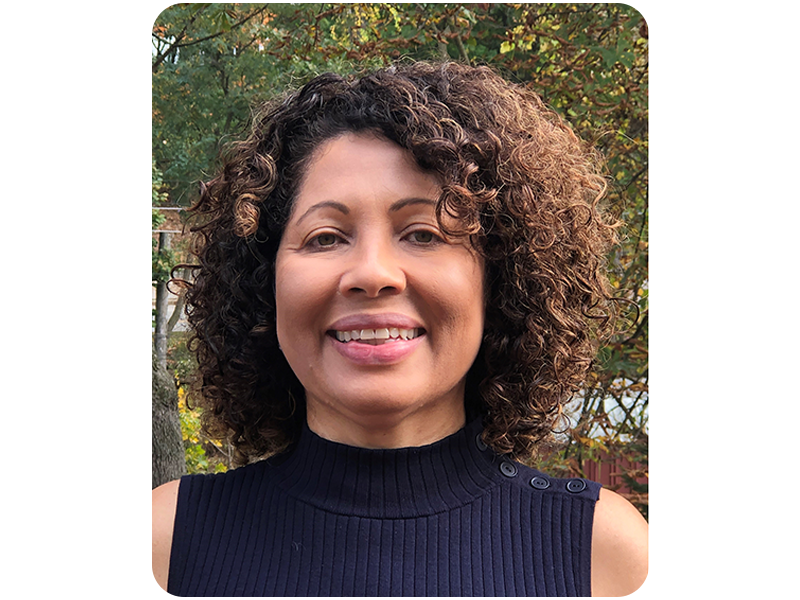
Leslie Soban Chief Experience Officer

Leslie Sobon

Chief Experience Officer, Imagine Learning

A veteran of technology marketing, Leslie was drawn to Imagine Learning by the opportunity to make a real difference within the education industry. “Each day, I am overjoyed to see first-hand how Imagine Learning has helped inspire positive change for teachers, students, and families across the nation.”

Before joining the Imagine Learning team, Leslie spent her career building and invigorating brands, launching products, developing innovative marketing models, and helping to drive growth at Texas Instruments and Dell. As Corporate V.P. of Worldwide Marketing at AMD, Leslie led marketing for their mobile, desktop, and server products.


February 13, 2023 12:45 pm

Competition & Student Motivation: Bowl Champions

School-vs-school competition increases student engagement & learning in math & literacy instruction as Georgia & Idaho schools are named national champions of the 2023 MyPath Bowl & Literacy Bowl.

Educators and researchers know that student engagement and motivation is crucial to student learning and many tactics aimed at increasing student motivation have been suggested, tested, and refined. Motivation is a desire to achieve a goal, combined with the energy to work towards that goal. Studies highlight how teachers play a vital role in motivating students and examine the function intrinsic and extrinsic motivation perform in student learning.

One approach to motivating students is incorporating learning-based gaming or competition. Competition has been proven to have a positive impact on students’ learning and motivation, though educators must be careful to connect competition to the desired learning and not invoke negative actions toward students who do not achieve. Additionally, academic competitions can serve as strong motivators for students by providing a compelling reason to study and work hard. Research shows that participation in academic competition enhances students’ learning motivation, and when students work together in groups or teams to compete, they develop collaboration and cooperation skills which are crucial in learning and work environments.

Academic competition in action: the 2023 National MyPath Bowl & Literacy Bowl

While millions of fans watched pro football playoff games during the fall of 2022 and the first weeks of 2023, students from around the nation completed digital math and literacy lessons to compete in the bracket-style 2023 Imagine MyPath Bowl and Imagine Literacy Bowl contests. This weekend, the top schools from the East Conference and the West Conference of each contest competed in the final battles—and champions emerged. Congratulations to Northcutt Elementary of Clayton County Public Schools, Georgia for winning the 2023 Literacy Bowl and to Juniper Hills–Nampa Idaho Department of Juvenile Corrections for being named the 2023 MyPath Bowl champion.

Schools qualified for the playoff rounds throughout the Fall semester by using Imagine MyPath and Imagine Language & Literacy digital education programs. The top usage schools in the East and the West battled in the playoff rounds to represent their Imagine Learning Conference. Week by week, the leaderboard was whittled down by the stiff competition—until only two schools remained in each contest. This past weekend, the champion schools were left standing above the rest.

“We’re proud of the accomplishments of this year’s MyPath Bowl and Literacy Bowl winners and for all the students that competed in this year’s contests,” said Sari Factor, Vice Chair & Chief Strategy Officer at Imagine Learning. “These competitions are a fun way to engage students in math and literacy, and it’s remarkable to see how enthusiastic they get about their learning. Congratulations to everyone involved—students, teachers, and parents. We know it takes a team to inspire learning breakthroughs, and we feel privileged to work alongside you.”

It was a rematch in this year’s Literacy Bowl with Northcutt Elementary from Clayton County Public Schools in Georgia defending their title against returning finals competitor Abraham Lincoln Middle School of Selma Unified School District in California. This was a historic win as Northcutt Elementary is the first school to be a repeat Literacy Bowl champion.

In a contest that came down to the wire, Juniper Hills–Nampa Idaho Department of Juvenile Corrections squeaked past Goliad Elementary School of Goliad ISD, Texas to win the second annual MyPath Bowl.

“Congratulations to everyone involved—students, teachers, and parents. We know it takes a team to inspire learning breakthroughs and we feel privileged to work alongside you.”

Sari Factor

Vice Chair & Chief Strategy Officer at Imagine Learning

Competitions lead to engagement, usage, and learning

During these academic contests, increased usage of Imagine Learning’s digital math and literacy programs is observable for competing schools. This evidence shows that the competition engages students and motivates them to complete more lessons than the schools who do not participate in the contests. This is also compelling information as multiple studies show students who use Imagine MyPath, Imagine Language & Literacy, and other Imagine Learning programs outscore their peers in state and national tests.

Winning schools receive a trophy and are honored in a school-wide awards assembly where top class and student efforts are recognized. Each runner-up school receives a certificate and a gift card for school supplies. Additionally, the top 20 MVP schools in each contest receive an e-gift card to celebrate their achievement during the competition.

About the Author

Lisa Wise, Customer Engagement Manager at Imagine Learning

Lisa Wise

Customer Engagement Manager at Imagine Learning

Lisa Wise has worked in the edtech industry for over 24 years, most recently as the Customer Engagement Manager at Imagine Learning. Lisa loves the opportunity to honor student achievement through engagement programs that get students excited about learning. A graduate of the University of Pittsburgh, Lisa lives with her family, dog, and beautiful array of plants in Pittsburgh, PA. She loves sports, gardening, and visiting her local garden center.

January 23, 2023 8:00 am

ChatGPT: What Are We Doing About It? 

Worried about how AI technology will impact student writing and academic integrity? Deborah Rayow, Imagine Learning’s Vice President of Product Management, Courseware, shares her thoughts about the future plus tips you can implement today.

If your family is anything like mine, you spent several hours over the holidays playing with a new technology called ChatGPT. For those of you not familiar with ChatGPT, it’s an OpenAI program that can write… well, anything. I’ve asked it to write a sonnet comparing Bali and Mars, a narrative essay about a one-eyed dog that goes back in time and meets Leonardo da Vinci, and an answer to the question, “Do you think Star Trek: Discovery should be considered Star Trek canon, and why or why not?” 

And yes, I’ve also asked it to write answers to several of the writing prompts in Imagine Edgenuity courses. Which it does exceedingly well. 

As ChatGPT is now broadly (and freely) available to anyone, we know that students have already started using it to “help” them with their work in Imagine Edgenuity. We know that educators are concerned. So are we. We’ve already begun the conversations internally about what steps we can and should be taking to help teachers determine when AI was used to generate a written response. 

What We Can Do Now 

Along with ChatGPT, OpenAI also created a tool that can analyze a piece of writing and predict the likelihood that it was created by artificial intelligence. Teachers can access this tool for free here. In our testing, we’ve found it to be remarkably accurate. We highly recommend using this tool if a student has submitted work that seems out of character — more formally written than usual, slightly robotic, or with details that don’t match what you know about the student. For example, one of our teachers read an essay from a sixth grader that talked about the difficulties he had fitting in on his first day at a large, public high school; something was clearly off, and the AI detector confirmed it. 

What We’re Working on for the Future 

We will be incorporating this kind of detection within the Academic Integrity toolset available now in Imagine Edgenuity. Just as we can currently report on the percentage of a written response that appears online or has already been submitted by another student, we will provide information to teachers on whether AI was likely involved in crafting the text. We are working to have this feature available before the end of the current school year.   

What Can Teachers Do to Promote Academic Integrity in Schools?

There are several things that teachers can do to ensure academic integrity in schools:

1. Clearly communicate expectations.

Teachers should make sure that students understand what is expected of them in terms of academic integrity. This can include guidelines for proper citation of sources, rules for collaboration on assignments, and consequences for academic dishonesty.

2. Use plagiarism detection tools.

There are a number of software tools available that can help teachers identify instances of plagiarism in students’ work. These tools can be especially helpful for detecting copied content from online sources.

3. Encourage responsible research practices.

Teachers can teach students how to properly research and cite sources and encourage them to ask for help if they are unsure how to do so.

4. Monitor for academic misconduct.

Teachers should be vigilant in looking for signs of academic misconduct, such as copied assignments or cheating on exams. If misconduct is suspected, teachers should follow the school’s policies for addressing it.

5. Promote a culture of academic integrity.

Teachers can set a positive example for students by demonstrating integrity in their own work and by stressing the importance of honesty in academic pursuits.

By taking these steps, teachers can help create a culture of academic integrity in their schools and ensure that all students are held to high standards of honesty and professionalism. 

And, in case you didn’t notice: that entire last section was written by ChatGPT.  Told you it was good. 

Deborah Rayow
Imagine Learning’s Vice President of Product Management, Courseware

About the author

Deborah Rayow

Imagine Learning’s Vice President of Product Management, Courseware

A former classroom teacher, Deborah has also previously worked with an array of educational publishers and consulting organizations, including Scholastic Education, Kaplan K12 Learning Services, and the New York Times Learning Network. Her expertise includes curriculum planning and professional development, online and hybrid learning, instructional design, and product management/development.

Deborah holds a B.A. in Child Development from Tufts University and a master’s degree in Mathematics Education from Rutgers University. Her areas of academic focus have included early literacy, problem-based learning, and comparative studies in mathematics instruction.

November 22, 2022 8:00 am

The Four Cs of STEM in Computer Science

Celebrate Computer Science Education Week and the international Hour of Code by exploring the four Cs of STEM. Students can learn about real-world applications of the four Cs in computer science from Chicago to Mars.

Digital tools, automation, network security, and AI are shaping our future. Recognizing the increased demand for digital literacy in the workforce, more than 500 CEOs recently petitioned education leaders to prioritize computer science instruction in K–12 schools. The U.S Department of Education followed that by launching the YOU Belong in STEM initiative to enhance science, technology, engineering, and math (STEM) education for all students.

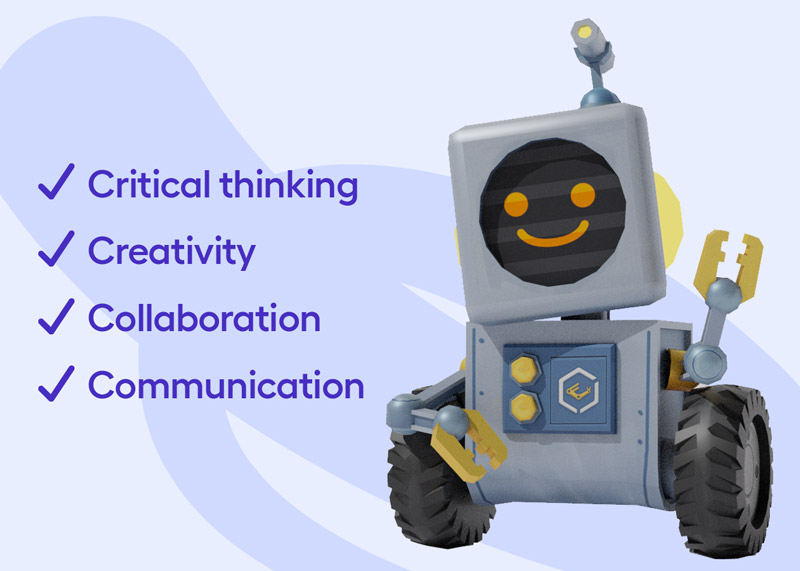
Computer Science Education Week, December 5th–11th, is the perfect time to get involved! A great way for educators at any grade level to explore STEM (which includes computer science!) is to teach its essential skills. Four of the most important abilities in STEM are critical thinking, creativity, collaboration, and communication, also known as the four Cs. These skills are necessary for 21st-century college and career readiness, in STEM and beyond:

  • Critical thinking involves analyzing systems, assessing evidence, integrating prior knowledge to make connections to new situations, and the ability to interpret information. 
  • Creativity is necessary to come up with new ideas. The ability to “think outside the box” when challenged, improve ideas, work within constraints, and learn from failure are all components of iterative design, which require creativity!
  • Collaboration means working in groups, sharing responsibility, and making decisions and compromises. 
  • Communication is critical in our global world. It’s the ability to express ideas, understand their meaning, and demonstrate concepts to different audiences.

The four Cs in the real world

Computer Science Education Week presents a great opportunity to learn with your students about how the four Cs are applied in the real world. Here are three examples.

1. Trashbot

Urban Rivers creates solutions to transform urban waterways, including a volunteer-controlled robot called Trashbot that cleans the Chicago River. The creators of Trashbot used critical thinking to recognize the complex system in which Trashbot would operate while also ensuring the safety of wildlife, civilians, and infrastructure.

The team realized the robot would need to be controlled because an automated robot could pose a risk to wildlife habitats. However, financial and personnel constraints made having a manual operator 24/7 impossible.

Urban Rivers tapped into their creativity and learned from previous failures to find a solution: volunteers could control Trashbot throughout the day to clean the river safely. Next, they collaborated with volunteers to make the solution possible, using media communications to teach them how to operate the equipment. Now, Trashbot is run by community volunteers who can clean up the Chicago River regularly.

Watch this video to learn more with your students.

2. UTM Project

An unmanned aircraft system (UAS) consists of drones or satellites, and the potential uses are limitless! NASA’s UAS Traffic Management (UTM) project aims to find ways for low-altitude drones to operate in large numbers, enabling businesses like Amazon to offer drone delivery services. 

The UTM team uses critical thinking skills to identify problems before they arise, such as how extreme weather could affect a drone or what happens if it is lost. The UTM project also researches how future technology would be managed. Drone technology could reduce traffic, fight wildfires, and perform dangerous tasks. 

The project is complex, with many interested partners in corporations and governments. The UTM team knows collaboration and communication are the keys to the project’s success, allowing them to include the needs and challenges of different groups in the research and share that research with the public. 

NASA’s UTM website provides up-to-date information and updates about the project. 

3. Mars Rover

The Perseverance Mars Rover roams the red landscape of Mars with the help of NASA’s scientists. On one mission, the team was challenged to drive Perseverance as far as possible. However, the rover would be self-driving, so the team needed it to drive effectively while avoiding obstacles.

The amount of possible paths to take on Mars is endless, but some paths are better than others. That’s why critical thinking is crucial to the mission: it’s used to assess the situation, make connections, and interpret data. Critical thinking also helps the team learn from previous Mars missions and determine new solutions.

Using creativity, they can overcome obstacles and imagine new ways to program the rover. The team coding Perseverance also understands how to collaborate. By working with teams across NASA and using clear and thorough communication, they can share and interpret data to put the rover on the right path.

Empowering the next generation

The significance of the four Cs of STEM is apparent across these three real-world examples. Critical thinking, creativity, collaboration, and communication are key to any mission. From cleaning up a river to exploring space, computer scientists use the four Cs daily.

What about the future STEM professionals in your classroom? Students can start their own journeys to Mars and practice the four Cs by celebrating Computer Science Education Week and participating in its international Hour of Code.

Hour of Code

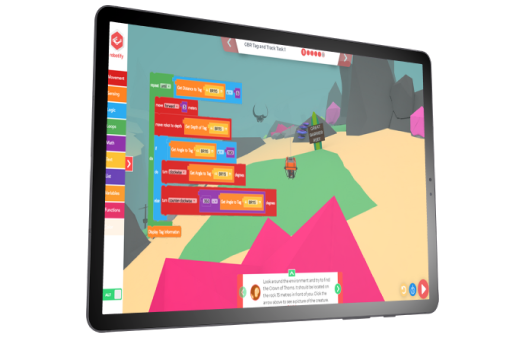
Hour of Code is – you guessed it – a one-hour introduction to computer science, using activities to show that anybody can learn the basics. If your school doesn’t already have a coding program, a few fun options to spark engagement and pique students’ interest could include:

Whether you celebrate Computer Science Week and Hour of Code with robots and crayons or by exploring essential skills, you’ll create more STEM possibilities for your students’ futures.

October 21, 2022 6:20 pm

The Importance of Being Vulnerable in the Classroom

Being vulnerable in the classroom (or anywhere) takes courage. Here are just a few ways you can open up to your students and show them that you’re human, too.

Research professor Dr. Brené Brown — who is famous for her talks on vulnerability and taking risks, as well as her #1 New York Times bestseller Daring Greatly — says vulnerability opens us up to pain and tragedy, but also to love, joy, and connection. It is uncertain and sometimes risky, but it can lead to feelings that make life worth living.

Dr. Brown says that learning itself is inherently vulnerable, and encouraging vulnerability in the classroom is not synonymous with “coddling,” as many may think. It’s actually quite the opposite of coddling because it pushes students to open themselves up, leave their comfort zones, and learn in a more personal, intentional way. And the first step to encouraging students to be vulnerable is by being vulnerable in the classroom as a teacher.

Veteran English teacher David Rockower learned this after years of reading predictable, not-very-emotional memoir-writing assignments. In previous years, he tended to shrug off the lack of unique emotional experiences and deep connections in his students’ writing as just a result of their age. But one year, he decided to change his approach. He realized he had to show his students that he was willing to do exactly what he was asking of them. And it ended up changing the game completely.

When explaining the assignment, instead of giving students an inspirational quote from a poet or examples of memoirs from strangers, Mr. Rockower wrote a story about one of the hardest, most emotional experiences in his own life. After reading his story to the class, the questions that followed weren’t the usual, “How long does my paper need to be?” or “How many paragraphs?” Instead, some students clapped, some wanted to share their personal experiences, and one student even asked, “Can we please write now?”

The stories his students turned in later were powerful and far more emotional than any he’d received before. His takeaway from this experience was profound: “My unwillingness to share, to write from the heart, [and] to be vulnerable was ultimately holding my students back. And when I finally took the leap, they followed.”

Teacher kneeling besides a student's desk assisting with school work

How Can You Start Being Vulnerable in the Classroom?

Being vulnerable in the classroom (or anywhere) takes courage. Leaving your comfort zone is not easy, and there will always be students who want to mock or use things against you, but, as one teacher put it, “for every student who negatively takes advantage of our openness, there will be scores more who thrive because of it.” Vulnerability is a powerful, emotional, and, at times, uncomfortable journey, led by both self-exploration and genuine intrigue to discover often uncharted territories.

Another teacher, who strove for perfection and sought to avoid “inevitable” mockery from his students, says that being the “all-knowing, impenetrable teacher” was uninspiring and untrustworthy. After receiving some life-changing news, he altered his teaching style and allowed himself to be vulnerable in front of his students, which yielded a new type of connection with them. These days, he says, “the mark of a good teacher is having a willingness to learn alongside of their students.”

Here are just a few ways you can open up to your students and show them that you’re a lot like them in many ways:

  • Share your stories, hobbies, likes, and dislikes with your students (as much as you are comfortable sharing, and, of course, using discretion).
  • Admit when you’re wrong, have made a mistake, or don’t know the answer. It takes more courage—but less time—than pretending or trying to be perfect and omniscient.
  • Remember when you were your students’ age and consider how your experiences can help them navigate their world.

Being vulnerable in the classroom can promote deeper thinking, strengthen your relationships with students, and prompt more authentic responses. Showing students that you’re not perfect helps them understand that it’s okay to have flaws and imperfections. Teachers across the nation, who first told us why they teach during Teacher Appreciation Week, opened up on the importance of being vulnerable in the classroom, and how they show students they’re human, too.

AJ, a high-school AP® and honors English teacher in New Mexico, said:

“Every day, I remind students that we’re a team. In order to get them to fully believe this, I don’t pretend to be an expert on everything. I value students’ opinions and admit when I am not sure about something. I hope this kind of humility shows students that we are always learning, even as adults. I also think this has been an effective way for me to gain a healthier sense of respect rather than one based solely on power and authority.”

Jenny, a first-grade teacher in Arizona, said:

“I talk to my students on the playground at recess. I read what they write in their journals and ask them about it. I make sure that they know I care about them. I tell them stories about me, my kids, and my life, so that they have buy-in.”

Chris, a high-school English teacher in New Jersey, said:

“You should share with them aspects of your life that are important to things that you’re talking about in what you’re covering that lesson. I stress several aspects of my personal experience. They need to see that I come from somewhere, and I think teachers fail their students if they don’t show them their own backgrounds. You have to share yourself with your students if you want them to take you seriously.”

Amanda, a middle-school special education teacher in Massachusetts, said:

“I joke and I share things about my life, weekend plans. I think it is also important to admit mistakes and let them know that even we make them, and that’s okay.”

Katie, a high-school AP and honors English teacher in New Mexico, said:

“You have to show your students that you are human, and that you also make mistakes. If you try to look perfect in front of them, you will fail. I think that by showing them you aren’t perfect, you really can connect with them. They become more comfortable with you and see that they can make mistakes and won’t be judged for them. I also feel that incorporating lessons/readings about what they’re interested in can create connections. They feel that you genuinely care about them and their needs, so they feel more comfortable and willing to open up to you.”

If you’re feeling anxious or uneasy about opening yourself up more to your students, remind yourself of the blessing of teaching—it’s naturally a very personal profession, and human connections will always strengthen learning. As our once not-so-vulnerable teacher says, “vulnerability is the essential root of the thinker and learner.” And it starts by challenging yourself to be courageous.

September 30, 2022 7:00 am

A Day in the Life of a Virtual Learning Administrator

The supervisor for online learning at the Berks County Intermediate Unit in Pennsylvania, Marcelle McGhee, shares their schedule and tips for prioritizing students throughout the day

As the supervisor for online learning at the Berks County Intermediate Unit in Pennsylvania, students are the focus of my day.  


I believe the key to my program’s success has always been the relationship-building I do with students and parents. I try to be open-minded, non-judgmental, and approachable to students and parents. I keep in mind that everyone’s circumstances are different. It may be cheesy to say this, but I try to meet students where they are. Homeless students need food and housing, and students struggling with illnesses need care before they can even focus on learning. 

Morning: 


After responding to urgent phone calls or emails,  I begin each day by checking the Edgenuity Learning Management System dashboard. Since I have students from multiple school districts, I toggle through those schools to review student progress. Red highlights are flags that I look for along with progress and then grades. I use the student filter on the dashboard to check on students who are behind in pacing. I  do a deep dive into each student’s Progress and Grades to determine the reason for lackluster pacing. I add these students to my “home phone call” list. 


Around mid-morning, I begin to call home to check on the students on my list. Usually, I have to leave a phone message requesting a callback. I follow up phone calls with a personalized email to the parent, student, and school counselor highlighting the pacing or grade issue. I keep notes on students in case there are extenuating circumstances such as illness that I need to consider before sending the email. 

“For teachers, it’s about communication, communication, communication. Students have to feel like you’re directly emailing them… they can tell if you’re disinterested, even if you’re working with them online.”

Marcelle McGhee

Mid-Day: 

In the second part of my day, I check attendance in the SIS. I use the SIS filters to create a list of students who have not accessed their classes in more than two school days. I use the LMS Dashboard to get a more detailed student attendance view and to confirm that an attendance email is appropriate for all students on the list. I then use the automatic email feature in the SIS to send students, parents, and school counselors an email regarding the student’s lack of attendance. 

I have an “online learning” toolbox of tips and tricks that I send to students. These tips include “directions for attending teacher study hall,” “Locating and Navigating Carone Fitness courses,” and using the Guided Notes” feature. ”  


Late Afternoon: 

I have open virtual office hours three days a week in the afternoon. I invite (more like insist) students who are behind pacing, have an actual grade of less than 75% in a course, or are violating the attendance requirements, to attend my virtual office hours so that I can assist them with getting back on track.

On other days my afternoons are reserved for administrative tasks that keep my program running smoothly.

My day usually ends with a check of email and last-minute phone calls. I often take parent phone calls and respond to text messages during the evening. 

Marcelle McGhee headshot image

About the Author — Marcelle McGhee

Marcelle McGhee is the Supervisor of Online Learning for Berks Online Learning, a service of the Berks County Intermediate Unit in Pennsylvania. A mother of two herself, Marcelle is proud to have the role of “professional mom” to those students who come to online learning needing support and accountability, helping students to learn the ropes of virtual school and reach their goals. As a first-generation college graduate and Guyana native, Marcelle has a wealth of experience and understanding that shines through as she goes above and beyond in supporting her students. Marcelle is a true Imagine Edgenuity veteran, having started using our products almost twelve years ago, and her expertise shines through in the way she provides support to other educators at every turn.

August 9, 2022 8:00 am

Sparking Connection with Online Students

Stephanie Reilly, the Teachers’ Lounge educator of the month, shares practical tips for creating a positive rapport with students in an asynchronous, fully online classroom.

I’ve been in my role as online learning coordinator for the Fox Chapel Area School District, located in suburban Pittsburgh, for three years and wanted to share some things that have worked for us. Our online students are either fully online or have a flex schedule, where they are in school for most classes and take an online class or two. The flex schedule allows the student to come into school late or leave early. Many students take advantage of this flexible schedule for sports, jobs, or just the amazing ability to sleep in and arrive at school two hours later.

High schooler studies on their bed with headphones

“Teddy Roosevelt had it right when he said people don’t care what you know until they know you care. Showing these fully online students that we care about them is the key.”

Stephanie Reilly

Each group of students has their unique challenges. The fully online students can be really challenging to reach. How can you connect with a student you only communicate with via email, especially since some students avoid email when they fall behind? Teddy Roosevelt had it right when he said people don’t care what you know until they know you care. Showing these fully online students that we care about them is the key.

Give “caught being good” notes

Catching kids doing something positive and emailing them or (even better) mailing home a note about it shows that we are watching their progress and we are on their side.

Send snail mail 

Snail-mailing school resources and information home so the students know what’s going on at school and still feel part of our school community is helpful.

Invite them to campus

Inviting the fully online students to come in and join a club or attend a school meeting and facilitating that happening can encourage the student to get out of their house and get involved.

Respond to their schedule

Responding to their needs on their time schedule as an asynchronous student can go a long way to showing the student that this isn’t school as usual. If I can quickly log on and help move a student along who is stuck at night, I am glad to do it, and that student can keep working and making progress. Some students are really struggling with various issues, so removing obstacles helps show them that we want to help.

Make feedback meaningful

Providing meaningful feedback to their written submissions, even if it’s feedback about plagiarism, shows the student that it’s not just them and the computer, but there is a real live teacher at our school who’s reading their work and available for help.

Create a warm, optional workspace

We also encourage students who are struggling online to come into school and work in my room. My room isn’t a typical classroom, it’s a relaxed environment complete with a Keurig, snacks, beautiful view of landscaping, plants, seating choices, etc. working here helps the student remember that they are indeed still a full-time student and allows me and other teachers to get to know the student, their work habits, and their struggles, and to start to build the relationship. Once we get that relationship growing, the student will respond to my emails and will even initiate emails to me and other teachers when they need help. The power of a conversation over a cup of tea cannot be underestimated.


I’d love to hear from other teachers and administrators about how they reach fully online, asynchronous students. It’s a journey! Let’s talk about it in the Teachers’ Lounge.

Stephanie Reilly

About the Author — Stephanie Reilly

Stephanie is the online learning coordinator and online teacher at Fox Chapel Area High School. She currently teaches online physics, earth & space, and SAT prep.

Stephanie’s first career was as a mechanical engineer. She worked in the nuclear power and telecommunications fields for 12 years, then stayed home with her children for about 10 years. She then went back to school for her teaching certificate. She taught math, physics, and computer science for about seven years before moving into her current position.

August 8, 2022 8:00 am

Multilingual Learners: Designing for Meaningful Interaction

Empower language learners to participate in classroom discussions with opportunities for observation and an environment that welcomes mistakes.

My teaching assignment in my first year was primarily English language learners from newcomer to almost reclassified in both EL-specific and ELA classes. As an idealistic new teacher having just read all the books and soaked up all that my student teaching had to offer, I thought that if I supplied them with the words, via labels and sentence frames, my students would have what they needed to participate in the lively classroom discussions I envisioned. I quickly learned that was not the case.  


The first time I asked my students an open-ended question, I was met with a silence so enduring that the touted “7-second pause” wasn’t nearly enough. Rewording my question didn’t change the response either. Perplexed and frustrated, I continued with our beginning-of-the-year activities. It wasn’t until later, when I had more success with eliciting answers, that I realized my students didn’t feel safe speaking up yet. That’s because research shows  “if English language learners (ELLs) are going to productively engage in classroom discourse and express their thinking related to content learning goals, teachers must create a trusting classroom culture in which students feel that whatever level of language they can produce, their contributions will be valued by their teacher and peers and will never be subject to ridicule, sanctions, or negative comparisons.” While this research (and my experience) speaks to English language learners specifically, we can also apply the recommendations to dual language programs — where every student is a language learner. 

“If English language learners (ELLs) are going to productively engage in classroom discourse and express their thinking related to content learning goals, teachers must create a trusting classroom culture in which students feel that whatever level of language they can produce, their contributions will be valued by their teacher and peers and will never be subject to ridicule, sanctions, or negative comparisons.”

Aída Walqui & Margaret Heritage

I hadn’t yet proven to them that our classroom met these criteria. It took many cheesy icebreakers, games, and showing time and time again that mistakes were a welcome part of learning to establish our room as a safe space. But despite the comfort we felt together and what I believed were thought-provoking questions, the room was still mostly silent (or off topic) during small-group academic discussions. What was I missing? 

I decided to go back to the basics because it seemed logical that before they’re comfortable participating in academic discussions, students need to feel confident in basic communication in the classroom. I decided to try a few things. 

Labeling the room 

As a high school teacher, this felt a little weird to me. But I grabbed a permanent marker and index cards and labeled everything I could think of around the classroom. Whiteboard, computer, pencil sharpener – you name it, it got a label. At first, my students thought it was strange too, but then it just became part of our classroom.  

The students who didn’t need them didn’t really pay attention to them after the initial wonderment, but I soon noticed students referencing the labels when asking me a question or talking to classmates. While primarily useful linguistically for my EL students, the mere existence of the labels continued my work of normalizing the various language acquisition levels within our class and maintaining an environment where anyone could get the help they needed without feeling embarrassed.  

Supplying sentence frames – or “formulaic expressions”  

The next level up from labeling the room, I started including what I called sentence frames with my discussion questions. Walqui and Heritage call these “formulaic expressions” because they “help start or link ideas and can be used in many situations,” whereas sentence frames are more specific and often lead to a single correct answer. 

Where the labels around the room were used almost exclusively by ELs, I quickly noticed that most (if not all) of my students used the formulaic expressions. Academic discourse doesn’t come naturally, native English speaker or not, so having the language to frame their ideas helped students feel more confident. They could then use these phrases, like “One example from the text is…” or “I agree with what ____ said about…” in other classes or sometimes even their writing. 

Turning on the closed captions 

This might be controversial, but I think movies can be legitimate language-learning tools. Before I lose all ethos as you picture me popping on a movie for my students every day in the name of “learning,” this statement comes with two caveats: first, we watch movies sparingly (and not all in one sitting); second, the closed captions must be on – in English (or whichever language students are learning). 

My newcomer students hated that last bit, but I never gave in to their pleas to change the language to Spanish (the majority native language in my class). While watching a movie in English was pretty far out of their comfort zones, being able to both hear and read the words not only improved their comprehension of the movie but helped supply them with real-life examples of conversation.   

——————————– 

At this point I felt like I had established a safe learning environment and provided my students with the language scaffolds they needed. So why were we still struggling with academic discussions? What was still missing? 

Low-stakes opportunities for discussion 

Even though we had a classroom culture where mistakes were welcomed and I reiterated that academic discussions should still feel like regular conversations, students naturally became nervous and stiff when it came time to discuss. EL students in particular would be noticeably more reserved.  

Knowing that “by some estimates, ELLs spend less than 2 percent of their school day in oral interaction,” I was determined to get my students speaking. That’s when I started doing something almost painfully simple. After our daily independent reading time, I would say, “turn to your partner and tell them what’s happening in your book right now.” These casual conversations didn’t feel academic to students and got them speaking – to the point where I usually had to cut them off.  

a group of students sitting around a table listening to the teacher

Modeling (fishbowl discussion) 

To bring the level of comfort they showed when talking about their books to the more “high stakes” types of conversations, I turned to a tried-and-true method: modeling. I found, especially for language learners, that seeing and hearing a model almost always resulted in more plentiful and confident interactions. In fact, if I didn’t provide an example for an activity, they always asked for one. 

So, to model a discussion, I wrote two scripts – one not-so-fruitful discussion and one more substantive. Student volunteers sat in the middle of the room and acted out each discussion, leaving time in between and afterwards to talk about the differences between the two. I was amazed at how observant the students were. Together, we listed what could improve in the first conversation and the qualities that made the second more effective. 

Opportunities to evaluate (discussion tracking) 

While the fishbowl model demonstrated that my students could identify the ideal characteristics of an academic discussion, it still had only minor effects on their own. That’s when I decided to turn their small-group discussions into mini fishbowls.  

I created a small checklist of the effective discussion “moves” that we identified in our whole-group fishbowl activity – asking a question, incorporating evidence, etc.— plus formulaic expressions they might use. Everyone got a checklist, but only half the students were speaking participants in the discussions that day. The other half were sitting on the outside of the group, listening to one specific person and keeping track of their participation.  

Having the opportunity to observe a real discussion before participating was equal parts eye-opening and comforting for my EL students. Then, they were able to follow along on the checklist with sentence starters when it was their turn to participate. Our classroom culture where students felt safe making mistakes was key as they were able to hold each other accountable for the checklist without judgment. 

It certainly wasn’t perfect. At one point I even incorporated a whole-class fishbowl version of the discussion tracking so that we could go over the dos and don’ts of each role. But academic discussions, and ensuring everyone benefited from them, became another aspect of our classroom dynamic that was always a work in progress. Ultimately, increasing the amount of time ELs spend interacting in the classroom is not just about giving them a seat at the table with the tools they might need, but about ensuring that they know their voice is valued in the room. That is truly the key that unlocks all the other strategies because students must feel safe to take the necessary risks that open the door to learning.  

About the Author – Ally Jones

Ally Jones is a California credentialed educator who specialized in teaching English language learners at the secondary level. Outside of education, she is passionate about fitness, literature, and taking care of the planet for her son’s generation.  

August 8, 2022 8:00 am

Subscribing to Self-Care with Dr. Maria Hersey

Everyone’s talking about SEL for students, but what about SEL for teachers? Cultivate and protect your own well-being with these tips and downloadable self-care planner.

A recent Instagram post from @selfcarewithwall shared an important thought for everyone to consider, but most importantly, for all the educators that are struggling to navigate the complicated and constantly changing realities of life, the following statement should ring true: “You are not selfish for wanting the same energy and love you give.”

During a recent presentation to teachers, we discussed the importance of identifying self-care practices that could be implemented in our daily lives. Many of the teachers shared that while they understood the importance of social-emotional learning (SEL) and well-being for students, as teachers, they often forgot to take care of ourselves FIRST. Self-care is the active process of making your body and mind a pleasant place to inhabit, by making sure to fill your own cup first. This definition helps to ensure that we have enough for others but asks us to consider our own needs first. It is important to remember that our own self-care and well-being must be a priority. Remember, if we want to give it, we must learn how to live it! This means that if we want our students, or others, to engage in well-being practices and self-care, we need to be willing to take the first steps and set intentions for mindful living in our own lives.

“…if we want our students, or others, to engage in well-being practices and self-care, we need to be willing to take the first steps and set intentions for mindful living in our own lives.”

Cultivating teacher well-being

The simplest definition of mindfulness offered by Dr. John Kabot-Zinn, is being present and in the moment, without judgment. It is making space for reflection and connection. Mindfulness magazine recently published an article about nine practices to engage in which support and build well-being. The authors remind us that cultivating and protecting our well-being is a personal process that requires us to check-in with ourselves on a regular basis. Being open to whatever we may need to navigate stress, anxiety, and overload is an important part of the process. Engaging in the habit of self-care is essential to our daily lives and well-being.

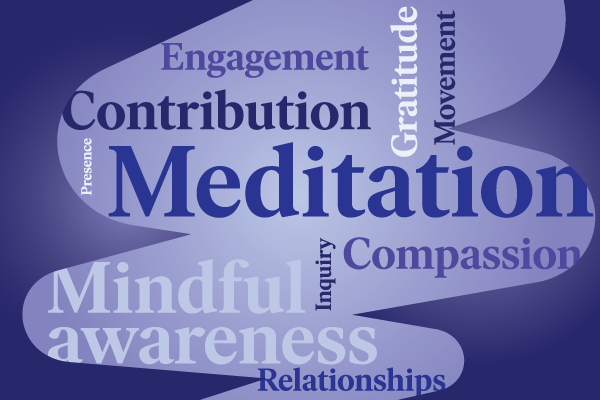
9 Mindful Habits for Well-Being word cloud

Cultivating and protecting our well-being is deeply personal. It requires us to check in with ourselves regularly and be open to whatever we may need to feel less stressed, more fulfilled, and at ease. In this guide to well-being, you will explore nine habits to integrate into your daily life that will serve as helpful tools in sustaining emotional wellness. In the article, 9 Mindful Habits for Well-Being – Mindful, the authors identify nine practices or habits that you can engage in on a daily basis to support our well-being. These practices or habits are:

  • Meditation or mindful awareness
  • Inquiry
  • Engagement
  • Presence
  • Gratitude
  • Compassion
  • Movement
  • Relationships
  • Contribution

Of these nine practices, which are just the beginning of a myriad of possibilities, which one resonates with you most? Which one can you set an intention for today to support and enhance your own well-being? Remember, the first step is the most important. Identify one of the practices that you can easily incorporate into your daily routine. Commit to making this a priority for yourself and for others. You deserve it!

Setting intentions

Let’s dig deeper into one of the nine habits. In conversations with educators and other adults, I am often asked “How do I prioritize my well-being with an already busy schedule?”  So many of us feel like we cannot add one more thing to our calendar of events, but it is important to remember that taking care of ourselves should be one of our daily priorities. One of the easiest ways to begin is with a small step each day. One practice could be committing just a few minutes to self-reflection and setting an intention for the day. Each morning when you wake up, set an intention for self-care. An intention is an act of instance of deciding mentally upon an action or result.  An intention may also be an aim that guides us to action. 

When we take a moment to set an intention, we can open our eyes to things we may have missed. For example, by observing some of the little wonders of the world such as the laughter of a child, we can shift our perspectives in an instant. Voicing our intentions can help to take our mind off our problems and perceived limitations and help to shift our focus on something that could positively impact our lives.  This doesn’t mean that we ignore our problems or challenges, it just means that we are taking some time for a mindful intention, a chance to be present and in the moment, without judgement.

Some examples of self-care intentions are:

“I intend to go on a mindful walk today and enjoy the beauty of nature and the great outdoors.”

“I intend to begin the habit of taking fifteen minutes for myself, to find a quiet corner and read a book.”

“I intend to take time today to write down three things that I am grateful for, allowing joy and positive energy to fill my mind, heart, and body.”

Intentions often have no limits and are expansive, they are not goals, but are about who you want to be and what you wish to contribute to your own self-care. Intentions can also include contributions to the greater good. For example, most of us feel concern about global issues, but sometimes feel like it is an overwhelming task. Just remember the butterfly effect: a slight change can result in significant differences. When we set an intention to act, we can open our mind to ideas, opportunities and the internal rewards that come from helping others.

It is important to remember the importance of small steps and building on the successes of each step taken on the never-ending journey of self-care. Try to maintain your daily intention for the week. At the end of the week, take a few moments to reflect on how your moments of self-care made you feel. Do you have more time for yourself? Are you able to reduce or release the stress that accumulates during the week? Do you feel a little better about life and how you are managing everyday stressors? Take a deep breath in and a deep exhale out, reflect things that happened that you are grateful for in the past week.  It does not have to be an exhaustive list, and you do not have to share it with others, just take some time for quiet reflection on how it feels to take care of yourself.

To build on this practice, begin each week with a new self-care intention, if you want, start a brand new one, or make a habit out of your previous intention and carry it forward. Take note of how you feel and at the end of the week, engage in your weekly gratitude practice. See if you can continue this for at least three weeks. At the end, what do you notice about how you feel about yourself? Have there been any shifts in your perspective? Are you finding more time to take care of yourself? Dr. Dan Siegel, a well-known author and clinical professor of psychology, states that one goal of regular mindful awareness practices is to turn “a state of being into a trait.” Mindfulness practices are “good hygiene” for our brain and setting and intention and practicing acts of gratitude are just two strategies for training our brains to be happier and healthier. 

Finding peace

According to Dr. Jill Bolte Taylor, to experience peace does not mean that life is always blissful. It means that we can tap into a blissful or peaceful state of mind amidst the chaos of a hectic life. It is important to stop listening to those voices inside your head that tell you there is no time for self-care or that self-care is selfish. In our highly connected, technological, and fast-paced world, we have all learned that sometimes we just need to unplug, hit the restart button, and begin again. Sometimes this simple solution is all we need. Think of your brain as a part of your body’s central processing unit and take some time to shut down and restart each day. Your body and your brain will thank you.

For further information or questions, please follow me on Twitter @mshersey or visit us at http://www.globaleduadvisors.com/

Self-Care Planner

Hit “print” and grab a flair pen for these fillable, teacher well-being journal pages.

Dr. Maria Hersey

About the Author – Dr. Maria Hersey

Maria Hersey is currently the Director of Strategic Partnerships for World Savvy (www.worldsavvy.org) and has over 20 years of experience in K-16 education. She is the founder and principal advisor for Global Education Advisors (www.globaleduadvisors.com), and served as the Director of Education & Training for The Goldie Hawn Foundation, and regional program manager and development specialist for the International Baccalaureate (IB). Maria has also had the privilege of working in public education as an elementary school teacher, program coordinator, and assistant principal.

Maria’s work has received international recognition for her work in social-emotional learning (SEL), program design and evaluation, curriculum development, and global-mindedness. She has been an invited keynote speaker and has led a variety of workshops across five continents. Maria holds a Ph.D. in educational leadership from Florida Atlantic University. Her dissertation work focused on the development of global-mindedness and school leadership perspectives.  

Maria’s work with children and educators is a fulfilling aspect of life that brings her great joy and happiness. She enjoys cooking, traveling the world, and spending time with family and friends. Follow Maria on Twitter @mshersey.

August 8, 2022 8:00 am

Creating Collaborative Math Classrooms

Dr. Bill McCallum, co-founder and CEO of Illustrative Mathematics, discusses how the theme of collaboration runs through the program’s design, creating dynamic learning environments for today’s students.

Collaboration is a core value at Illustrative Mathematics. Creating a high quality instructional system — with curriculum and professional learning — is complex work. The demands of mathematical coherence and pedagogical appropriateness often pull in different directions; you can have a curriculum that is mathematically correct but not engaging for students, and you can have a curriculum that students enjoy but where they are not learning grade-level mathematics. We think IM K–12 Math has achieved the perfect balance between coherence and engagement, and we got there by having mathematics experts and educators working together, reviewing and critiquing each other’s work, and coming to a consensus around tough questions.

student in a classroom on a tablet

Collaboration in writing the curriculum and professional learning

A good example of the balance between mathematical and pedagogical priorities is the tuna casserole activity in Lesson 2.6 of Grade 6 in IM 6–8 Math. Recipe contexts are good for learning about equivalent ratios because the ratios between various quantities in the recipe have a real world meaning (the flavor of the recipe) and because recipes are often scaled or cooked in containers of different sizes. The tuna casserole example provides a rich arithmetic context, particularly with fractional quantities, thus affording important skill building as students work with the ratios in the recipe. Furthermore, the extension activity, Are You Ready For More?, depends crucially on the fact that the vessel is rectangular, and gives students an opportunity to reinforce and use prior knowledge about area and volume. This is an example of the sort of collaborative thought that went into all the IM lessons.

Another sort of blending of expertise occurs when we try to put research about pedagogy into practice. Research recommends a problem-based approach to instruction where students have a chance to work on problems for themselves and the teacher synthesizes learning afterwards. But the practical experience of the teachers involved in writing our curriculum reminded us that you have to make the problem-based instructional model explicit and learnable. This led us to develop a carefully curated set of instructional routines, which help teachers and students manage problem-based instruction without getting bogged down in logistics, and which teachers can learn over time as they become more familiar with the curriculum.

“Because students are sharing their thinking, students using less efficient strategies will see other students using more efficient ones and learn from them. It also works the other way around. Students using more efficient strategies deepen their understanding as they explain those strategies.”

Dr. Bill McCallum

Collaboration in the IM classroom

The principle of diverse teams collaborating extends to what goes in a classroom using IM. Many of the activities are designed so that students can use a range of strategies to solve them. Because students are sharing their thinking, students using less efficient strategies will see other students using more efficient ones and learn from them. It also works the other way around. Students using more efficient strategies deepen their understanding as the explain those strategies. 

The Mathematical Language Routines in IM K–12 use collaboration to help all learners, including English learners, produce mathematical language to enable rich discussion of mathematical ideas. For example, in the Information Gap students work in pairs where each student has different parts of the mathematical problem and they ask each other questions to collaboratively solve the problem. The structure of the routine is designed so that students must formulate specific mathematical questions in order to get the information they need. 

The collaborative learning embedded in the IM instructional model is particularly important in supporting culturally responsive pedagogy. Collaboration comes naturally to many cultures that are often marginalized in the classroom. Giving students an opportunity to share what they bring to the classroom builds their sense of belonging and self-efficacy. 

Collaboration with partners

Another way in which we live out our value of collaboration is in working through IM Certified distribution partners such as Imagine Learning. Again, each partner brings something different to the collaboration. IM brings its expertise in curriculum and professional learning, whereas Imagine Learning brings a digital platform that makes teachers’ lives easier and supports student engagement with additional features such as Student Spotlight Videos.

The future

The next phase of IM’s journey involves collaborating with schools and districts around implementation support. We plan to build an implementation support ecosystem around our curriculum and professional learning that provides schools with a coherent suite of products and services that all work together to help teachers bring about our vision of a world where all learners know, use, and enjoy mathematics. Stay tuned for more exciting news about these plans over the next few months!

Dr. Bill McCallum

About the Author — Dr. Bill McCallum

Bill McCallum, co-founder of Illustrative Mathematics, is a University Distinguished Professor Emeritus of Mathematics at the University of Arizona. He has worked both in mathematics research, in the areas of number theory and arithmetical algebraic geometry, and in mathematics education, writing textbooks and advising researchers and policy makers. He is a founding member of the Harvard Calculus Consortium and lead author of its college algebra and multivariable calculus texts. In 2009–2010 he was one of the lead writers for the Common Core State Standards in Mathematics. He holds a Ph. D. in Mathematics from Harvard University and a B.Sc. from the University of New South Wales.