Heart Work / Breaking The Cycle of Math Anxiety / Part 2
Breaking the Cycle of Math Anxiety
Part 2
In the second episode, Lauren heads to Toronto for
math therapy with the Math Guru herself, Vanessa Vakharia.
As she analyzes where her relationship with math went wrong and why it left her so anxious, she begins to realize that math itself was never the problem. So where does the anxiety really come from? Featuring Vanessa Vakharia, My Mathematical Mind founder Dr. Deborah Peart Crayton, and cognitive behavioral therapist Emma Fogel.
Transcript
Lauren Keeling: I’m nervous.
Vanessa Vakharia: What are you nervous about?
Lauren: Feel my palms.
Vanessa: You are like the guy in Love is Blind who has sweaty palms the entire time.
Also, for the listeners who can’t see, she has handed me her palms, which are very sweaty, and in one of them she is clasping a little glass unicorn that she took from my Christmas tree.
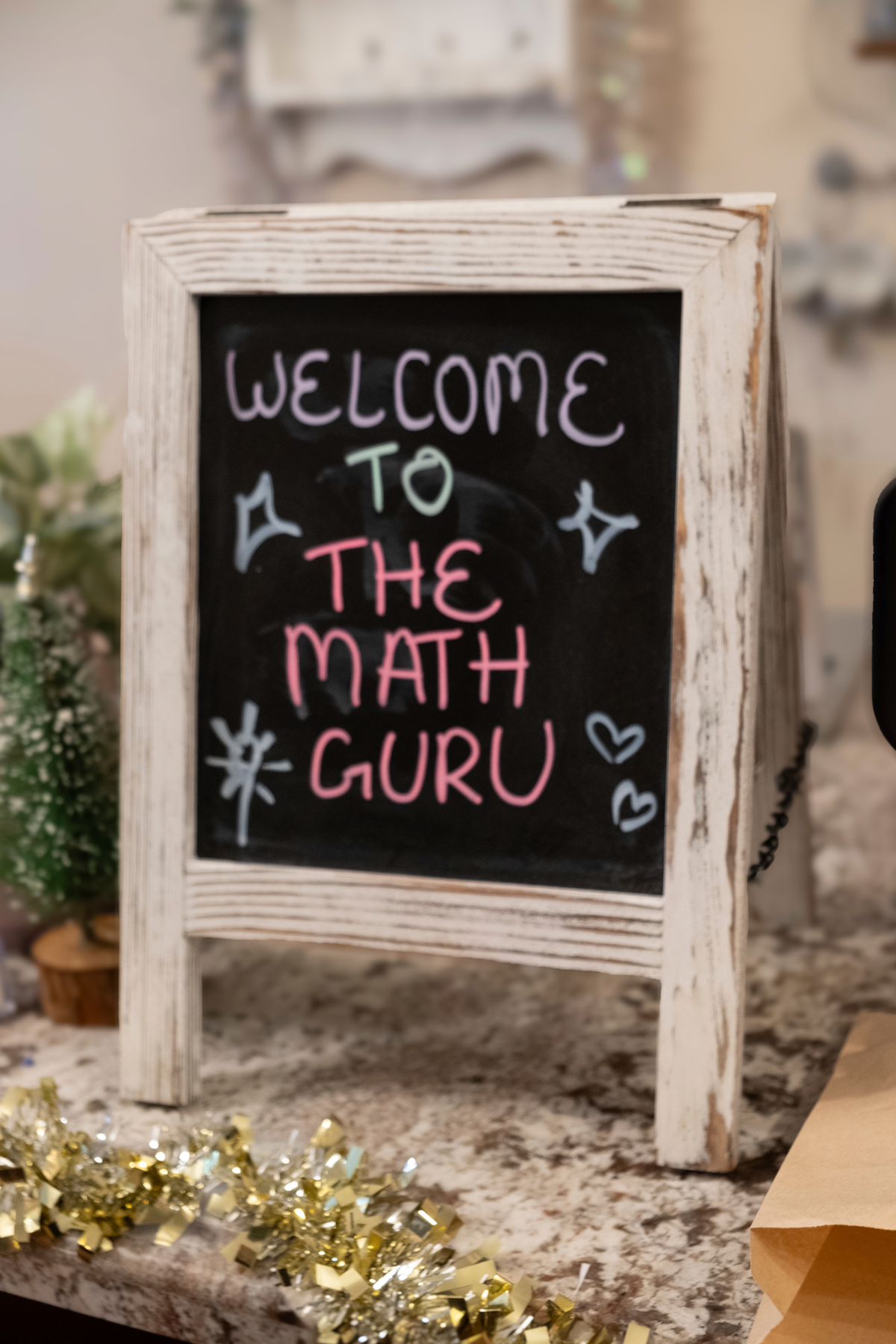
Welcome to the Math Guru sign

Lauren Keeling and Vanessa Vakharia sitting on a crushed velvet couch
So this is how I find myself in Toronto, sitting next to Vanessa Vakharia.
Vanessa is known in the math education world as the Math Guru. She does math therapy — a phrase that, frankly, terrifies me. As far as my own math anxiety goes, avoidance is working very nicely for me. It certainly wasn’t in my plans to confront it head-on.
But Vanessa’s studio doesn’t feel like a math space. There are plants, a piano, vintage furniture. We’re reclining on matching pink velvet sofas, beneath a crystal chandelier. The vibe is bohemian and tastefully glam.
Oh yeah, and there’s a Christmas tree — even though it’s February. She says it’s common in Toronto for people not to take their trees down until winter starts to lift.
At the center of everything sits Vanessa in flowing turquoise satin pants and a rust-colored velvet duster, her jewellery jangling as she moves. She looks like a rock star. She looks like she’s never been afraid of anything. I start to tell her what’s making me afraid right now.
Lauren: Failure. Terrified that you’re going to ask me to do math today, and my entire body is going to lock up, and my brain is going to freeze, and I’m not going to be able to produce anything for you.
Vanessa: I’m not going to whip out a time test.
Lauren: OK (laughs).
In the first episode, I learned that many people feel shame because of math. That they’re not really smart. They’re limited. Certain doors are just closed to them.
I’m one of them, and I want to understand where those feelings came from and what can be done to turn math into a joyful experience, one that breaks the cycle of math anxiety passed down across generations.
Vanessa: So when is the first time you felt this way?
Lauren: In first grade. I can very clearly pinpoint my beautiful, wonderful, and soft teacher, Mrs. B.
In Vanessa’s studio, I repeat the memory I shared in episode one. Sweet Mrs. B. walking in her denim skirt to set my finished paper down on my desk. My shame and bewilderment to see all those red Xs. Big, giant, thick Sharpie-marker red Xs.
That detail gets me every time I think about it, not because it’s dramatic — it’s not — but because it takes me back to being that child discovering, for the first time, that there is a thing everyone else seems able to do more easily than I can.
Vanessa: This is decades later.
Lauren: Decades later!
Vanessa: Decades later, and your body remembers that experience. It does. And actually, with math trauma and any sort of microtrauma, our bodies do go back into the state we were in when we had the first traumatic incident. Every time you’re faced with math, you are back to being that six-year-old.
That might sound overstated, but sitting here in Toronto as an adult, after all this time, gripping a tiny unicorn, I can feel something in my body responding.
Vanessa: Your anxiety that you think you’re walking in here with is around math. You keep mentioning the time test, but you’re not actually talking about content. Can we talk about the mathematics content? Were you able to, in a non-time situation, do what was on the paper?
Lauren: I could, and perhaps not perfectly or well, but I felt like I had the time to be able to count on my fingers.
Vanessa: The world’s OG manipulative, everyone.
Lauren: So when we were sitting at our tables and learning in our classroom — which was a very individualized experience, it was not collaborative — I could use the strategy that worked best for me at the time, which was, “I’m going to count this on my fingers,” or “I’m going to draw it out on my paper.” And I could get to that, given whatever amount of time she was giving us in the classroom.
So as long as I could actually draw it out or write it out or touch it out on my hands, I could get to the answer eventually.
Vanessa: Was there any intervention? Did you have a tutor? Because it kind of sounds like you were like getting away with it, in a way.
Lauren: I was absolutely getting away with it. I was a good student. Yeah, in general, I did my homework. I did my work every day in class.
Vanessa: You’re not failing math?
Lauren: I’m not failing math.
Vanessa: Like, are you actually doing kind of OK?
Lauren: I’m doing OK.
Vanessa: Oh, wow.
“Getting away with it” is an odd phrase to use about learning. It sounds almost underhand, like I wasn’t doing math so much as avoiding being exposed as someone who couldn’t. But the moment where that falls apart is when the work becomes public.
Vanessa: Is your stumbling block in your mind? Is your core memory every time you have a time test or every time you have to do anything mathematically?
Lauren: Anytime that I had to do, what I remember in my mind as performance math, so time tests were performance math.
Vanessa: I love this term also.
Lauren: Because it feels like what it is, right?
Vanessa: Totally.
Lauren: And then also, as I was a learner growing up, the practice was to solve things at the board by yourself. And then there was a competitive edge to that over time as well. So the teacher would call out a problem, you had to write the problem on the board, and solve it as fast as you could against the person standing beside you.
Performance math. I realise that what I’m describing isn’t necessarily about a deficit in understanding. It’s a mismatch between ability and the conditions under which that ability is measured. In so many classrooms, math becomes less about reasoning and more about showing off speed of recall against the pressure of the clock.
On top of the anxiety around performance, I realize there’s another fear for me: that letting go of math anxiety might mean letting go of a long-held identity that, in some ways, actually helps me. That in some ways I might actually… like.
Vanessa: I did math therapy with someone last year. She had this moment where, after our first session, she came back the next session, and she was like, “Oh my God, it’s so crazy. I’m starting to notice all this math I am doing and, you know, starting to really rethink my story.”
And then she goes, “I’m really nervous.” And I was like, “Oh, are you nervous about doing math?” And she was like, “No, I’m scared that I’m going to start seeing myself as a math person. It’s been such a core part of my identity. It’s like a loss.” Does that resonate?
Lauren: That resonates so deeply. I made myself not a math person in a way. I chose it. It’s not a badge of honor, but it’s a club.
Vanessa: It’s definitely a club. And if you don’t belong to the “I’m a math person” club, at least you can belong to the “I’m not a math person” club.
Like, think about every stereotype of what it means to be a math person. You definitely don’t like music and the arts. You’re a logical thinker. You always get the right answer. You sit and study all the time. You can do things really, really quickly. You have quote-unquote natural ability. You never fail. You know, like, there are so many things the term means. So the problem is, I’m not surprised when you’re like, “You know what? Being “not a math person” is part of my core identity.”
There is, undeniably, a social dimension to this identity. Saying “I’m not a math person” doesn’t surprise people. You don’t have to justify it. More often, it’s met with recognition — even relief. It places you in a category that is widely understood, one that carries its own set of assumptions about who you are and what is expected of you.
And those expectations matter. If you are “not a math person,” then certain demands fall away. You are no longer expected to be quick, or confident, or even particularly engaged when it comes to math. The identity, in effect, does some of that avoidance work for you.
But if this identity is offering protection and maybe even a sense of belonging, then anxiety itself may not simply be a problem to eliminate, but a response with a function.
Not far from Vanessa’s studio in Toronto, her former student Emma Fogel is a social worker and cognitive behavioral therapist specializing in how anxiety develops in learning environments. I speak to Emma to get another perspective on this.
Emma Fogel: What anxiety is at its core is an irrational fear, meaning that it is unlikely to happen, where a person overestimates the threat and underestimates their ability to cope.
So, if we’re talking about this in terms of math anxiety, you have a person having an irrational fear: “Oh my God, I’m going to fail,” where they overestimate the threat. “I don’t understand this concept. I don’t feel comfortable raising my hand in class. I don’t want to make a mistake.” And they underestimate their ability to cope: the fact that they were in class, the fact that they did their homework, the fact that they may have a tutor, and the fact that they can go to the teacher.
And when this becomes more of a chronic, long-standing issue or problem is typically when I say the anxiety starts to interrupt activities of daily life.
Lauren: So the feeling is real, but what that feeling is preparing you for is distorted?
Emma: Yes, when we’re talking about anxiety, it’s very normal for everyone to have stress, positive stress, and discomfort around homework, right? Or around having to write a test. But when it becomes more of an anxiety concern is that with studying or at the end of the day, with homework, there’s a high amount of avoidance.
The child doesn’t want to do their homework. The child is not able to fall asleep or eat dinner, or wants to go to extracurricular activities, because they have to study. So it can present in sometimes over-studying and getting lost in the content of, “Oh my gosh, I can’t do this.” It’s too much. Do they study too much?
It can present as a lack of studying, which both are sort of interruptions of activities of daily life. And also when you’re sort of seeing and interacting like I said, sleep, appetite, if they want to cancel activities or plans, if they want to avoid going to school on the day of a test, or can’t fall asleep and then sleep in the next day, that’s when I would say, we’ve got a feeling that is interrupting a child’s ability to cope or function in the world.
Lauren: What does that lead to over time?
Emma: A longstanding belief of: I can’t do this. It can build and manifest through a child’s years in school.
Anxiety, what it looks for is, it wants things to be easy. It wants things to be comfortable. It wants things to be certain, right? So anxiety is a problem, and it presents in that it feels uncomfortable when things are difficult and uncertain. And so it will come up when subject matters become more difficult, when things don’t come as easily, and then it will build into this sense of, “Oh, I’m bad at math” or “I can’t do this.”
When that sense of this feels hard in grade one, this feels hard in grade three, this feels way overwhelming in grade five or grade six. What that results in, again, is that anxiety is built sort of at the surface from encountering moments of discomfort over and over and not knowing how to cope or how to problem solve.
And so if that happens in a chronic, long-standing way, and you know, the way that I present this to parents or educators is that every time a child encounters a situation of difficulty or discomfort, what the anxiety will do, is that voice in their head, it will say, “I can’t do this. I’m not good at this. This is too hard. I can’t cope.” And that plants a seed in that student or that child year after year. And so when we have multiple planted seeds, then those seeds turn into a bed or a garden that makes someone deep inside feel, “Oh well then maybe I’m stupid,” or “Something is wrong with me,” or “I’m not smart.”
And that is sort of what results in that feeling of shame. Shame is often connected to there’s something wrong with me.
Back in Vanessa’s studio, that idea surfaces in a more personal way.
Vanessa: I think math is bringing out a side of you that clearly exists, where you feel like you have — if you’re not the best at something and doing something within expectations, then you are not good at it. And math just happens to be the medium for the message in a way.
Lauren: Math was my first failure.
Vanessa: It was your first failure.
Vanessa: It feels like you felt like you were good at everything up to that.
Lauren: I was six years old — I thought I was amazing.
Vanessa: Which you are, but that has formed this childhood protector part that now lives within you and wants to make sure you never feel that way again.
But the core story is untrue because your core story is, “Unless I do math in this specific, exact way, I can’t be good at it, and if I’m not good at it, I’m a failure.” What’s the real core story? If you’re a failure, then what?
Lauren: That’s such a deep question, and I don’t know what the outcome today for me is in that statement because I do not reflect on myself as a failure. I’ve tried tons of things and done tons of things and failed forward, as we like to say in the educational world. So that has become a part of my identity everywhere except for math.
Vanessa: Do you only do things that you know you’re going to be good at?
Lauren: No, I’m a terrible cook.
Vanessa: And you’ll do it?
Lauren: It’s not very good. And then we eat another meal, or my husband valiantly sweeps in and makes something delicious. Or we go get Sonic and have cheeseburgers and fries for dinner.
Vanessa: And like, do you feel bad about yourself?
Lauren: I don’t feel personally invested in cooking, I think maybe, but because I wanted to be so good at school, I felt so personally invested in my success in math.
Vanessa: There is so much pressure on math because in our society, math is the thing we associate with intelligence. Like, we don’t call Picasso smart. We don’t call LeBron James smart. When you’re good at math, you are smart. It’s obvious when we’re at school that the kids who are good at math are the smart kids, like the kids who are great at drama, who are the most incredibly skilled actors; we’re not calling them smart. You’re just not getting the clout from that.
Vanessa puts into words a thought often taught indirectly: the smart kids are the math kids.
That perceived hierarchy of intelligence was something that came up again and again in my conversation with Deborah Peart Crayton. She’s spent years listening to how the line gets drawn and how differently it holds in reading and in math.
Dr. Deborah Peart Crayton: It was really interesting to interview folks and ask them about their learning journey with reading and mathematics, and to hear what the differences were in their experiences as learners.
And oftentimes, the most common thing that actually became one of my themes was belonging or non-belonging. So in reading spaces, they all felt like they belonged, even when it was a struggle for them; teachers found ways to support them, even if they weren’t strong readers, they enjoyed listening to stories.
So there were ways to continue to engage with reading, even when it was tough. But with mathematics, there is this idea that you get to opt out of math if it’s hard. You’re just not a math person, so you don’t need to keep going. You’re done. Math is over for you. The problem with that is it’s never over.
Lauren: You said so many things that I am just reflecting on and thinking about. When I say I’m not a math person, people automatically let me off the hook and will do the math for me, which was wonderful. I never had to think about it. Like letting anyone else calculate the tip at the end of the meal.
Deborah: The next time you go out to eat with those friends who say, “Just calculate the tip and tell me what I owe,” what I want you to do is take the total bill, add a generous tip, then divide it by the number of people at dinner minus yourself, and tell everyone what they owe. And you are going to have a free meal every time, because no one’s going to check your math. They’re just going to throw their credit cards in the middle of the table, and they’re just going to be so glad that you calculated the tip and they didn’t have to think about it.
But let’s go to the beginning of the meal. How odd would it be if I, “the math person,” said, “Oh goodness, can someone please read this menu? My God, there are so many words. Ugh. I don’t really do words. I’m not a word person.” That would be ridiculous. Either we laugh, or you judge me, but either way, you wouldn’t let me off the hook and read the menu.
Math is everywhere. It’s a part of life, and we eat, breathe, drink, sleep mathematically. And the crazy thing to me was that we are literally born “mathers,” and we can recognize patterns. We can recognize differences in quantity even as infants and toddlers.
And you have to be taught to read in a way that you don’t have to be taught to math because even animals in nature are mathematical. So it’s just interesting that the thing that should feel most intuitive to us is kind of taken away by our experiences with others, with environments, and with failure.
If we want people to start to feel more confident about their math ability and heal their relationship with mathematics, it starts with comfort. And we build comfort by having fun, by experiencing math in joyful ways, by recognizing the way that we’re already “mathing.”
If math starts off being part of how we make sense of the world, then something must be getting in the way. Math hasn’t changed, but our experience of it did.
Vanessa: Kids and adults are not afraid of math. We’ve kind of figured that out here, right? We — the things we’re afraid of are not being good at something, and being embarrassed, shamed, or feeling stupid. And then also, if you think about it, math in schools is entirely transactional. It’s like you need math to get somewhere.
Vanessa: So there are some myths that go along with that. What makes somebody good at math? Like what are the things that make someone good at math? I’ll give you the first one. They’re fast.
Lauren: They just always seem to know.
Vanessa: They just knew calculus somehow.
Lauren: They were born with it.
Vanessa: But we don’t hold that in any other subject or area of life. If you were playing a sport, it’s like — think about the way these people train, like, it’s not easy, right? So there’s all of these myths. So one of my favorite things to do is to bust these myths. The biggest predictor of math ability is nurture. It’s practice.
So I want to sit with you, and we’re going to actually do a little skills analysis. So I want you to name math skills.
Lauren: Addition.
Vanessa: I’m going to say, baking cake.
Lauren: Oh, you just opened a door for me. Planting my garden.
Vanessa: I’m going to actually say putting together furniture.
Lauren: Arranging furniture.
Vanessa: Packing a suitcase or a car trunk.
Lauren: I’m thinking about deals. So when I go shopping, 40% off deals. Do you know I can confidently do that math?
Vanessa: You can?
Lauren: I can.
Vanessa: You could do 40% off of something?
Lauren: As long as it isn’t a weird number.
Vanessa: When somebody says they feel bad at math, I often start arguing with them. I’ll be like, “But you’re doing math.” “But you do this, that’s math,” And what I’ll find is, what they actually really mean is I wasn’t good at school math. Like, I wasn’t good at the math that got graded.
I want you to circle like anything you feel good at.
Lauren: Planting a garden is first. I’m pretty great at arranging furniture. I do it often. I am circling things that are fun for me.
Vanessa: In your mind, I bet you’re like, it doesn’t really count.
Lauren: It doesn’t really count.
Vanessa: Why does it not count? Because you were never graded on it. You were never graded at it, and that is where we start seeing that it is not math that’s the problem. It’s the way we are treating math in a school setting.
Vanessa: Often, the difference between math and not math is simply the language we allow to be used. And there’s a lot of stuff you circled that I wouldn’t be able to circle. Does this change, in any way, the way you feel about your math ability? Looking at all the math things you circled.
Lauren: It does, because it’s what I think, I don’t think about sneaky math…
Vanessa: I’m sorry. Pardon? What did you just say?
Lauren: Sneaky math — where we’re looking at angles and thinking about putting together my garden or arranging my furniture. There’s sneaky math in there. I’m looking at those angles, and I’m looking at those spaces, and I’m thinking about, does this couch fit in this space next to this chair? So I’m not actively working and manipulating numbers.
Vanessa: So it’s like sneaky because you’re learning math without explicitly learning math.
Lauren: Yes, and doing math without explicitly doing it.
Vanessa: As we’ve established on this sheet here, you have so many math superpowers that I don’t have.
Part of what you were saying earlier is, you felt like you weren’t good at math because you weren’t doing it the way you were supposed to or the way other people do it. And what I want everyone to know is that what is actually your math superpower is that when you’re planning the garden, you’ve made up this whole method. You have all these skills that not everybody in the class has.
Every single person has these latent math skills, these — sorry, implicit, sneaky math skills that are not necessarily brought to the fore.
I want you to think of something that you love doing that you feel so good at. What is it?
Lauren: Reading.
Vanessa: What are you doing when you’re reading that might be like — what are some of the skills you’re using?
Lauren: Creativity, imagination. I love to predict what I think is going to happen, so I’m storytelling myself, and I’m thinking about other books I’ve read and similar story and plot lines.
Vanessa: Okay, so creativity, imagination, predicting, patterning. How can those skills be used when you’re doing math?
Lauren: Math is patterns. We’re often trying to discover and look for patterns when we’re working through math and problem-solving, whether it’s numbers or even planting a garden, right? So those are patterns that I’m looking for — I’m repeating, I’m finding what works.
Vanessa: Yeah. You’re using creativity, I think, and imagination to see where those patterns might end up.
Lauren: We’re talking about pattern recognition which is so valuable.
Vanessa: So valuable, and there is no difference. You’re already doing it, and you feel so strong about it. You feel so good at it. And this is translating that exact same skill. This is a superpower you have that most people don’t have.
That’s why it all ties back to the identity thing, to be like, that’s why these identities aren’t separate. What makes you a great mathematician and a great doer of math, or whatever you want to call it, is the fact that you have these other skills that you’re bringing into pattern recognition, that you’re bringing into mathematics.
It’s the Venn diagram that is Lauren that makes you able to do math in a way that nobody else does it, and that is the strength.
Lauren: I’ve never allowed those two to cross pollinate. I’ve never allowed those two spaces to overlap.
Vanessa: But how can they not?
I’d never really considered that the Lauren who’s creative and the Lauren who has to do math could overlap — that one could shape the other. For such a long time, being not a math person was both a limitation and a refuge for me. But sitting with Vanessa, that idea is beginning to fall apart. And while I definitely don’t leave suddenly eager to do algebra. I do leave questioning the idea that there are “math people” and “not math people” at all.
I wonder how my attitude to teaching math would have been different if I realised this then.
Deborah: When it was time for reading, there isn’t a child who ever was in my presence who didn’t love being told a story by me. I do all the voices. I am very animated, and we have a good time.
And then I taught math from the place of, “And now it’s time for math. Open the book to page 35. Today’s lesson is…” I couldn’t even be myself because it wasn’t spilling over. I sometimes say the joy oozes. It wasn’t oozing out because there was no joy.
I didn’t love mathematics. I didn’t understand why things happened or how they worked. I just did them.
The problem is, not everyone gets to do math therapy with Vanessa, and we can’t fix this one student at a time. Something has to change on a much bigger scale.
But first, I think we — as educators — have to look inward and find joy in math for ourselves. What is our own relationship with math? Where did it come from? And how does our experience shape what students experience in the classroom?
After all, how can we expect students to find joy in it if we don’t?
Next time on Heart Work, my colleague Sam Murro Shea is in a rural district in Northern California. And she’s visiting two schools eight months into adopting a new approach to math.
This episode of Heart Work is produced by Justyna Welsh, Anise Lee, Danny McPadden, Steven Smithwhite, and me. Editing and mixing by Fraser Allan. Artwork by Kate Clough. Our executive producer is David McGinty. Music is from Universal Production Music. Special thanks to our contributors Vanessa Vakharia, Dr. Deborah Peart Crayton, and Emma Fogel.
Heart Work is brought to you by Imagine Learning.
About the Host
Lauren Keeling is a seasoned education professional with a unique blend of experiences. A former broadcast journalist, elementary teacher, and principal, she now combines her passion for education with her love of storytelling at Imagine Learning. Above all, Lauren is a dedicated literacy advocate pursuing a doctorate in Leadership with a focus on Public and Non-Profit Organizations to further her impact on education nationwide.
Join the Club
Heart Work is our platform for telling educators’ stories. Sign up for the Heart Work Club to be among the first to share yours. You’ll also get the latest podcast episodes, articles, and exclusive content delivered straight to your inbox.