Heart Work / Breaking The Cycle of Math Anxiety / Part 3
Breaking the Cycle of Math Anxiety
Part 3
In the third and final episode of Lauren’s personal journey, she explores how students experience math. From classroom practices to wider school systems, what needs to change to make math feel less isolating? Featuring Building Thinking Classrooms creator Peter Liljedahl, National Math Improvement Project director Hillary Rinaldi, Imagine Learning’s own Kallie Markle and daughter Winter, and curriculum specialist Sam Murro Shea.
Transcript
Sarah (Math Coach): We were in a meeting with administrative personnel within our district. And I basically said, if we don’t change our curriculum, I can no longer do my job.
(Music)
Teacher: OK, so how many trips would that take? How would we get there to 96?
Student: It would take 12 trips.
Teacher: 12 trips. So you’re saying 8 times 12 is 96?
(Music)
Kirsten (Director of Elementary Education): What we were doing before wasn’t working. It felt like the teacher was doing all the heavy lifting, and our kids just were there to kind of absorb it somehow. We knew we needed to do something differently.
(Music)
Teacher: Do we agree with Christian? I see some people agreeing with him.
Student: I have a different strategy.
Teacher: OK, Isaac.
Student: Can I come up?
(Music)
Arti (Principal): Our teachers have made great strides, and the kids are learning, the kids are definitely learning. And now they feel comfortable going through that struggle or that process, and it’s just the norm.
It’s an unfortunate truth that the US ranks lower than we’d like in mathematics globally. Thirty-fourth in the 2022 PISA rankings. And while many districts across the country are rethinking how math is taught, for many students, math still feels like something to endure.
In 2025, a RAND study asked middle and high school students if they found math interesting. Only a quarter said they did. But it was another finding from this study that caught my attention. The students who stayed engaged were those who believed they could do it — specifically, they identified as math people. And by now, we know that identity doesn’t form in a vacuum.
I’ve spent months looking at my own relationship with math. But this doesn’t end with me. Math anxiety is still being built and passed on routinely. And you don’t have to look very far to find it. When I told my colleague Kallie I was making a podcast about math anxiety, she told me I had to speak to her daughter. So that’s what I did.
Kallie: Well, this is my daughter Winter.
Lauren: Hi, Winter. Nice to meet you.
Kallie: She’s 14, she’s in eighth grade.
Lauren: Wow. What a time to be alive, girl.
Winter: I guess.
Winter is a capable, thoughtful student. But like a lot of teenagers, she measures herself against the people around her. I remember that feeling all too well myself.
Lauren: How did it feel to not understand?
Winter: Frustrating. I felt like everybody else understood, but I didn’t, and it was like, I’m just behind everybody else.
Lauren: How were you when you were in these classrooms where it felt like that? How was it set up?
Winter: We were just in rows, and we just had to do it by ourselves. You couldn’t really ask anyone for help, and then she’s just waiting for you to understand. It was just kind of like, I’ll tell you once, but you better be paying attention.
Lauren: Are you confident? Do you feel like you want to be answering questions? Do you or are you hiding?
Winter: If I’m like, “I don’t know if this is right,” I would not risk it because I don’t like being wrong. Even if I worked out the problem and I’m like, “I think I know it,” I still don’t raise my hand. I don’t really raise my hand that much because, I don’t know. She’s like, “Why didn’t you put that answer up?” I was like, “I don’t know. I didn’t want you to call on me,” because she makes everyone stand up if you have the answer. It’s so awkward, and if you’re wrong, you just sit back down in sorrow.
Lauren: I think that’s the name of this episode. So, let’s say tomorrow we have promoted you to being a math teacher. What are you going to do to make sure that other kids in that classroom do not feel like 14-year-old Winter felt?
Winter: I’d give them table groups so they could talk to other people and understand it together. And then I would make it so they’re comfortable asking me questions, so they don’t feel like, “Well, I’m confused, but I don’t want to ask.”
Speaking to Winter, I don’t feel like I’m listening to someone who deep in her heart dislikes math. What she doesn’t seem to like is the experience of learning math in a specific way — in this system that makes it easy to feel lost and scary to risk speaking up. And when I talk to Kallie, her mom, I hear something familiar.
Kallie: I’m not a math person, and so I’m not a big help to her either, but her dad is very math-minded, so she will work through her homework and, you know, ask him for help along the way. He will write her more problems, and then he’ll write another version of the practice test that they can go through.
Kallie went through school at roughly the same time I did, and like a lot of us, she came out of it with the conclusion that math just wasn’t part of who she was. Meanwhile, Winter is moving through a system that, in subtle and not-so-subtle ways risks teaching her the same lesson. So how can we break out of this?
At NCTM — where this series began — Vanessa Vakharia was presenting a session with a professor of mathematics education and researcher Peter Liljedahl.
Together, they asked a deceptively simple question: how do you build a math classroom that doesn’t produce anxiety in the first place?
Their session brought together two perspectives that are central to what we’re looking at in this series: Vanessa’s work on math therapy and identity, and Peter’s work on what happens inside classrooms when students are asked to really think.
Following my session with Vanessa, I want to speak to Peter to find out what it takes to build a classroom that interrupts the anxiety cycle. Sam, herself a huge fan of Peter’s work, joins the call, too.
Sam Murro Shea: I was working in a school district as a math director, and I found Peter Liljedahl’s work by reading Building Thinking Classrooms during COVID. What a wild time that was to be in education. That book shifted how I thought about classrooms, not just curriculum, but really the conditions under which students are asked to think.
That book is Building Thinking Classrooms, a widely adopted approach that reinvents the fundamentals of classroom design, from where students sit to how they collaborate and share their ideas.
At math conferences, Peter Liljedahl’s sessions are standing room only. Educators like Sam line up to get into the room.
The reason why is simple: his work focuses on practical, immediate changes that transform how students experience math.
I wonder what he first saw happening in classrooms that made him feel that something needed to change.
Peter Liljedahl: Anytime you’re in a classroom with students, you can sense that there is an unease. There’s a discordance between the goals of the teacher and the actions of the students, right? The teacher has the best of intentions for the students. They really want these students to do well. The students maybe are not equally motivated to do well.
But what I was seeing in particular wasn’t that students weren’t performing, and I mean on tests. It wasn’t that students were unhappy, because that seems to be almost like a status quo in classrooms around the world. It was that they weren’t thinking.
There’s a lot of what I eventually came to call “studenting,” which is what students do to kind of get through the lesson. They were engaged in lots of activity, and this activity was keeping them busy, but it wasn’t requiring them to think.
There was some group work, but there was a huge emphasis on mimicking. And mimicking is that sort of, “I’m going to show you how to do it, and now you just do it.”
Lauren: And if the classroom already feels uncomfortable for a lot of students, what happens when you make their thinking even more visible?
Peter: So this is actually a really interesting question because some of the key features of a thinking classroom, for example, is you’re going to be put into random groups. So now you’re immediately thrust in front of peers.
You’re going to be standing and working at a vertical whiteboard. So now you’re visible to everybody. You would think that this actually makes them feel more visible, which could increase anxiety, but it turned out, it actually did the opposite.
So first of all, when they’re standing at the whiteboards, everyone’s standing at the whiteboards, and everyone is focused on their work. No one’s really looking at how you are doing. Now, that may not be something they’re aware of to begin with, but they certainly settle on that very quickly, and they start to realize that this whiteboard, although it is publicly available, is an incredibly private space, right?
I know from experience that when a student feels like they’re the only one who’s not getting it, it’s extremely isolating. Peter says that if we change those conditions — if we make it apparent to everyone that the struggle is shared — then we change the experience.
Peter: So the very first time they experience a thinking classroom is a sort of cacophony of emotions, I would say.
For students who like math, this is exciting, right? For students who are really good at mimicking, this could be a little uncomfortable. For a student who is anxious, this could be really terrifying to begin with — I’m not going to deny that — but I think that’s true of any time a student walks into a classroom that has an unpredictable environment.
Sam: Mm-hmm.
Peter: Because if they’re anxious, what’s triggering for them is, “I’m going to be put in front of people, and I’m not going to know what’s going on.” Because what we have to understand is that seven-year-old Lauren’s experience has lodged itself in your memory and in your emotions, and that’s what’s coming forward — that trauma, right?
When I am sending you to a whiteboard, what you’re not thinking about is the fact that everyone’s at the whiteboard. You’re thinking about that time that you had to go up and do something on the whiteboard in front of everybody else and got laughed at, right? But what happens very quickly after that first moment is that the student starts to realize that this is not that.
One of the ways that I onboard a really anxious student is that I don’t force them to interact on that first day. I do require them to go to their group. They can stand like six feet back, and I actually give them a job. I say, “OK, your job is to go spy on your group. You don’t have to contribute. You don’t have to hold a pen. But I want you to stay there for five minutes and then come and tell me what it is that they’re saying.”
And then as they tell you what’s going on, you just got to be so fascinated by this. “What’s happening next? Oh, can you go give me another five minutes and come and tell me what happens?” And you just keep doing this, right? And the second day, you do the same thing, and the third day, you do the same thing.
Within seven days, there’s like a 95% chance that this student is going to say something to their group, and the minute they say something, that bubble is burst. And within three days, they’re holding the marker, and four weeks later, you can’t tell the difference between the student and any other student in the room.
We didn’t allow them to opt out. But we sort of gently enabled them to opt in.
My colleague Sam Murro Shea is in a rural district in Northern California. It’s early March. And she’s visiting two schools eight months into adopting a new approach to math.
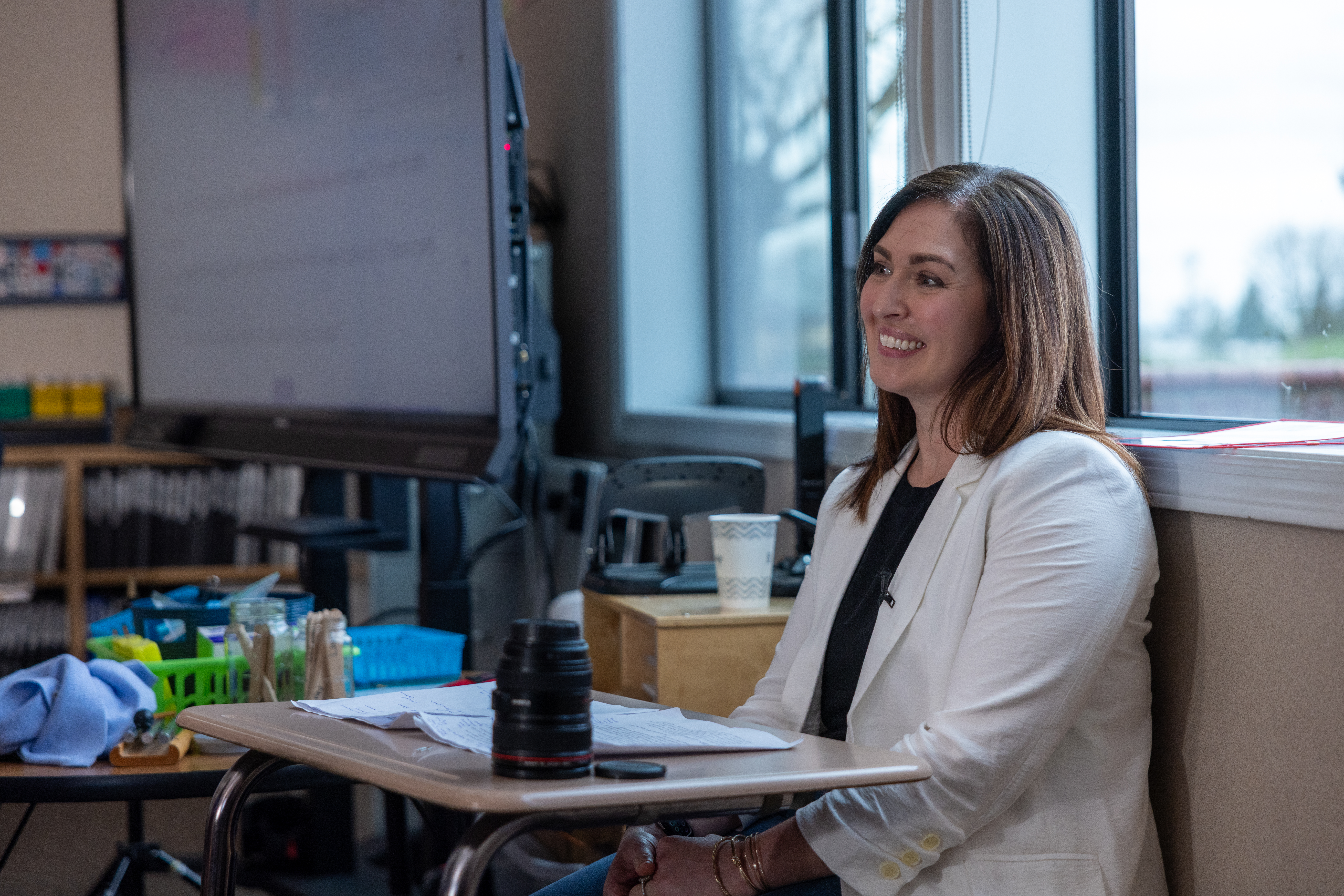
Sam observes a math class in Ceres Unified School District.
Sam: Hey, my friends, can I just take a quick little picture of this? Oh, you guys are the best. Hi, I’m Sam, by the way.
One that emphasizes curiosity and real-world connections, with a focus on conceptual understanding.
Teacher: OK, ladies and gentlemen, take a big, deep breath. Let it go. Alright, guys, come on in.
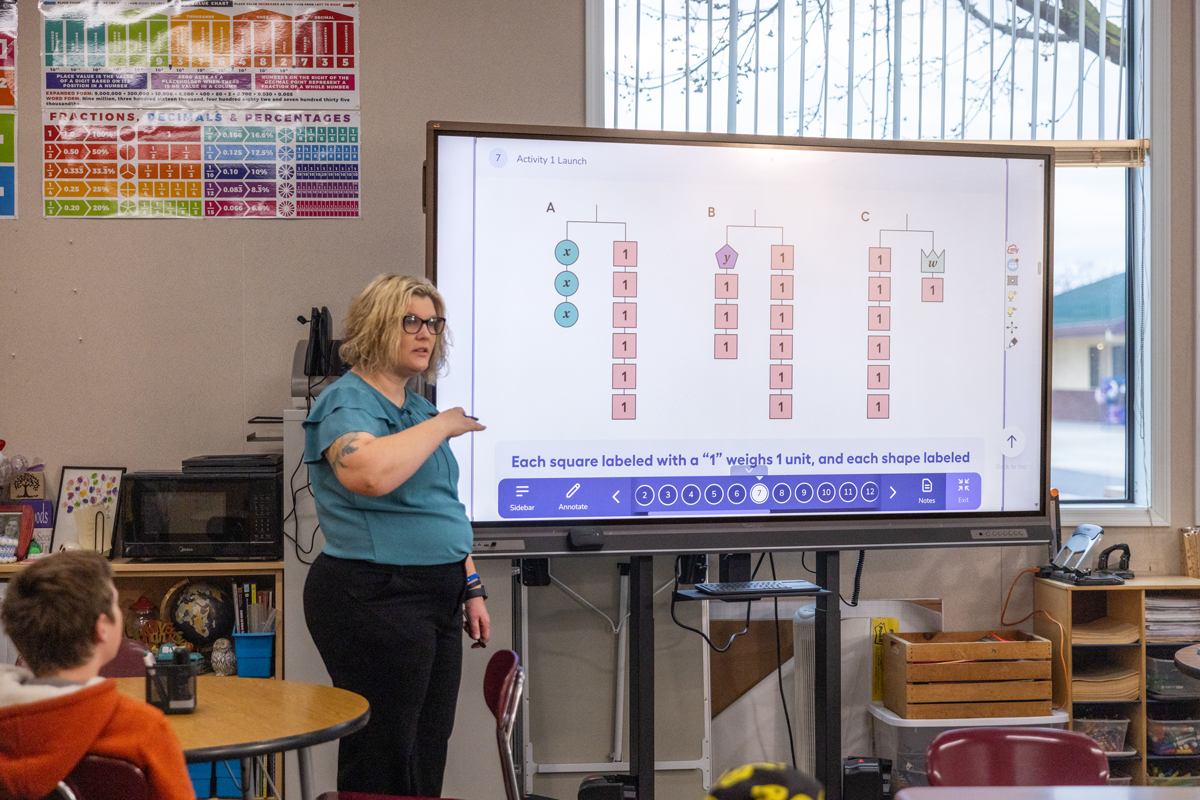
Grade 6 teacher, Mrs. Woods, introduces the day’s lesson.
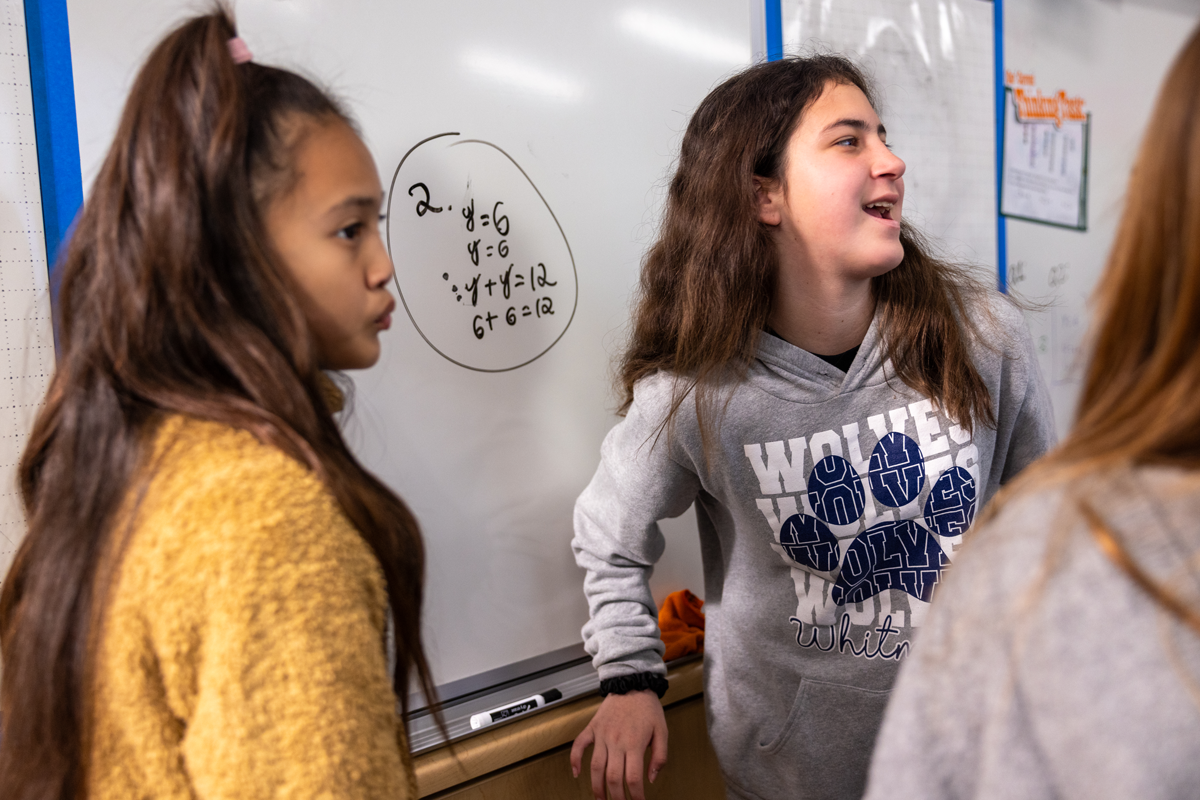
A group of students solve equations at a vertical whiteboard.
Sam spends time in a 6th-grade classroom. Today, they’re solving equations using balanced hangers.
Teacher: OK, ladies and gents, are you guys ready? If you get group 7…
Lauren (to Peter): Which practices are most helpful in taking a student from anxiety to feeling like “I can do this”?
Peter: Ironically, I think it’s random groups, but it can’t just be random on its own. It has to be random groups coupled with the teacher’s work to make sure that the groups are functional and that there’s respect, empathy, and so on and so forth.
Another one that actually really works well at reducing anxiety is what’s called “thin slicing.” So thin slicing is how I start with a task that every single student can do, right? So that when they’re walking away from the launch, they’re already feeling like, “I got this,” right? And then we work our way up.
The task gets a little bit harder and a little bit harder, and they’re still feeling in control. “Yeah, this is good. I got this, I got this, I got this.” And then on question number six or seven, they’re kind of like, “OK, here it is.”
They know it’s coming, right? But in the meantime, they’re enjoying the experience. “Yeah, we’re high-fiving each other, we got this,” and then, all of a sudden, you hear the students go, “OK, here it is. Been waiting for this. OK, let’s roll up our sleeves. Let’s get to it.”
And then they enter into a state that we call productive struggle. So it’s not, “Challenge them!” It’s, “I’m going to have you have some success, success, success, success. Here comes a challenge!”
And in that guided way, they’re feeling really safe so that by the time they’re actually working hard and actually thinking and collaborating because they need each other, they are so full of confidence.
We’re not just throwing these kids to the wolves. We are completely present, making sure that these experiences are positive. But the best thing that we could ever achieve in a classroom is when the students have walked out and they feel like they succeeded and they figured it out on their own. And our fingerprints are all over that, right? Like, we manufactured this completely, but they feel like they’re on top of the world because they did it, right?
One of the things I always say is, “I want to create learning without footprints of teaching.”
Sam: I absolutely love that because you really hit a couple of things really hard. It’s not just about making sure that the kids are thinking, but really changing how they feel about mathematics, which sometimes I think it’s more important, because when you feel like you’re capable of doing something, you at least go at attempting it.
This kind of resilience and willingness to try was evident to Sam in the classroom, with students working through anxieties that might once have stopped them.
Sam (to students): Do you guys ever get nervous about speaking out loud in front of your whole class?
Student: A little.
Sam: What would make you nervous about talking about this problem?
Student: It wouldn’t make me nervous talking about the problem. It just makes me nervous talking in front of everybody, and then everybody’s eyes are on me.
Sam: But what great practice, because you’re going to do that like the rest of your life, right?
I think back to some of those educators Sam and I spoke to at NCTM — people who’d grown up with math anxiety, but then turned it around to become successful, confident math instructors.
Many of them talked about how they were able to make this transformation as adults through exposure to the kinds of practices Peter evangelizes in Building Thinking Classrooms.
Michelle: Once the shift in mathematics happened, I started feeling more confident. When I first started, the first six, seven years were still rote memorization math.
And then this new wave started coming in where we would get PD on learning the conceptual background and why we were doing the things we were doing. And I would sit there thinking, “Why didn’t they just say that? I could have figured that out. That I get.”
I started, more and more, realizing that I did know the math. I just couldn’t memorize the math, and then I wanted to share that.
For Michelle, going through that process herself — relearning the math — helped her better support her teachers.
Michelle: So, giving teachers dedicated PD on actual math concepts, taking our math teachers and allowing them to learn the conceptual math, is vital.
We start with tasks. We have the teachers go through the tasks. We have the teachers grapple with the task and start feeling what it feels like to not know what’s happening, to have that productive struggle, so then they know how the students are feeling.
Christopher had a similar journey too — starting out believing he didn’t have a quote-unquote math brain, but then he found strategies that worked for him.
Christopher: I know the strategies that help me, so I can help the students, and it has helped them.
The process of understanding the problem to get to the answer is fulfilling, right? And because of that, I’m getting grades that are almost 90–100%.
You don’t have to have a math brain, but if you have the strategies in place, you can achieve this for yourself.
These stories, and Peter’s work, show what’s possible inside individual classrooms, but classrooms don’t exist in isolation.
The way math is taught and experienced is shaped by the decisions districts make, the support teachers receive, and the systems students move through every day.
Hillary Rinaldi is director of the National Math Improvement Project, a network of major school districts across the country working to rethink how math is taught at scale. Its focus is how entire systems can create the conditions for students to experience math differently.
Math anxiety goes way beyond my own experiences, or Winter’s, or any of the many other people we spoke to for this podcast.
I ask Hillary how much math anxiety is actually produced by the system that students have to learn in.
Hillary Rinaldi: Math anxiety is kind of like the elephant in the room anytime you’re talking about math. We are hopeful that as we do all of these things, a byproduct of this work is that math anxiety can disappear.
When we say, “What does the system produce?” I think what we know now about how brains function and how kids can learn math can both look different than it did when you and I were sitting in desks in rows.
What I’ve never understood is this idea that, you know, if you say that you hated math in school, then you also want kids now to learn it in the same way that you learned it.
What if we flip the question and say, “What are the things that are mitigating math anxiety? What are the conditions necessary to make those classrooms deliver on relevance, rigor, and joy?”
Creating classrooms that reduce anxiety takes intentional design at every level of the system. And that starts with how we support the people at the center of it: teachers and school leaders.
Hillary: I think the teacher and leader training is one of the things that can’t be missed. In our recent report about year zero in developing high-quality implementation of high-quality instructional materials, this is the first time that they have been focused on narrowing the instructional materials that are being used. Instead of leaving it up to schools to determine what makes sense in their classrooms, they can instead rely on the district to make those decisions.
And then, of course, the teacher is still the person who knows their classroom best. It doesn’t take away from the individuality of the teacher and those students. It can’t all fall to that third-grade teacher to figure out, all on their own, how to support students in thriving in math.
What Hillary is advocating is often called inquiry-based — or problem-based — math instruction. It starts with meaningful problems, often grounded in real situations, and asks students to make sense of them, rather than memorize a procedure first. The connection to anxiety is that when math feels connected to something real — something you can reason through — it stops feeling like a set of arbitrary rules you either “get” or you don’t.
Hillary doesn’t want to abandon basics, but to build them differently, developing fluency and number sense alongside understanding, so procedures don’t just get followed, they make sense.
I love these ideas. But I think about myself as a kindergarten teacher, when I only knew how to teach the way I was taught. Learning, or unlearning, something new felt so uncertain.
Hillary: You’re not alone in being, especially as an early grades teacher or an elementary teacher, someone who was not super excited to be teaching math, right? And part of that is also a gap in our educator preparation programs. Very little math practice or pedagogy is baked into our elementary ed coursework.
Part of this comes from the adoption of high-quality instructional materials, right? As teachers are preparing to actually implement new materials with integrity, we know it takes more than just unboxing, right?
To me, it’s quite simple. We need teachers to also be doing the math, right? And part of doing the math means that there’s more than one way to do it. And if there’s more than one way to do it, we have to give our students the ability to test and fail and replicate.
And this idea that, you know, being fearful of making mistakes is the antithesis of math. Doing math inherently means that you are making mistakes. That’s actually the whole point.
The challenge of the elementary teacher to re-release that cognitive load to their students is challenging because it’s not what you expected to be doing, maybe, as a teacher, and it means you don’t always know exactly where the class is headed. But we know that our students are going to be more successful if we give them that time and space to explore, not to be in an unproductive struggle, but to ask: How do we support all students with the scaffolds that we can bring in to make math both relevant and rigorous, but I think most importantly, enjoyable?
There’s an idea that keeps coming up in these conversations — with Deborah, Vanessa, Peter, and now Hillary.
Joy. Enjoyment.
At the beginning, I would never have connected those words to math, but now I understand what they mean.
Hillary: The more instances I have conversations with students that say they really enjoy math class, that they’re having fun in math, that they like what they’re doing, or even if it’s not their favorite subject.
Part of that is because of these shifts in pedagogy and practice where math is more engaging, right? Where it is students working in small groups or working with technology-enabled solutions that are really targeted to either catch them up right or accelerate their learning.
What LAUSD did last summer with their Algebra 1 courses, they actually used prisms VR and put students into a virtual reality setting to engage in math in a not just procedural and conceptual way, but also in spatial reasoning.
When you’re connected to your body and seeing what’s happening, predicting the LA fires based on logarithmic functions, it’s both checking those boxes of extremely relevant to the student, maintaining that rigor of aligned to standards, but also making it fun, right?
Time and again in my math anxiety journey, and yet again listening to Hillary speaking, I keep coming back to something simple.
These math classrooms I’m discovering are not only more engaging, but they also leave more room for students to be human: to try something and be wrong, to not get it right away without feeling like they’ve already failed.
Peter: What math anxiety does is it prevents students from stepping into possible identities. If we can reduce the anxiety or eliminate the anxiety, these spaces open up again. And now these students can move forward. But the same is true of teachers, right?
They can move forward into who they see themselves as, and this is really, really important to remember that a student who sees themselves as mathematical will have a different vision of their future than somebody who sees themselves as math-avoidant, right? So that’s really important.
Every experience in this series, from my little six-year-old self to the teachers at NCTM, to Vanessa’s students, to Winter – has started with the same feeling: I hate math, math is hard, and it makes you feel alone.
Hillary: In my opinion, the connection and the community are really all that matter. One of the greatest myths that we’ve told students about math is that math is something that happens while you’re sitting at a desk in silence alone with a paper and pencil, right? That is not how mathematicians or engineers or anyone who’s in STEM works, but more importantly, it’s not how any human works.
When’s the last time that you were grappling with something and you’re like, I know how I’ll solve this. I’m going to sit alone and talk about it to myself. Like, that’s just not how we function.
But avoiding math put me back on the inside with the not-math people group.
Hillary: Community can be built around all disliking the same thing, but I actually think it’s much more compelling when we build community around the things that we’re most proud of and the things that can actually help us all grow and learn together.
I realize now that becoming a “math person” was never really the point. I am a learner of things, and that includes math.
And I wonder what I would have done differently as a math-anxious kindergarten teacher and elementary principal if I had known how to bring community into the math classroom.
Not every child is going to love math, and that’s okay, but they deserve to build their own relationship with it — one rooted in joy.
And not just step into the one that we had.
This episode of Heart Work is produced by Justyna Welsh, Anise Lee, Danny McPadden, Steven Smithwhite, and me. Editing and mixing by Fraser Allan. Artwork by Kate Clough. Our executive producer is David McGinty. Music is from Universal Production Music. Special thanks to the Ceres Unified School District, the educators who spoke with us for this episode, and to our contributors Sam Murro Shea, Peter Liljedahl, and Hillary Rinaldi for your expertise and passion. And an extra special thanks to my colleague Kallie and her daughter Winter.
Heart Work is brought to you by Imagine Learning.
About the Host
Lauren Keeling is a seasoned education professional with a unique blend of experiences. A former broadcast journalist, elementary teacher, and principal, she now combines her passion for education with her love of storytelling at Imagine Learning. Above all, Lauren is a dedicated literacy advocate pursuing a doctorate in Leadership with a focus on Public and Non-Profit Organizations to further her impact on education nationwide.
Join the Club
Heart Work is our platform for telling educators’ stories. Sign up for the Heart Work Club to be among the first to share yours. You’ll also get the latest podcast episodes, articles, and exclusive content delivered straight to your inbox.