Vanessa: Should we be pushing people to become a “math person”? Math identity isn’t just about math. It’s about what math means in relationship with all the other identities we hold.
Lauren: You have struck me speechless.
Lauren (voiceover): I have math anxiety, and statistically, you probably do, too. From Imagine Learning, I’m Lauren Keeling, and this is Heart Work, an honest profile of America’s educators. This time, we’re investigating math anxiety, why it’s so widespread, and what it will take to break a cycle that spans generations.
For as long as I can remember, math has made me feel small. So I came to Toronto to meet with Vanessa Vakharia, a math educator and tutor renowned for helping people rewrite their relationship with math. I’m hoping to understand where this anxiety comes from, not just for myself, but for the teachers and students who carry that same fear every day, and maybe help all of us leave some of it behind.
Lauren: It’s really valuable and so important for us to be here in Toronto, where Vanessa has built the soul of her work. This is where the heartbeat happens, where she talks to people about math therapy. It makes all the difference in the kind of conversation we want to have.
Vanessa: Oh, my God. It’s so good to meet you. Woo! Are you ready for some math therapy?
Lauren: I’m ready. Let’s do some math. Vanessa, it’s so exciting to be here. Your space is really beautiful.
Vanessa: I’m so glad you’re here.
Lauren (voiceover): I feel my nerves starting to fade as Vanessa shows me her studio and opens up about her own struggles with math.
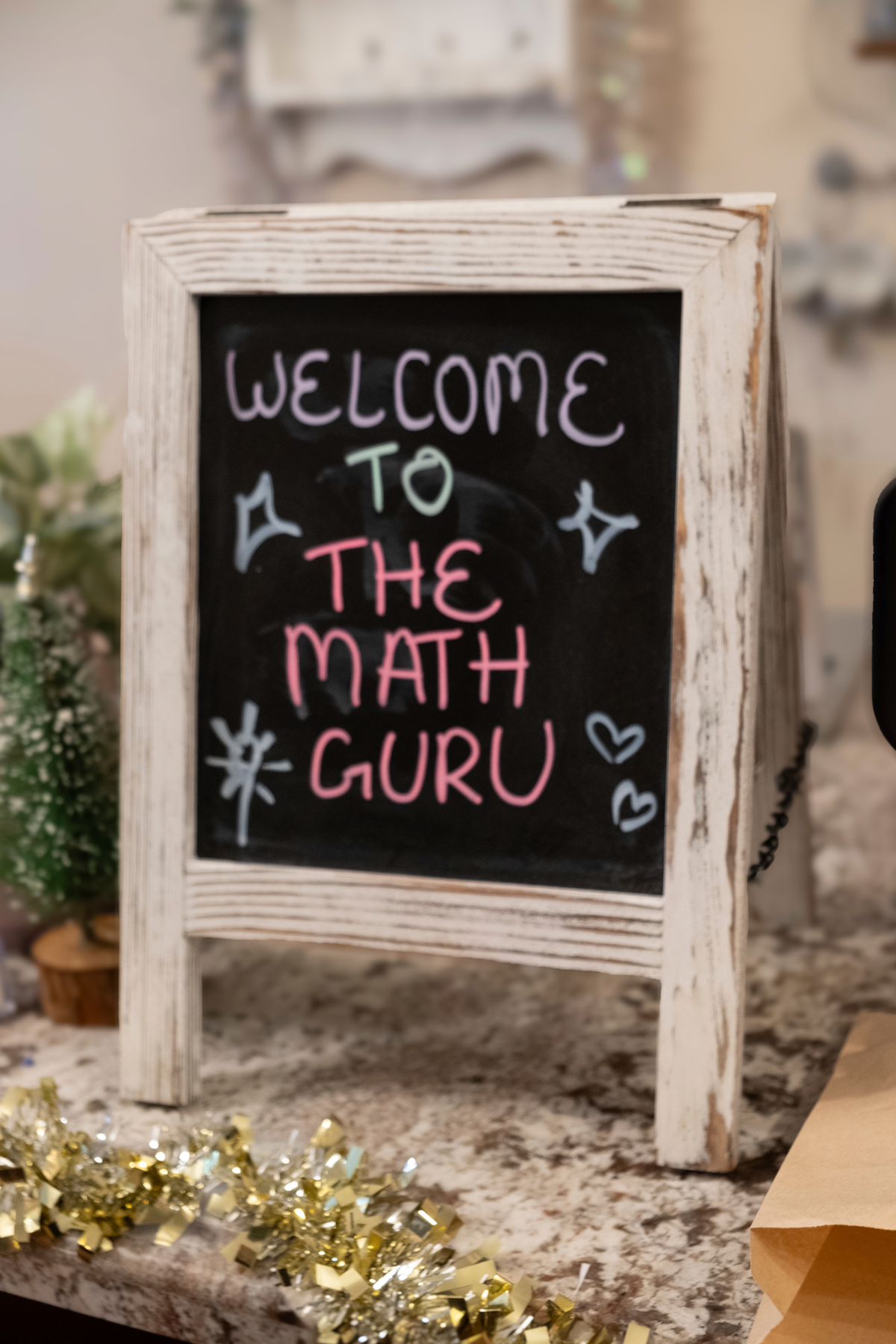
Vanessa: So I wanted to design my space like my favorite place to do math. Back in the day, I failed math twice at my regular, traditional school, and then I went to this school, and it changed my life.
There was so much about it that changed my life, but one of the key things was that the building was not like a school building. It was this office building. You walked into it, and you would take this elevator to get to class. The whole energy around it was different. There were plants. It didn’t feel like a school, and because of that, I felt more able to sink into a new learning experience instead of bringing previous baggage with me, because our physical experiences often bring up old memories.
So I wanted to design my space like my favorite place to do math. Getting rid of the idea that math is a solo sport.
Lauren: Yeah.
Vanessa: Right? You don’t have to be antisocial when you’re doing math. You can be hanging out with your friends. You should never have to sacrifice your identity to be a doer of math. You can sit on the couch with your tutor and do work.
Lauren: Really lowers the pressure.
Vanessa: Lowers the pressure, and again, you should be able to feel comfy and cozy and relaxed while doing math. Those two things should not live in opposition to one another. All of our senses are a part of our learning experience, so we should be comfortable.
Lauren: Yeah. The vibe just feels so good and so warm in here. But what I am really curious about are these boards. Why is something like this important? Why not just grab a bunch of paper and work at the table?
Vanessa: Yeah. Well, I’ve always been a really big fan of whiteboards on walls. When we have a non-permanent surface, it gives kids the feeling like, “Oh my God, mistakes are expected on here.”
Lauren: And what a difference that makes for children to be able to have a math conversation.
Vanessa: You can just bring your whole self in here. So do you want to sit down, have a tea latte, and talk math?
Lauren: Let’s go. OK, Vanessa, welcome to Heart Work.
Vanessa: And Lauren, welcome to Math Therapy.
Lauren: I’m nervous.
Vanessa: OK, so this is actually a really good starting point. I actually am curious. Your anxiety that you think you’re walking in here with is around math. Can you pinpoint what you’re nervous about?
Lauren: Failure. I am terrified that you’re going to ask me to do math today, and my entire body is going to lock up, and my brain is going to freeze, and I’m not going to be able to produce anything for you.
Vanessa: First of all, I am not, I’m not going to whip out a timed test. So let’s go with this. So your literal fear is that I’m going to ask you to do math, and you are going to freeze. You’re not going to be able to produce anything.
Lauren: Yes.
Vanessa: OK.
Lauren: And I’m afraid it’s going to be really basic math. Because it doesn’t matter what level of math it is, if you ask me to produce it and if you put a time capsule on it, I actually would probably melt into the couch.
Vanessa: Here’s my question to you. If I asked you what eight plus eight was and you couldn’t get it, and your fear came true, your fear, which is that you are going to lock up, you’re going to be unable to produce, you might even get the wrong answer, and even worse, on a public forum…
Lauren: Yes.
Vanessa: Like, people are listening. What would that mean about you?
Lauren: That I am a failure, that I am a dummy.
Vanessa: When was the first time you felt this way?
Lauren: In first grade. It centers on those timed tests. That’s when we started doing flashcards. I see Mrs. B walking down the aisles, and she sets this paper down in front of me that I have just finished, and it is full of red Xs. And that very moment is the very first moment that I can recall in my life feeling like I wasn’t very good at this thing, and that something was wrong with me. And then it happened again, and then it happened again.
Vanessa: OK, so that sounds, first of all, very, very hard. And I can feel the emotion coming out of you as you talk about it. It’s really interesting, right? You said it was a core memory, but then the evidence is that you literally remember every detail.
Lauren: I do.
Vanessa: You remember what she was wearing, you remember how you felt. Can we talk about the mathematics content? So you got the stuff wrong, you got the red Xs. Forget the timed test. Were you able to, in a non-timed situation, do what was on the paper?
Lauren: Perhaps not perfectly or well, but I felt like I had the time to be able to count on my fingers. I could do touch math.
Vanessa: The world’s OG manipulative everyone.
Lauren: I had to do it a completely different way from the very straightforward way that my teacher was doing it up on the board.
Vanessa: Got it. So there are a few really interesting things, which is that, just from a theoretical point of view, and like a scientific point of view, it’s really important that we hang onto this moment for a second, because this is years and years, this is decades later. Decades later.
Lauren: Decades later.
Vanessa: Decades later, and your body remembers that experience — it does. And actually, with math trauma, and any sort of micro-trauma or macro-trauma, our bodies do go back into the state we were in when we had the first traumatic incident. So I actually want you to just give yourself some grace.
We’re going to talk about this more later, but remember that now, every time you’re faced with math, you are back to being that six-year-old. It’s not just made up. That is what’s happening, and how can you possibly perform mathematically when you feel like you can’t access your working memory? Your amygdala is being hijacked. You’re back in that trauma memory. And I just want to reflect back, there’s a part of you that’s like, “Even though I’m able to work this stuff out, and get the result and get a good grade, it doesn’t actually count, because I’m not doing it fast enough. I’m not doing it the way everyone else is. I’ve got to use these tools no one else is doing, so it doesn’t actually count as me being good at math.”
Lauren: Yes, I had to figure out, I had to draw the pictures, I had to make the circles. You know, I had to do all of the different strategies.
Vanessa: And is that not being good at math in your mind?
Lauren: No, it’s not being good at math, in my mind.
Vanessa: And why?
Lauren: Because there’s one way to do math. My childhood teaching tells me there’s one way to do math, and if you have to do all of this extraneous stuff to get there, you’re not doing it right.
Vanessa: Yeah.
Lauren: One pathway. But can I tell you one more big piece of math trauma…
Vanessa: Tell me whatever you want, yeah.
Lauren: …that lives in my grown-up life? From a career perspective, I’ve done a lot of different things, and when I transitioned out of my very first job as a journalist and moved into — I decided that, because we were raising girls, I needed a different schedule in my life. I wanted to be a teacher. My mom was a teacher. I knew I loved kindergarten — my heart was called to it.
I had to go back to school and get my master’s degree, but then came the really difficult part, because in Ohio, where I was getting certified, I had to take four different tests in the core subjects, right? So math, reading, science, and social studies. I went to take my math Praxis, and I’m sitting in this little quiet room, and these sweet ladies are on the outside of the glass, and you know you’re not allowed to talk when you’re taking those tests.
Vanessa: Sure.
Lauren: You’re in your little cubicle. So I’m working through this test, and at the end, I fail it — this big test that’s going to allow me to get my certification. And I fail it by just a very minimal number, less than 10 points. And I was super disappointed, but I knew I could take it again. So I went back to my tutor, and we bought all of the Math for Dummies books and practice Math for Dummies books, and we studied through all of those.
Vanessa: Probably in retrospect, not a good name.
Lauren: Terrible name, I know. So we did all of those books, and I went back, and I took that test again the second time, and I was really trying to focus my brain on, like, “You can do this. This is a really important thing to you. You have the skill.” And I failed it again.
Vanessa: OK.
Lauren: By this time, the ladies on the other side of the zoo glass are invested in what I’m doing as well, and they were disappointed for me. So I’m going to do it again. I’m going to do it a third time. We’re going to do all the same stuff over again. We’re going to keep practicing. I failed it by two points on the third time. I had one more chance to take it.
Vanessa: This is so stressful. So stressful. Were you stressed in there?
Lauren: Yes.
Vanessa: OK.
Lauren: By the third time, I was not — I was not well taking that third test. Because the real-life, grown-up pressure was on this. This was a career. I was making a huge shift away. I was taking a chance. This was… the only way I could get a job to teach is if I passed this thing.
After all of that, on the fourth test, I did pass, and I barely passed, and I loudly celebrated in my quiet cubicle in the space you’re not supposed to talk.
And the ladies outside the zoo glass celebrated when they saw my arms go up, because we were just all living this moment of, like, here’s this poor girl who has come in here 1,000 times and just keeps missing it by a mark.
So all that to say, that was just another grown-up moment for me that proved, in my mind, that small thing that I knew that I was missing when I was doing that math: that if I could have just done it the way they taught me to do it, and I didn’t have to do all of the other stuff to get to that answer, I would’ve been quicker, I could’ve had more time to check my answers, and I probably would’ve passed.
Vanessa: So there’s a lot that’s sort of knitted into that. OK. Like — I don’t love it, but this totally makes so much sense.
Lauren: I believe that deep in my soul. Even knowing what I know today, even having the experiences I have today, teaching children math as a kindergarten teacher, working with teachers to pick and put out a curriculum in our district — even knowing all the things I know today, I still, in my soul, when I dig down deep and think about math for Lauren Keeling, there’s only one way to solve that problem, and you’re not doing it right.
Vanessa: This is so interesting, because when I work with teachers, I often — I do a lot of talks around defining failure and success, and I find educators, very often, will have this idea of success for the people they lead, right? Either the teachers they work with or their students, and they’ll be like, “Success is just trying and failing. It’s showing up. It’s whatever,” but their standard for themselves is always completely different.
Lauren: Yep.
Vanessa: Right? And it definitely sounds like that for you, because off-screen or mic or whatever, you and I were talking, and you were saying that one of your deep core beliefs is that there are multiple ways to learn things and do things, and even if in math you’ve got to get to the one answer, there’s so many ways you can do it, and all of those are equally valuable, and now it seems like you’re just completely gaslighting yourself.
Lauren: But not for me.
Vanessa: Yeah, not for you.
Lauren: Everyone else in the world can have their own voice to get to mastery, but for me, nope, there’s, there’s one way, and I don’t know how to do it.
Vanessa: OK.
Lauren: So fast forward. I got my licensure. I was hired, thankfully, to teach third grade, and the books in third grade are amazing. They’re so fun to teach, but do you know what else you teach in third grade?
Vanessa: What?
Lauren: Fractions.
Vanessa: Oh my God, do you love that?
Lauren: I hate that.
Vanessa: Cool.
Lauren: Deeply.
Vanessa: So what happened?
Lauren: So I taught fractions, and I’m air-quoting that I taught fractions.
Vanessa: Why are you air-quoting?
Lauren: Because I just had to read directly from the book, because that was a style of math that I didn’t understand until I started failing forward at cooking and using measuring cups.
Fractions finally started to make a little bit of sense for me in my 30s when I was practicing it that way, which would’ve been a great strategy to bring into my classroom for the students.
Vanessa: Yeah, I don’t want to be sarcastic and snippy, but I’m like, “Oh, wow, when you encountered the thing in real life, and it was actually relevant, it made sense.” Like, shocking.
Lauren: Not separate and apart and using strange things in a book?
Vanessa: Yeah.
Lauren: Yeah. So as soon as I — third grade, the children were wonderful, the books were great; fractions were horrible. I was panicked every day that I was destroying math futures for children because I myself was uncomfortable teaching fractions, and I felt like there was just no possible way that wasn’t somehow seeping into a child in the classroom who was also finding it to be a little confusing and uncomfortable. And so I only spent one year in third grade, truly because I just could not torture myself through teaching fractions.
Vanessa: Yeah.
Lauren: And I got out, and I started teaching kindergarten.
Vanessa: There are probably a lot of teachers listening that feel the exact way that you felt in grade 3.
Lauren: Yeah.
Vanessa: What would you tell those teachers? What would you say?
Lauren: It’s hard as a first-year teacher to feel like you’re doing good work in any space, because you’re just figuring it out, and then it’s also extra hard when it’s something that you’re not confident in yourself. And if I separate myself from how Lauren Keeling felt, and I look at you as the administrator that I became, I would say, “We’re going to figure it out together.”
Vanessa: Oh.
Lauren: “And I’m going to give you all the supports that you need, and I actually know a teacher just right across the hall from you who is really doing great work teaching children fractions and can maybe support you in this.”
As a grown-up who has had great people in her life and who has raised daughters and lived in the world, what that person needs is just really what you’re doing for me right here, providing an opening for them to talk about it and think about it and actually connect to what the real root issue is, and then how do we figure it out? You love third grade. Let’s pretend that that’s what it is. You love third grade.
Vanessa: Oh, I cannot imagine teaching third grade.
Lauren: This is the space you want to be in. Tons of people are cut out for third grade, and that’s where they want to be. Math is hard, and that’s not going to change, but you’re smart. You’re a teacher. You passed all these hard tests. You’ve done all of these things, and you have a really big heart for helping these children figure it out, so let’s also have a really big heart for you figuring it out, and let your heart be big for yourself to figure it out. What kind of grappling work can we do to get there? How can I help you?
Vanessa: We’re going to need, once this is done, for you to play back to yourself. To the third-grade teacher you were, I wish someone had said that to you. But also, I fully support being like, “I don’t want to torture myself.”
Lauren: Yeah.
Vanessa: We are adults.
Lauren: Yes.
Vanessa: Ok? We get to choose now. We don’t have to do anything we don’t like.
Lauren: Yeah.
Vanessa: Right? So you are fully able to be like, “I, actually, this…” Like, there are tons of things I do where I’m like, “I could do this, but it’s going to take a lot of work, and I don’t want to put in that work,” or, “This is going to make me miserable, and I don’t want to do it.” It doesn’t mean I don’t think I can do it, but I think that is a bit of the difference. And you, as an administrator, and all the administrators listening to this, you probably have teachers that you are leading who feel this way. I think this is really important to hear. You’re not the only one who thinks this.
Like, I think math can do that, because math is so weighted, and it gives people such visceral experiences, often negative, often so identity-based, because we do use it as this identity piece, like you’re either a math person or not, that we can use it to leverage this incredible identity shift with people.
Vanessa: Most of us learned that failure is really bad at some point. Definitely, failure in school is really bad, and so math was this perfect storm for you…
Lauren: Yeah.
Vanessa: …that has formed this childhood protector part, as IFS would say, that now lives within you and wants to make sure you never feel that way again.
But the core story is untrue. Because your core story is, “Unless I do math in this specific, exact way, I can’t be good at it. And if I’m not good at it, I’m a failure.”
In our society, math is the thing we associate with intelligence.
Lauren: Yes.
Vanessa: Right?
Lauren: Yes, absolutely.
Vanessa: Like, we don’t call Picasso smart. We don’t call LeBron James smart. When you’re good at math, you are smart.
Lauren: That’s so true.
Vanessa: I don’t want to make this gendered, but my master’s thesis was called Imagining a World Where Paris Hilton Loves Math, and it is specifically about women in math.
Lauren: That’s a fantastic title.
Vanessa: It was about media representation of mathematicians and of women, and how so many women self-select out of mathematics because they feel like there’s no room for their full identity to merge with the identity of a mathematician.
Lauren: Yeah.
Vanessa: There is a lot of research around this. So it’s not — you know, I bring it up because women tend to be so much harder on themselves than they are on those around them, and this is a large reason we see a discrepancy when it comes to gender and mathematics.
There’s a whole range of things behind that, but this is one of them: this idea that if you can’t achieve perfection, then it means that you are a failure, and there is nothing worse than being a failure, so you stick to the things you’re good at.
Kids know that. They know that they are literally one wrong answer away from getting written off. And I hope you’re seeing these major themes coming out — that math symbolizes so much more for us, right? It symbolizes what intelligence is.
Lauren: Yes. We just bought a house. We were talking all about mortgages, and numbers, and percentages, but I certainly didn’t want to have any hands in trying to actually do the numbers, and think about the numbers, and look at the numbers.
It just, one, made me super nervous, because what if I got it wrong?
I just hated the fact that even if I were going to sit down and try to suss those numbers out and figure out what it might or could be, I could be wrong, and that could have given us a poor picture of what we were going to do, right?
That’s like an actual risk. So there are real consequences connected to the math that I would be responsible for doing, or thinking through, or putting on paper and actually sharing today.
And so when I say I feel indifferent, I feel indifferent because I’m just saying, “OK, someone else can figure this out. I can put this on someone else’s plate who is going to get it right because they are math smart, and I don’t have to worry about the outcome.”
If I do it, we have to worry about the outcome, because we’re going to have to look at it with a magnifying glass and have somebody else check my work, right?
Vanessa: My goal with anyone — even with students — is, I don’t need you to go into STEM or do math. I actually really do not care. I care that you believe that you could if you wanted to or needed to. That’s actually what I care about.
Right now, you’re not in a position to be figuring out mortgages, right?
Lauren: Right.
Vanessa: Like, you have math trauma from grade 1. You don’t like it. It sucks. And there’s someone who can do it. So really, there’s nothing — I don’t want us feeling bad about that.
You don’t need to be doing your own math. It’s like when somebody uses a calculator. I’m like, “Don’t feel bad about it.” Maybe you just didn’t feel like thinking about it in the moment.
I don’t care what you’re doing. I just want you to know you’re capable of doing it.
Again, when I was talking about my master’s thesis, the big finding from that was that for the girls that I was working with, in order to become math people, it meant they had to shed the identity they had.
For example, a lot of them were cheerleaders. We have never seen a cheerleader represented as being good at math in the media. The two are opposites.
We all know the movie, right? Like, you’re either the cheerleader who needs the smart girl to help her with math, and then you give the smart girl a makeover, and then she’ll be, like, whatever.
So there was a very big identity conflict. These girls were great at math. They were getting 90s. They were getting As in my grade 10 classroom, but they were like, “We are not good at math.”
And when we really dug down to it, it was kind of like this conversation we’re having here, where the proof — the evidence — was that they were good at math, but it was like, if they became good at math, did they have to let go of something else? Did it mean that they had to engage in different behavior?
And I think we really disregard identity. You know, we talk about math identity a lot, but I think we’re missing a very key component of math identity, which is: How does math identity — like, in the Venn diagram of identities — intersect with our own identity?
Is it diametrically opposed to it? What happens, right?
Math identity isn’t just about math. It’s about what math means in relationship with all the other identities we hold.
Lauren: You have struck me speechless. Which has never happened in the history of this podcast.
Vanessa: I don’t believe that.
The problem is, what being a math person also means, whether we choose to accept it or not, is things like: you don’t like creative things.
Like, think about every stereotype of what makes a math person. You definitely don’t like music and the arts. You’re a logical thinker. You’re boring. You always get the right answer. You sit and study all the time. There’s so many things the term means.
So the problem is, I’m not surprised when you’re like, “You know what? Kind of being not a math person is part of my core identity.”
I think that it’s a really interesting question to ask, because the question is: Should we be pushing people to become a math person? Or is it perhaps counterproductive to our goal, which is to — like, my goal is to show every single student that they can build a better relationship with math.
It’s for people to just feel capable, and to be like, “Hey, you know what? I’m capable of more than I thought I was, including these fractions.”
But my agenda is not to be like, “No, you need to call yourself a math person.” I hate labeling in general, so why are we now using this as a label?
Lauren: I don’t have to become a math person to just be able to do math.
Vanessa: Exactly.
Lauren: I even think about that from a school perspective: to release children from — and teachers from — the idea that they have to be this person or that person.
Vanessa: Why are we doing that? Ew.
Lauren: And it’s OK to like math, and it’s OK to like reading. But to like those things does not make you that person.
Vanessa: And to like those things doesn’t mean all of a sudden you have to go into a STEM career.
Lauren: So what is it, Vanessa, that you do? What did I come here needing from you today?
Vanessa: I mean, you should probably tell me that. We shouldn’t speak for you.
I think that the number one thing people need, in my experience, is validation.
They need to feel validated. They need to see that they’re not alone. And the reason I like to always start opening the conversation — and whenever I do a talk, I do this — is I frame it as, “I would like everyone to think about whether they’ve ever had a negative experience with math.” That’s my number one teacher move, and we did it here today.
The reason that can be so groundbreaking for people is when they start talking about it, which you did, right? And I hope for you it’s really empowering because it shows you that you were not born with these feelings. You developed these feelings, right? Emotions encode experience. When we have an experience that is very emotional, we remember that experience. It forms a memory that is very hard to let go of.
Neuroscience shows us that the percentage of people born with a natural aptitude for mathematics is so small. You know, when you think about a prodigy or something like that — though it exists — the percentage is so, so, so, so, so small. And other than that subset of people, math ability being something that you are born with — like nature versus nurture, the nature part of it — it is so, so, so small in terms of its effect on your future math ability.
And the biggest predictor of math ability is nurture. It’s practice.
Have you read Outliers by Malcolm Gladwell?
Lauren: No.
Vanessa: Oh my God. What? OK. No, stop. OK. This book, it’s about the most famous hockey players, the most famous mathematicians, the most famous musicians — the ones that you would believe, like, they must have been born with exceptional ability, they’re so good at it.
And he did all this research and found that the one thing all of these people had in common — they had one thing in common — was that they had all spent over 10,000 hours practicing their craft.
Lauren: Wow.
Vanessa: And if you think about it that way, to put in 10,000 hours, it would help if you started at a young age. It’s a lot of hours to put in, right?
So often, we conflate nature and nurture because the conversation would be like, “Well, from a young age they were so good at this thing,” but it would often be someone who was tinkering with the piano when they were three years old.
Or, you know, Eugenia Cheng talks about how her parents would read her math stories at night. Instead of story time, they had math games. Like, we have been shown time and time again that nurture plays a larger role, yet we love — we love the juicy story of people born with this crazy thing, and it also gives us an excuse to be like, “Well, I just was born at a deficit.” But it’s just not true.
Lauren: So tell me how this feeds into the work that you do.
Vanessa: OK. So I feel like I wrote Math Therapy after years and years and years of, you know… I think if you talk to most teachers, they’re like, “Yeah, I’m doing therapy in the math classroom,” right?
Lauren: Sure.
Vanessa: Like, a lot of the work I’m doing is really therapeutic. So I wrote it after years and years and years — over 20 years of teaching and tutoring and working one-on-one with kids — and really realizing that the number one thing, I mean, I’ve had so many different types of students in this space, and the number one thing that makes a difference is actually not whether they’re taught through the algorithm or not, or with worksheets or not.
I mean, those things matter, but the number one thing that mattered was actually the therapeutic element of interacting with them. It was doing stuff like this. It was having these conversations. It was so emotional.
One of the biggest strategies is when somebody says they feel bad at math or they’re not good at math, I often start arguing with them. I’ll be like, “But you’re doing math. But you do this. You took down the Christmas tree — that’s math. And what I’ll find is what they actually really mean is, “I wasn’t good at school math.” Like, “I wasn’t good at the math that got graded, that got evaluated.”
So I want to sit with you, and we’re going to actually do a little skills analysis, OK?
Lauren: OK?
Vanessa: So I want you to name me math skills — math skills or things that are math. So I’m going to write one thing on here. I’m going to say mental math, OK? Give me one.
Lauren: Uh, addition.
Vanessa: Addition. OK, great. I’m going to say baking.
Lauren: Planting my garden.
Vanessa: What do you do?
Lauren: Making my rows, figuring out the distances and the distances between each of my flowers that I’m planting. How do I do that? The depth of putting the bulbs in the ground. I use…
Vanessa: Oh, do you use a ruler?
Lauren: I use non-standard measurement — my arm — but I told you I love non-standard measurements.
Vanessa: No, but that’s really good. OK, good.
Lauren: So yes, it’s gardening.
Vanessa: Planting a garden. Now, if I had a student who felt bad at math, I would do this with them, and then I’d be like, OK, I would look up how these tied to the content I was teaching right now. So I’d be like, “Planting a garden. Here are all the units that I’m teaching this year. Tell me exactly how this ties in.” Why would I do that? Because you, Lauren, are sitting here being like, “Yeah, I guess I do this math, but I didn’t really qualify it as math.” In your mind, I bet you’re like, “It doesn’t really count.”
And that is where we start seeing that it is not math that’s the problem. It’s the way we are treating math in a school setting that is ruining math for everyone. You were never graded at this, and that is the only thing that counts.
OK, so now I’m going to give you this.
Lauren: OK.
Vanessa: And I want you to, with this pink pen, circle anything you feel good at.
Lauren: I feel good at?
Vanessa: Yeah.
Lauren: Well, planting a garden is first. OK.
Vanessa: And you feel satisfied after or something?
Lauren: I do. I feel really great after I plant my garden. Just the way that it looks like it fits in the space. That’s a real puzzle to me that I love putting together.
Vanessa: Put puzzles on the list.
OK, so I want us to look at this. We have 19 items on here, and you circled one, two, three, four, five, six, seven, eight, nine, 10, 11. Eleven out of 19. Over half of the things on here you circled, OK?
I would now like you to look at this and ask yourself, do you believe everything you circled has some sort of mathematical component?
Lauren: I do.
Vanessa: You’ve circled a lot of math stuff, and there’s a lot of stuff you circled that I wouldn’t be able to circle. Does this change in any way the way you feel about your math ability? And you can say no. I’m just curious, looking at all the math things you circled.
Lauren: It does, because it’s what I think… I don’t think about sneaky math. So for me, sneaky math is where…
Vanessa: I’m sorry, pardon?
Lauren: Sneaky math. Where we’re looking at angles and thinking about putting together my garden or arranging my furniture. I’m not actively working and manipulating numbers. Sneaky math.
I don’t mind putting my garden together because I don’t actually have to come into contact with numbers when I’m doing it.
Vanessa: I fully get what you mean. One hundred percent.
Lauren: Measuring and baking is sneaky math. It’s sneaky math. I didn’t realize I was doing fractions until I had a moment where I thought, “Wait, three quarters of a cup is the same as a…”
Vanessa: If we made more sneaky math — can we call it implicit math, just for what I’m going to say?
Lauren: Sure.
Vanessa: It’s going to sound like more of a mic drop. OK, so if we made more implicit math explicit, more people would realize how much math they were doing and how good they were at it.
Lauren: Yes.
Vanessa: Think about how much discussion we can now be having with kids. And kids are like, “Oh my God, well, I do this,” and then just like we were, we’re like, “OK, well, what about this? And what… OK, fine. If you’re going to say baking, I’m going to say measuring.”
Now we’re realizing how much math we’re doing.
For a lot of kids — and probably for you a little — you’re like, “OK, but it’s not feeling like it’s… I didn’t say algebra, and I didn’t say sine and cosine.” So we do want to tie it to the things we’re doing in our curriculum and the content we’re teaching. We do want to tie it in and give it that language. That really helps.
As we’ve established, on this sheet here, you have so many math superpowers that I don’t have, and every single person has these latent math skills — these, sorry, implicit sneaky math skills — that are not necessarily brought to the fore.
And part of what you were saying earlier is you felt like you weren’t good at math because you weren’t doing it the way you were supposed to or the way other people do it. And what I want everyone to know is that is actually your math superpower.
When you’re planning the garden, you’ve made up this whole method, right? You have all these skills that not everybody in the class has, and in a classroom of students, you are going to have kids who have all circled different things on this page, and that is not bad.
That is the blessing in it — to be like, “Guys, look. You all have these different skills, and in our room combined we have 30-plus math superpowers. We all have something different to bring to the table.”
It also helps create this collaborative environment where instead of kids competing with one another, you can be like, “Hey, you need help with that? Well, Sally circled this thing. Their math superpower is problem-solving. Go talk to them about this.” “Oh, you need help with counting? Didn’t somebody…” Right? And so everyone is now not competing with one another, but realizing that the whole is greater than the sum of the parts.
OK, the last thing I wanted us to do is on your phone.
Lauren: Yes.
Vanessa: Open up Duolingo. They have now added math as a language.
Lauren: OK. I see that.
Vanessa: So add math to your thing. Great. Do you want to do a lesson right now?
Lauren: Sure.
Vanessa: Oh, OK. We’re now suddenly doing math. OK, go for it. I’m not even looking. OK, keep going. OK. I think there’s only a few. It’ll take like one minute. But you do that. See how it goes.
Lauren: While I’m working on this, tell me: is this a practical strategy for parents and teachers?
Vanessa: The reason I love it is, when we go into avoidance with math — like you were saying, you avoid math…
Lauren: I do.
Vanessa: …we’re not going to get better at something when we avoid it. That’s just how life works.
Lauren: I’m doing really well.
Vanessa: Sorry, I can’t hear my voice over all the loud bings and bops happening from Lauren’s mastery of mathematics right now.
So it’s three minutes a day, and it starts building confidence. But more than that, it rewires the thing in your brain that you have, which is: “When I do math, a horrible thing happens.”
Whether you get the answers right or wrong on the app, you’re seeing that when you do math, a horrible thing does not happen. Actually, a really joyful thing happens.
And even if you get something wrong, you’re just going to try again the next day.
When we have math anxiety, we get stuck in the anxiety-avoidance cycle, and we are never going to get out of it unless we break the cycle out of avoidance, which means we need to do some math. And it’s a great way to do math.
You are really crushing here.
Lauren: I’m really doing a great job.
Vanessa: What is happening? OK, we’re almost done.
Lauren: Yep. I pulled something out of this that you just said…
Vanessa: Yeah.
Lauren: …that Duolingo’s doing. Math is a language.
Vanessa: Right? Can I just tell you what they added? They added math and music. Those were the two new languages, and I was like, again, this is a language issue.
Lauren: It is a language.
Vanessa: It is.
Lauren: And it is OK for language to be hard to learn.
Vanessa: Preach.
Lauren: I think I’m done. I don’t feel stressed because I…
Vanessa: I’m done here. I’m finished.
Lauren: Well, I’m a learning legend.
Vanessa: Is that what it says?
Lauren: Uh-huh.
Vanessa: OK, so every day, just do it for two weeks and see what happens.
Can I just point out that you just not only did math, you did math while we’re all actually kind of now impatiently waiting. At this point we’re on the third battery. I am staring at you. You actually were talking at the same time, and you’re being recorded. You did not seem stressed.
Lauren: Landing on the fact that math is a language…
Vanessa: That’s crazy.
Lauren: …that we speak is a big deal for me personally as a learner, as a teacher, as a thinker.
It lifts, releases, throws away, pushes out the window a lot of the pressure around just having to show up and be good at it, because we don’t expect anyone to show up and just be good at a language.
We teach really explicitly and thoughtfully and with full hearts. It’s the same with math.
Math is a language.
Vanessa: Should we just end with a Duolingo beep being like, “Good job”?
Team: Yay!
Vanessa: Should we crown Lauren? Oh. There you go. There you go. The unicorn of understanding. Oh, I love it. There she is, our queen. Our math queen.
Lauren: Oh, I do love a crown.
Lauren (voiceover): Being in Vanessa’s space, having really heart-to-heart conversations about what that work looks like, sounds like, feels like, what inspires it, what changes it — it makes all the difference.
Sometimes it’s so nice to be in a different area too, because it allows me personally, and our team together, to just take a breath and recenter on what it is that we’re doing and why we love the work that we love.
Travel can sometimes be stressful, but in moments like this, where we’re in a city like Toronto surrounded by water and snow and the beauty of the season, it also gives us a moment to kind of step back and relax.