November 3, 2023 7:00 am

The Science of Math Instruction: Incorporating Research-Based Instruction into Technology

Everyone’s talking about the science of reading, but what about mathematics? Take a look at agreed-upon best practices called cognitively-guided instruction, as well as technology that puts it into practice.

Teaching mathematics means more than introducing algorithms and procedures to students. Research shows that effective instruction also involves the development of a student’s conceptual understanding, mathematical reasoning, and problem-solving skills.

One research-based approach to mathematics instruction is Cognitively Guided Instruction (CGI), as described in Children’s Mathematics: Cognitively Guided Instruction (Carpenter et al., 2014). CGI shifts an educator’s focus away from direct instruction and toward understanding an individual student’s mathematical thinking. The teacher then leverages this understanding as the foundation to guide the student toward increasingly complex concepts.

Now, as online programs gain popularity in today’s classrooms, schools have the opportunity to choose technology that not only supports students’ procedural fluency but also aligns with research-based principles to develop students’ conceptual understanding. By evaluating the technology we bring to students through the lens of a framework such as CGI, we can help ensure that students have the opportunity to develop the skills they need to succeed beyond memorization.

What is Cognitively Guided Instruction (CGI)?

CGI is an approach to teaching mathematics that focuses on students’ critical thinking and problem-solving. Instead of just showing students how to solve a problem, teachers guide students to explore strategies and approaches that make sense from their unique understanding of a situation. The following are just some of the principles of CGI, as highlighted in Children’s Mathematics (Carpenter et al., 2014).   

  • Problem Solving: Students are encouraged to tackle problems using critical thinking and creativity before receiving direct instruction. Given a story problem anchored in a real-world context familiar to students (such as sharing a food item among friends), students reason using a strategy of their choice.
  • Teacher as a Facilitator: Teachers transition away from the role of traditional instructors and toward the role of facilitators. They listen to students’ strategies, pose thought-provoking questions, and steer discussions while providing opportunities for students to learn from their peers’ thought processes.
  • Building on Prior Knowledge: Students bring their experiences and understandings into the classroom. Teachers leverage each student’s prior knowledge as a foundation and layer new concepts on top of the ideas that students have already grasped.
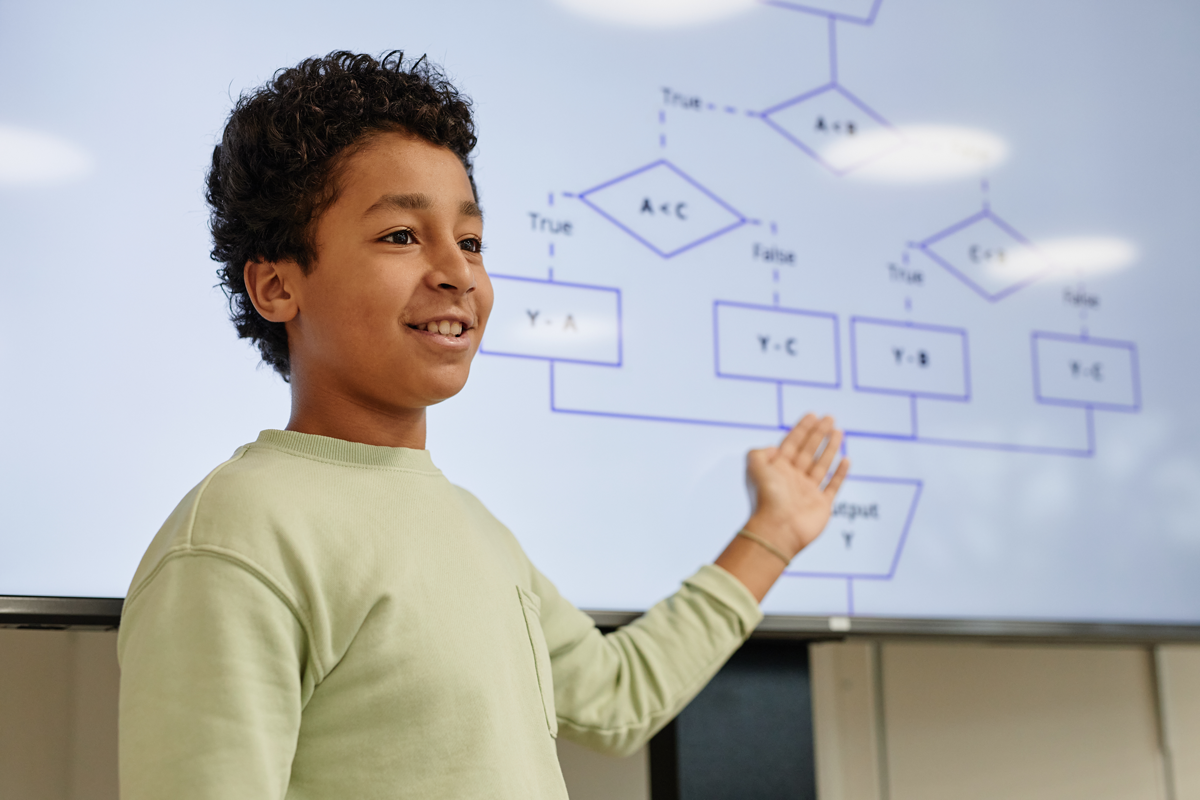
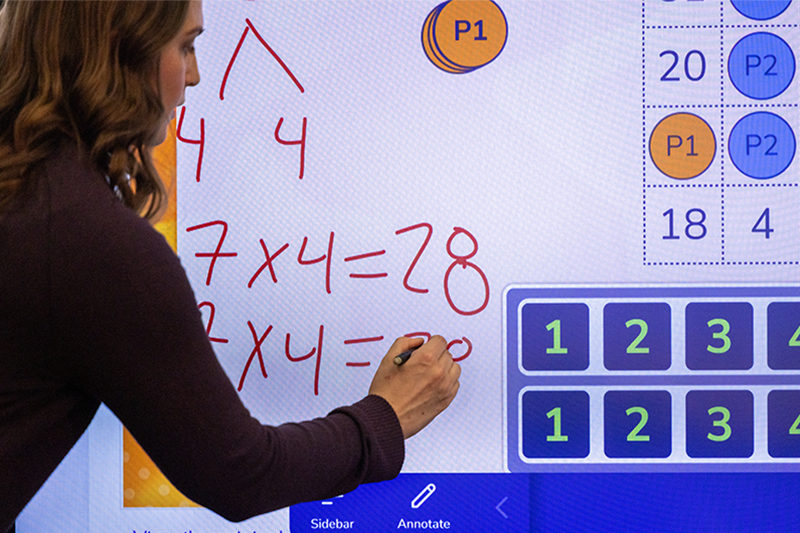
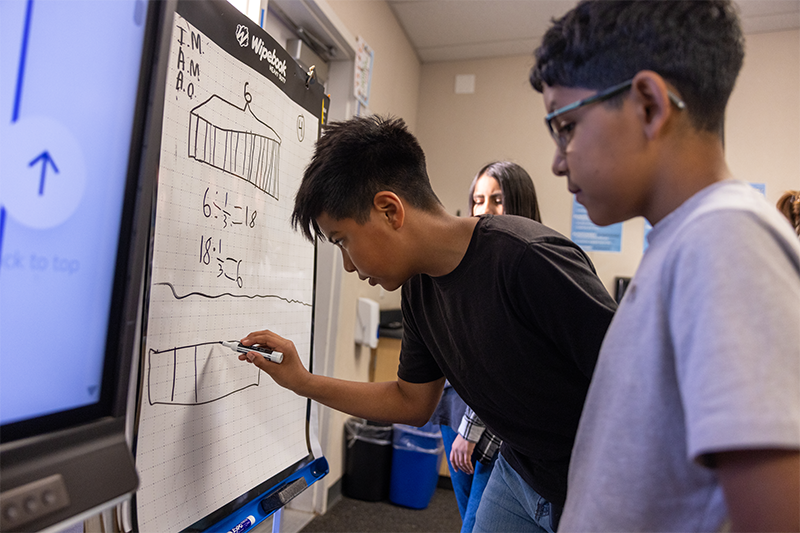
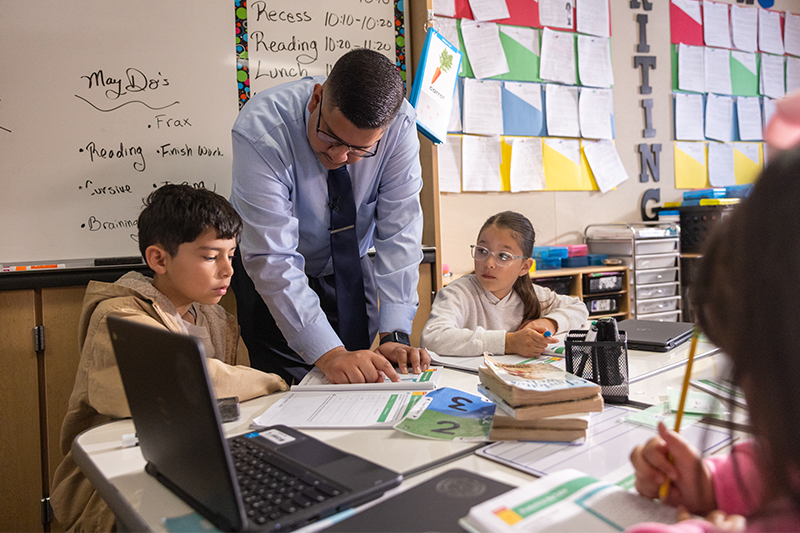
student solving math equation

Applying CGI to Online Learning

When designed with research-based principles in mind, online programs have the ability to increase accessibility to effective instruction. For example, the following characteristics of various online programs provide the flexibility to support CGI practices.

  • Adaptive Learning Environments: Adaptive learning environments powered by algorithms can provide students with a personalized learning experience that caters to their unique needs and preferences. By analyzing a student’s performance and feedback, online platforms can generate customized content tailored to their strengths and weaknesses. This approach to learning aligns with CGI’s emphasis on personalized education, which recognizes that every student has a unique learning style and pace.
  • Virtual Manipulatives: Utilizing virtual tools, such as base-ten blocks, offers students an interactive experience to experiment with variables and visualize outcomes. This approach enables them to select the appropriate device that aligns with their current understanding and apply critical thinking and creativity to solve a given problem.
  • Real-world Problem Solving: Online platforms can offer practical problem-solving exercises that mirror real-life challenges. This approach aligns with cognitively guided instruction’s emphasis on applying mathematical concepts to everyday situations. By bridging the gap between theory and practical significance, students can gain a deeper, contextual understanding of mathematics and its relation to the world around them.

By incorporating CGI practices with online platforms’ capabilities, we can anchor each student’s learning experience in student-centered, data-driven instruction.

The Idaho Study: A Snapshot of Research-Based Technology in Action

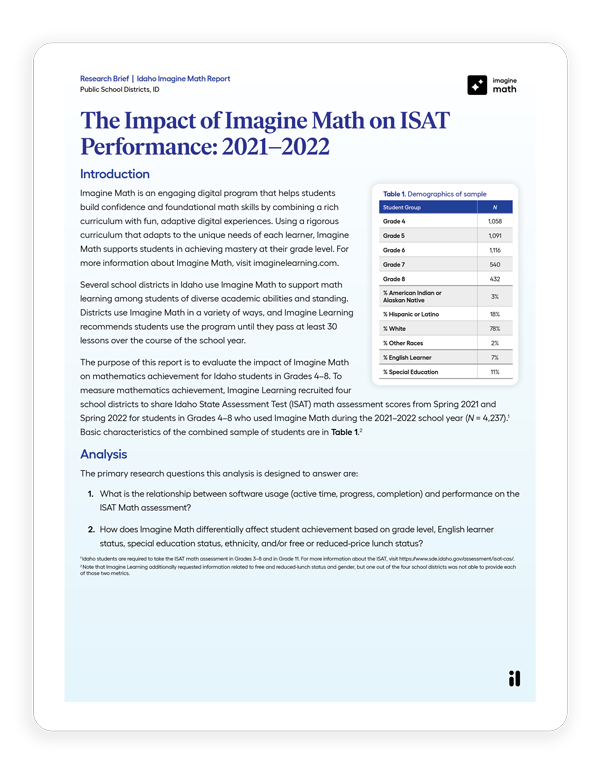
Imagine Math ISAT Performance Research Brief
Read the Full Study

Imagine Math is one supplemental, personalized online program that incorporates the features highlighted above. It presents students with problems, equips them with virtual tools, and adapts its levels of support in response to students’ answers. “Imagine Math’s personalized learning platform aligns with each student’s needs while providing the right amount of challenge to help the student achieve grade-level proficiency,” said Sari Factor, Chief Strategy Officer at Imagine Learning (New Study Reveals Significant Gains in Student Math Performance with Imagine Math, 2023).

This year, a study was conducted to assess the impact of Imagine Math on students’ academic performance. The study analyzed over 4,000 math assessment scores from the Idaho State Assessment Test (ISAT) of students in grades 4 through 8. The assessment scores were taken from schools across four different districts in Idaho during the 2021-22 academic year. Key takeaways from the research include:

  • The relationship between Imagine Math lessons passed, and ISAT score growth is positive for all grades and statistically significant for grades 4 through 7.
  • Positive and significant relationships between Imagine Math lessons passed and ISAT math score growth for various student subgroups, including special education students, English learners, students eligible for free or reduced-price lunch, and Hispanic/Latino or American Indian/Alaskan Native students.

These findings underscore the potential of platforms like Imagine Math that align with student-centered methodologies to enhance student outcomes.

The Future of Math Instruction

In today’s rapidly evolving society, education has significantly shifted due to technological advancements and a more comprehensive understanding of how individual students learn. By leveraging technology that incorporates research-based instruction, educators can create a more engaging and effective learning experience for students, leading to better academic outcomes and a more promising future.

About the Author – Erin Springer

Erin Springer is a former elementary school teacher who transitioned to supporting other teachers as a Professional Development Specialist at Imagine Learning. She is enthusiastic about helping teachers use educational technology to improve student outcomes, save time, and understand students’ needs.

Citations:

Carpenter, T. P., Fennema, E., Franke, M. L., Levi, L., & Empson, S. B. (2014). Children’s Mathematics: Cognitively Guided Instruction (2nd ed.). Heinemann.

Imagine Learning. (2023, June 20). New Study Reveals Significant Gains in Student Math Performance with Imagine Math [Press release]. https://www.imaginelearning.com/press/study-reveals-significant-gains-student-math-performance-imagine-math/

September 7, 2023 10:21 am

Soft Skills with Big Impact: the 4Cs of STEM

Make STEM classrooms a playground for curiosity, a canvas for creativity, a stage for communication, and a hub for collaboration. When students embrace these skills, they’re not just preparing for the future — they’re shaping it.

“Hey Siri, how many rings does Saturn have?”

“Alexa, tell me what the square root of 1089?”

“ChatGPT: give me HTML code to embed a basic calculator on a webpage.”

There was a day when students had to ask their teachers, librarians, or even consult an encyclopedia for this type of information. But those days are long (like really long) gone, and the teacher is no longer the only keeper of information in the room.

Since the teacher’s role is evolving due to new technologies, and certainly students are not motivated to memorize what Alexa already knows, what should STEM classrooms be focused on? What skills are employers in STEM careers looking for if ChatGPT can produce code for free?

A 2018 survey by the Association of American Colleges & Universities showed, “that just 34 percent of top executives and 25 percent of hiring managers say students have the skills to be promoted. Many of those skills are soft skills — communication, team work, problem-solving — that are critical in a quickly shifting job market. Entry-level skills change every few years; it’s the habits of learning to learn and navigating the ambiguity of a career that will prove most valuable to undergraduates in the long run.”

The National Education Association has boiled these soft skills down to the 4 Cs: Creativity, Critical Thinking, Communication, and Collaboration. Let’s explore why these 4Cs are critical to providing a modern STEM education that gives students real career opportunities.

1. Critical Thinking: where curiosity begins

Imagine a classroom buzzing with questions. Except, not fact-based “how many rings does Saturn have” questions. Questions like: is it possible for New York City to become carbon neutral? What would that plan look like? Or: why does the kind of water (fresh or salt) affect how long it takes an ice cube to melt? That’s the power of critical thinking at work. It’s all about encouraging young minds to ask, “Why?” and “How?” Critical thinkers don’t just accept things at face value; they dig deeper. When students learn to analyze information, separate facts from opinions, and spot patterns, they become problem-solving heroes.

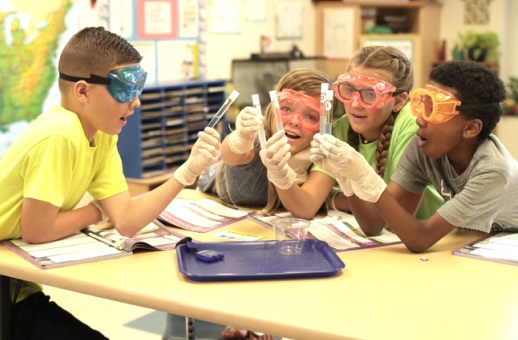
Picture a group of students exploring a science experiment. Instead of just following a set of instructions, they’re asking themselves, “What will happen if we change this variable?” That’s critical thinking igniting their imagination — it’s like a spark that lights up their learning journey.

2. Creativity: where imagination takes flight

Creativity isn’t just for artists — it’s a skill that every STEM student needs. It’s about looking at a problem from a different angle and dreaming up new solutions. Think of it as the magic wand that turns ordinary ideas into extraordinary ones.

Take a moment to think about a famous inventor, like Thomas Edison. He didn’t just stumble upon the light bulb; it took him 1000 attempts to find a design that worked. Creativity is what made him keep going, even when things got tough. Encouraging our students to think outside the box, to come up with wild ideas, and to believe that they can change the world — that’s the heart of creativity in STEM education.

3. Communication: bridges between minds

Imagine a world where nobody understood each other. It would be chaotic, right? Communication is like a bridge that connects our thoughts to the world. In STEM, it’s not enough to have brilliant ideas; you also need to share them effectively.

Think about a young engineer who designs an amazing new gadget. If they can’t explain how it works to others, their idea might never see the light of day. Teaching students how to express complex ideas in simple terms empowers them to inspire, collaborate, and bring their innovations to life.

4. Collaboration: teamwork for triumph

Remember the saying, “Two heads are better than one”? That’s the spirit of collaboration. In a world where problems are more complex than ever, working together is key. Collaboration is like a puzzle; each piece has its role, and when they come together, they create something amazing.

Think about a group of students working on a science project. Some are great at designing, others excel at research, and a few are natural leaders. When they pool their talents, their project becomes a masterpiece. It’s the same spirit that built the tallest skyscrapers and sent humans to the moon.

Putting the 4Cs into action

Imagine a classroom where students use their critical thinking skills to solve a real-world problem. Maybe they’re designing a water-saving system for their school garden. They brainstorm creative ideas, like using rainwater and self-watering plants. Then, they work as a team to build the system and explain their design to their classmates. These students are embracing the 4Cs in action: critical thinking, creativity, communication, and collaboration.

Empowering educators for success

As educators, you’re the guides on this exciting journey. You hold the keys to nurturing the 4Cs in your students. Encourage them to question, to dream, to share, and to work together. Make STEM education a playground for curiosity, a canvas for creativity, a stage for communication, and a hub for collaboration.

When students embrace these skills, they’re not just preparing for the future — they’re shaping it.

Imagine Learning STEM

Prepare the next generation of STEM leaders with digital and hands-on learning aligned to the 4 Cs.

Tell Me More

About the Author – Carolyn Snell

Carolyn Snell started her career in education teaching first grade in San Bernardino, California. A passion for the way technology and stellar curricula can transform classrooms led her to various jobs in edtech, including at the Orange County Department of Education. Her knack for quippy copy landed her a dream job marketing StudySync—an industry leading ELA digital curriculum. Now, as the Senior Content Marketing Manager for Imagine Learning, Carolyn revels in the opportunity to promote innovative products and ideas that are transforming the educational space for teachers and students.

Breaking the Cycle of Math Anxiety

Listen on Spotify
Listen on Apple Podcasts

Math Therapy with Vanessa Vakharia

In this raw and personal conversation, math therapist, educator, and author Vanessa Vakharia taps into the trauma behind Lauren’s lifelong math anxiety and helps her understand just how much it shaped her identity. Together, they explore what it will take to move past the idea of being a “math person” and how educators and students alike can build a healthier, more human relationship with math.

Vanessa: Should we be pushing people to become a “math person”? Math identity isn’t just about math. It’s about what math means in relationship with all the other identities we hold.  

Lauren: You have struck me speechless. 

Lauren (voiceover): I have math anxiety, and statistically, you probably do, too. From Imagine Learning, I’m Lauren Keeling, and this is Heart Work, an honest profile of America’s educators.  This time, we’re investigating math anxiety, why it’s so widespread, and what it will take to break a cycle that spans generations. 

For as long as I can remember, math has made me feel small. So I came to Toronto to meet with Vanessa Vakharia, a math educator and tutor renowned for helping people rewrite their relationship with math. I’m hoping to understand where this anxiety comes from, not just for myself, but for the teachers and students who carry that same fear every day, and maybe help all of us leave some of it behind. 

Lauren: It’s really valuable and so important for us to be here in Toronto, where Vanessa has built the soul of her work. This is where the heartbeat happens, where she talks to people about math therapy. It makes all the difference in the kind of conversation we want to have. 

Vanessa:  Oh, my God. It’s so good to meet you. Woo! Are you ready for some math therapy? 

Lauren: I’m ready. Let’s do some math.  Vanessa, it’s so exciting to be here. Your space is really beautiful. 

Vanessa: I’m so glad you’re here. 

Lauren (voiceover): I feel my nerves starting to fade as Vanessa shows me her studio and opens up about her own struggles with math. 

Vanessa: So I wanted to design my space like my favorite place to do math. Back in the day, I failed math twice at my regular, traditional school, and then I went to this school, and it changed my life. 

There was so much about it that changed my life, but one of the key things was that the building was not like a school building. It was this office building. You walked into it, and you would take this elevator to get to class. The whole energy around it was different. There were plants. It didn’t feel like a school, and because of that, I felt more able to sink into a new learning experience instead of bringing previous baggage with me, because our physical experiences often bring up old memories. 

So I wanted to design my space like my favorite place to do math. Getting rid of the idea that math is a solo sport. 

Lauren: Yeah. 

Vanessa: Right? You don’t have to be antisocial when you’re doing math. You can be hanging out with your friends. You should never have to sacrifice your identity to be a doer of math.  You can sit on the couch with your tutor and do work. 

Lauren: Really lowers the pressure. 

Vanessa: Lowers the pressure, and again, you should be able to feel comfy and cozy and relaxed while doing math. Those two things should not live in opposition to one another. All of our senses are a part of our learning experience, so we should be comfortable.  

Lauren:  Yeah. The vibe just feels so good and so warm in here. But what I am really curious about are these boards. Why is something like this important? Why not just grab a bunch of paper and work at the table?  

Vanessa:  Yeah. Well, I’ve always been a really big fan of whiteboards on walls. When we have a non-permanent surface, it gives kids the feeling like, “Oh my God, mistakes are expected on here.” 

Lauren: And what a difference that makes for children to be able to have a math conversation.  

Vanessa: You can just bring your whole self in here. So do you want to sit down, have a tea latte, and talk math? 

Lauren:  Let’s go. OK, Vanessa, welcome to Heart Work.  

Vanessa: And Lauren, welcome to Math Therapy.  

Lauren: I’m nervous. 

Vanessa: OK, so this is actually a really good starting point.  I actually am curious. Your anxiety that you think you’re walking in here with is around math. Can you pinpoint what you’re nervous about?  

Lauren: Failure. I am terrified that you’re going to ask me to do math today, and my entire body is going to lock up, and my brain is going to freeze, and I’m not going to be able to produce anything for you.  

Vanessa: First of all, I am not, I’m not going to whip out a timed test.  So let’s go with this. So your literal fear is that I’m going to ask you to do math, and you are going to freeze. You’re not going to be able to produce anything.  

Lauren: Yes. 

Vanessa: OK. 

Lauren: And I’m afraid it’s going to be really basic math. Because it doesn’t matter what level of math it is, if you ask me to produce it and if you put a time capsule on it, I actually would probably melt into the couch. 

Vanessa: Here’s my question to you. If I asked you what eight plus eight was and you couldn’t get it, and your fear came true, your fear, which is that you are going to lock up, you’re going to be unable to produce, you might even get the wrong answer, and even worse, on a public forum… 

Lauren: Yes. 

Vanessa: Like, people are listening. What would that mean about you?  

Lauren: That I am a failure, that I am a dummy.  

Vanessa: When was the first time you felt this way?  

Lauren: In first grade. It centers on those timed tests. That’s when we started doing flashcards.  I see Mrs. B walking down the aisles, and she sets this paper down in front of me that I have just finished, and it is full of red Xs. And that very moment is the very first moment that I can recall in my life feeling like I wasn’t very good at this thing, and that something was wrong with me. And then it happened again, and then it happened again. 

Vanessa: OK, so that sounds, first of all, very, very hard. And I can feel the emotion coming out of you as you talk about it. It’s really interesting, right? You said it was a core memory, but then the evidence is that you literally remember every detail. 

Lauren: I do.  

Vanessa: You remember what she was wearing, you remember how you felt. Can we talk about the mathematics content? So you got the stuff wrong, you got the red Xs. Forget the timed test. Were you able to, in a non-timed situation, do what was on the paper?  

Lauren: Perhaps not perfectly or well, but I felt like I had the time to be able to count on my fingers. I could do touch math.  

Vanessa: The world’s OG manipulative everyone.  

Lauren: I had to do it a completely different way from the very straightforward way that my teacher was doing it up on the board. 

Vanessa: Got it.  So there are a few really interesting things, which is that, just from a theoretical point of view, and like a scientific point of view, it’s really important that we hang onto this moment for a second, because this is years and years, this is decades later. Decades later. 

Lauren: Decades later. 

Vanessa: Decades later, and your body remembers that experience — it does. And actually, with math trauma, and any sort of micro-trauma or macro-trauma, our bodies do go back into the state we were in when we had the first traumatic incident. So I actually want you to just give yourself some grace. 

 We’re going to talk about this more later, but remember that now, every time you’re faced with math, you are back to being that six-year-old. It’s not just made up. That is what’s happening, and how can you possibly perform mathematically when you feel like you can’t access your working memory?  Your amygdala is being hijacked. You’re back in that trauma memory. And I just want to reflect back, there’s a part of you that’s like, “Even though I’m able to work this stuff out, and get the result and get a good grade, it doesn’t actually count, because I’m not doing it fast enough. I’m not doing it the way everyone else is.  I’ve got to use these tools no one else is doing, so it doesn’t actually count as me being good at math.”  

Lauren: Yes, I had to figure out, I had to draw the pictures, I had to make the circles. You know, I had to do all of the different strategies.  

Vanessa: And is that not being good at math in your mind?  

Lauren: No, it’s not being good at math, in my mind.  

Vanessa: And why? 

Lauren: Because there’s one way to do math. My childhood teaching tells me there’s one way to do math, and if you have to do all of this extraneous stuff to get there, you’re not doing it right. 

Vanessa: Yeah. 

Lauren: One pathway. But can I tell you one more big piece of math trauma… 

Vanessa: Tell me whatever you want, yeah. 

Lauren: …that lives in my grown-up life? From a career perspective, I’ve done a lot of different things, and when I transitioned out of my very first job as a journalist and moved into — I decided that, because we were raising girls, I needed a different schedule in my life. I wanted to be a teacher. My mom was a teacher. I knew I loved kindergarten — my heart was called to it. 

I had to go back to school and get my master’s degree, but then came the really difficult part, because in Ohio, where I was getting certified, I had to take four different tests in the core subjects, right? So math, reading, science, and social studies. I went to take my math Praxis, and I’m sitting in this little quiet room, and these sweet ladies are on the outside of the glass, and you know you’re not allowed to talk when you’re taking those tests. 

Vanessa: Sure. 

Lauren: You’re in your little cubicle. So I’m working through this test, and at the end, I fail it — this big test that’s going to allow me to get my certification.  And I fail it by just a very minimal number, less than 10 points.  And I was super disappointed, but I knew I could take it again. So I went back to my tutor, and we bought all of the Math for Dummies books and practice Math for Dummies books, and we studied through all of those.  

Vanessa: Probably in retrospect, not a good name. 

Lauren: Terrible name, I know.  So we did all of those books, and I went back, and I took that test again the second time, and I was really trying to focus my brain on, like, “You can do this. This is a really important thing to you. You have the skill.” And I failed it again.  

Vanessa: OK. 

Lauren: By this time, the ladies on the other side of the zoo glass are invested in what I’m doing as well, and they were disappointed for me. So I’m going to do it again. I’m going to do it a third time. We’re going to do all the same stuff over again. We’re going to keep practicing. I failed it by two points  on the third time. I had one more chance to take it.  

Vanessa: This is so stressful. So stressful. Were you stressed in there? 

Lauren: Yes. 

Vanessa: OK. 

Lauren: By the third time, I was not — I was not well taking that third test. Because the real-life, grown-up pressure was on this. This was a career. I was making a huge shift away. I was taking a chance. This was… the only way I could get a job to teach is if I passed this thing. 

After all of that, on the fourth test, I did pass, and I barely passed, and I loudly celebrated in my quiet cubicle in the space you’re not supposed to talk. 

And the ladies outside the zoo glass celebrated when they saw my arms go up, because we were just all living this moment of, like, here’s this poor girl who has come in here 1,000 times and just keeps missing it by a mark. 

So all that to say, that was just another grown-up moment for me that proved, in my mind, that small thing that I knew that I was missing when I was doing that math: that if I could have just done it the way they taught me to do it, and I didn’t have to do all of the other stuff to get to that answer, I would’ve been quicker, I could’ve had more time to check my answers, and I probably would’ve passed. 

Vanessa: So there’s a lot that’s sort of knitted into that. OK. Like — I don’t love it, but this totally makes so much sense. 

Lauren: I believe that deep in my soul. Even knowing what I know today, even having the experiences I have today, teaching children math as a kindergarten teacher, working with teachers to pick and put out a curriculum in our district — even knowing all the things I know today, I still, in my soul, when I dig down deep and think about math for Lauren Keeling, there’s only one way to solve that problem, and you’re not doing it right. 

Vanessa: This is so interesting, because when I work with teachers, I often — I do a lot of talks around defining failure and success, and I find educators, very often, will have this idea of success for the people they lead, right? Either the teachers they work with or their students, and they’ll be like, “Success is just trying and failing.  It’s showing up. It’s whatever,” but their standard for themselves is always completely different.  

Lauren: Yep.   

Vanessa: Right? And it definitely sounds like that for you, because off-screen or mic or whatever, you and I were talking, and you were saying that one of your deep core beliefs is that there are multiple ways to learn things and do things, and even if in math you’ve got to get to the one answer, there’s so many ways you can do it, and all of those are equally valuable, and now it seems like you’re just completely gaslighting yourself. 

Lauren: But not for me. 

Vanessa: Yeah, not for you. 

Lauren: Everyone else in the world can have their own voice to get to mastery, but for me, nope, there’s, there’s one way, and I don’t know how to do it.  

Vanessa: OK.  

Lauren: So fast forward. I got my licensure. I was hired, thankfully, to teach third grade, and the books in third grade are amazing.  They’re so fun to teach, but do you know what else you teach in third grade? 

Vanessa: What? 

Lauren: Fractions.  

Vanessa: Oh my God, do you love that? 

Lauren: I hate that. 

Vanessa: Cool.  

Lauren: Deeply. 

Vanessa: So what happened? 

Lauren: So I taught fractions, and I’m air-quoting that I taught fractions.  

Vanessa: Why are you air-quoting?  

Lauren: Because I just had to read directly from the book, because that was a style of math that I didn’t understand until I started failing forward at cooking and using measuring cups. 

 Fractions finally started to make a little bit of sense for me in my 30s when I was practicing it that way, which would’ve been a great strategy to bring into my classroom for the students. 

Vanessa: Yeah, I don’t want to be sarcastic and snippy, but I’m like, “Oh, wow, when you encountered the thing in real life, and it was actually relevant, it made sense.” Like, shocking. 

Lauren: Not separate and apart and using strange things in a book? 

Vanessa: Yeah. 

Lauren: Yeah. So as soon as I — third grade, the children were wonderful, the books were great; fractions were horrible. I was panicked every day that I was destroying math futures for children because I myself was uncomfortable teaching fractions, and I felt like there was just no possible way that wasn’t somehow seeping into a child in the classroom who was also finding it to be a little confusing and uncomfortable. And so I only spent one year in third grade, truly because I just could not torture myself through teaching fractions. 

Vanessa: Yeah. 

Lauren: And I got out, and I started teaching kindergarten.  

Vanessa: There are probably a lot of teachers listening that feel the exact way that you felt in grade 3. 

Lauren: Yeah. 

Vanessa: What would you tell those teachers? What would you say? 

Lauren: It’s hard as a first-year teacher to feel like you’re doing good work in any space, because you’re just figuring it out, and then it’s also extra hard when it’s something that you’re not confident in yourself.  And if I separate myself from how Lauren Keeling felt, and I look at you as the administrator that I became, I would say, “We’re going to figure it out together.” 

Vanessa: Oh. 

Lauren: “And I’m going to give you all the supports that you need, and I actually know a teacher just right across the hall from you who is really doing great work teaching children fractions and can maybe support you in this.” 

 As a grown-up who has had great people in her life and who has raised daughters and lived in the world, what that person needs is just really what you’re doing for me right here, providing an opening for them to talk about it and think about it and actually connect to what the real root issue is, and then how do we figure it out?  You love third grade. Let’s pretend that that’s what it is. You love third grade.  

Vanessa: Oh, I cannot imagine teaching third grade. 

Lauren: This is the space you want to be in. Tons of people are cut out for third grade, and that’s where they want to be. Math is hard, and that’s not going to change, but you’re smart. You’re a teacher. You passed all these hard tests. You’ve done all of these things, and you have a really big heart for helping these children figure it out, so let’s also have a really big heart for you figuring it out, and let your heart be big for yourself to figure it out.  What kind of grappling work can we do to get there? How can I help you?  

Vanessa: We’re going to need, once this is done, for you to play back to yourself. To the third-grade teacher you were, I wish someone had said that to you.  But also, I fully support being like, “I don’t want to torture myself.” 

Lauren: Yeah. 

Vanessa: We are adults. 

Lauren: Yes. 

Vanessa: Ok? We get to choose now. We don’t have to do anything we don’t like. 

Lauren: Yeah. 

Vanessa: Right? So you are fully able to be like, “I, actually, this…” Like, there are tons of things I do where I’m like, “I could do this, but it’s going to take a lot of work, and I don’t want to put in that work,” or, “This is going to make me miserable, and I don’t want to do it.”  It doesn’t mean I don’t think I can do it, but I think that is a bit of the difference. And you, as an administrator, and all the administrators listening to this, you probably have teachers that you are leading who feel this way. I think this is really important to hear. You’re not the only one who thinks this. 

 Like, I think math can do that, because math is so weighted, and it gives people such visceral experiences, often negative, often so identity-based, because we do use it as this identity piece, like you’re either a math person or not, that we can use it to leverage this incredible identity shift with people. 

Vanessa: Most of us learned that failure is really bad at some point. Definitely, failure in school is really bad, and so math was this perfect storm for you… 

Lauren: Yeah. 

Vanessa: …that has formed this childhood protector part, as IFS would say, that now lives within you and wants to make sure you never feel that way again. 

But the core story is untrue. Because your core story is, “Unless I do math in this specific, exact way, I can’t be good at it. And if I’m not good at it, I’m a failure.” 

In our society, math is the thing we associate with intelligence. 

Lauren: Yes. 

Vanessa: Right? 

Lauren: Yes, absolutely. 

Vanessa: Like, we don’t call Picasso smart. We don’t call LeBron James smart. When you’re good at math, you are smart. 

Lauren: That’s so true. 

Vanessa: I don’t want to make this gendered, but my master’s thesis was called Imagining a World Where Paris Hilton Loves Math, and it is specifically about women in math. 

Lauren: That’s a fantastic title. 

Vanessa: It was about media representation of mathematicians and of women, and how so many women self-select out of mathematics because they feel like there’s no room for their full identity to merge with the identity of a mathematician. 

Lauren: Yeah. 

Vanessa: There is a lot of research around this. So it’s not — you know, I bring it up because women tend to be so much harder on themselves than they are on those around them, and this is a large reason we see a discrepancy when it comes to gender and mathematics. 

There’s a whole range of things behind that, but this is one of them: this idea that if you can’t achieve perfection, then it means that you are a failure, and there is nothing worse than being a failure, so you stick to the things you’re good at. 

Kids know that. They know that they are literally one wrong answer away from getting written off. And I hope you’re seeing these major themes coming out — that math symbolizes so much more for us, right? It symbolizes what intelligence is. 

Lauren: Yes. We just bought a house. We were talking all about mortgages, and numbers, and percentages, but I certainly didn’t want to have any hands in trying to actually do the numbers, and think about the numbers, and look at the numbers. 

It just, one, made me super nervous, because what if I got it wrong? 

I just hated the fact that even if I were going to sit down and try to suss those numbers out and figure out what it might or could be, I could be wrong, and that could have given us a poor picture of what we were going to do, right? 

That’s like an actual risk. So there are real consequences connected to the math that I would be responsible for doing, or thinking through, or putting on paper and actually sharing today. 

And so when I say I feel indifferent, I feel indifferent because I’m just saying, “OK, someone else can figure this out. I can put this on someone else’s plate who is going to get it right because they are math smart, and I don’t have to worry about the outcome.” 

If I do it, we have to worry about the outcome, because we’re going to have to look at it with a magnifying glass and have somebody else check my work, right? 

Vanessa: My goal with anyone — even with students — is, I don’t need you to go into STEM or do math. I actually really do not care. I care that you believe that you could if you wanted to or needed to. That’s actually what I care about. 

Right now, you’re not in a position to be figuring out mortgages, right? 

Lauren: Right. 

Vanessa: Like, you have math trauma from grade 1. You don’t like it. It sucks. And there’s someone who can do it. So really, there’s nothing — I don’t want us feeling bad about that. 

You don’t need to be doing your own math. It’s like when somebody uses a calculator. I’m like, “Don’t feel bad about it.” Maybe you just didn’t feel like thinking about it in the moment. 

I don’t care what you’re doing. I just want you to know you’re capable of doing it. 

Again, when I was talking about my master’s thesis, the big finding from that was that for the girls that I was working with, in order to become math people, it meant they had to shed the identity they had. 

For example, a lot of them were cheerleaders. We have never seen a cheerleader represented as being good at math in the media. The two are opposites. 

We all know the movie, right? Like, you’re either the cheerleader who needs the smart girl to help her with math, and then you give the smart girl a makeover, and then she’ll be, like, whatever. 

So there was a very big identity conflict. These girls were great at math. They were getting 90s. They were getting As in my grade 10 classroom, but they were like, “We are not good at math.” 

And when we really dug down to it, it was kind of like this conversation we’re having here, where the proof — the evidence — was that they were good at math, but it was like, if they became good at math, did they have to let go of something else? Did it mean that they had to engage in different behavior? 

And I think we really disregard identity. You know, we talk about math identity a lot, but I think we’re missing a very key component of math identity, which is: How does math identity — like, in the Venn diagram of identities — intersect with our own identity? 

Is it diametrically opposed to it? What happens, right? 

Math identity isn’t just about math. It’s about what math means in relationship with all the other identities we hold. 

Lauren: You have struck me speechless. Which has never happened in the history of this podcast. 

Vanessa: I don’t believe that. 

The problem is, what being a math person also means, whether we choose to accept it or not, is things like: you don’t like creative things. 

Like, think about every stereotype of what makes a math person. You definitely don’t like music and the arts. You’re a logical thinker. You’re boring. You always get the right answer. You sit and study all the time. There’s so many things the term means. 

So the problem is, I’m not surprised when you’re like, “You know what? Kind of being not a math person is part of my core identity.” 

I think that it’s a really interesting question to ask, because the question is: Should we be pushing people to become a math person? Or is it perhaps counterproductive to our goal, which is to — like, my goal is to show every single student that they can build a better relationship with math. 

It’s for people to just feel capable, and to be like, “Hey, you know what? I’m capable of more than I thought I was, including these fractions.” 

But my agenda is not to be like, “No, you need to call yourself a math person.” I hate labeling in general, so why are we now using this as a label? 

Lauren: I don’t have to become a math person to just be able to do math. 

Vanessa: Exactly. 

Lauren: I even think about that from a school perspective: to release children from — and teachers from — the idea that they have to be this person or that person. 

Vanessa: Why are we doing that? Ew. 

Lauren: And it’s OK to like math, and it’s OK to like reading. But to like those things does not make you that person. 

Vanessa: And to like those things doesn’t mean all of a sudden you have to go into a STEM career. 

Lauren: So what is it, Vanessa, that you do? What did I come here needing from you today? 

Vanessa: I mean, you should probably tell me that. We shouldn’t speak for you. 

I think that the number one thing people need, in my experience, is validation. 

They need to feel validated. They need to see that they’re not alone. And the reason I like to always start opening the conversation — and whenever I do a talk, I do this — is I frame it as, “I would like everyone to think about whether they’ve ever had a negative experience with math.” That’s my number one teacher move, and we did it here today. 

The reason that can be so groundbreaking for people is when they start talking about it, which you did, right? And I hope for you it’s really empowering because it shows you that you were not born with these feelings. You developed these feelings, right? Emotions encode experience. When we have an experience that is very emotional, we remember that experience. It forms a memory that is very hard to let go of. 

Neuroscience shows us that the percentage of people born with a natural aptitude for mathematics is so small. You know, when you think about a prodigy or something like that — though it exists — the percentage is so, so, so, so, so small. And other than that subset of people, math ability being something that you are born with — like nature versus nurture, the nature part of it — it is so, so, so small in terms of its effect on your future math ability. 

And the biggest predictor of math ability is nurture. It’s practice. 

Have you read Outliers by Malcolm Gladwell? 

Lauren: No. 

Vanessa: Oh my God. What? OK. No, stop. OK. This book, it’s about the most famous hockey players, the most famous mathematicians, the most famous musicians — the ones that you would believe, like, they must have been born with exceptional ability, they’re so good at it. 

And he did all this research and found that the one thing all of these people had in common — they had one thing in common — was that they had all spent over 10,000 hours practicing their craft. 

Lauren: Wow. 

Vanessa: And if you think about it that way, to put in 10,000 hours, it would help if you started at a young age. It’s a lot of hours to put in, right? 

So often, we conflate nature and nurture because the conversation would be like, “Well, from a young age they were so good at this thing,” but it would often be someone who was tinkering with the piano when they were three years old. 

Or, you know, Eugenia Cheng talks about how her parents would read her math stories at night. Instead of story time, they had math games. Like, we have been shown time and time again that nurture plays a larger role, yet we love — we love the juicy story of people born with this crazy thing, and it also gives us an excuse to be like, “Well, I just was born at a deficit.” But it’s just not true. 

Lauren: So tell me how this feeds into the work that you do. 

Vanessa: OK. So I feel like I wrote Math Therapy after years and years and years of, you know… I think if you talk to most teachers, they’re like, “Yeah, I’m doing therapy in the math classroom,” right? 

Lauren: Sure. 

Vanessa: Like, a lot of the work I’m doing is really therapeutic. So I wrote it after years and years and years — over 20 years of teaching and tutoring and working one-on-one with kids — and really realizing that the number one thing, I mean, I’ve had so many different types of students in this space, and the number one thing that makes a difference is actually not whether they’re taught through the algorithm or not, or with worksheets or not. 

I mean, those things matter, but the number one thing that mattered was actually the therapeutic element of interacting with them. It was doing stuff like this. It was having these conversations. It was so emotional. 

One of the biggest strategies is when somebody says they feel bad at math or they’re not good at math, I often start arguing with them. I’ll be like, “But you’re doing math. But you do this. You took down the Christmas tree — that’s math. And what I’ll find is what they actually really mean is, “I wasn’t good at school math.” Like, “I wasn’t good at the math that got graded, that got evaluated.”  

So I want to sit with you, and we’re going to actually do a little skills analysis, OK? 

Lauren: OK? 

Vanessa: So I want you to name me math skills — math skills or things that are math. So I’m going to write one thing on here. I’m going to say mental math, OK? Give me one. 

Lauren: Uh, addition. 

Vanessa: Addition. OK, great. I’m going to say baking. 

Lauren: Planting my garden. 

Vanessa: What do you do? 

Lauren: Making my rows, figuring out the distances and the distances between each of my flowers that I’m planting. How do I do that? The depth of putting the bulbs in the ground. I use… 

Vanessa: Oh, do you use a ruler? 

Lauren: I use non-standard measurement — my arm — but I told you I love non-standard measurements. 

Vanessa: No, but that’s really good. OK, good. 

Lauren: So yes, it’s gardening. 

Vanessa: Planting a garden. Now, if I had a student who felt bad at math, I would do this with them, and then I’d be like, OK, I would look up how these tied to the content I was teaching right now. So I’d be like, “Planting a garden. Here are all the units that I’m teaching this year. Tell me exactly how this ties in.” Why would I do that? Because you, Lauren, are sitting here being like, “Yeah, I guess I do this math, but I didn’t really qualify it as math.” In your mind, I bet you’re like, “It doesn’t really count.” 

And that is where we start seeing that it is not math that’s the problem. It’s the way we are treating math in a school setting that is ruining math for everyone. You were never graded at this, and that is the only thing that counts. 

OK, so now I’m going to give you this. 

Lauren: OK. 

Vanessa: And I want you to, with this pink pen, circle anything you feel good at. 

Lauren: I feel good at? 

Vanessa: Yeah. 

Lauren: Well, planting a garden is first. OK. 

Vanessa: And you feel satisfied after or something? 

Lauren: I do. I feel really great after I plant my garden. Just the way that it looks like it fits in the space. That’s a real puzzle to me that I love putting together. 

Vanessa: Put puzzles on the list. 

OK, so I want us to look at this. We have 19 items on here, and you circled one, two, three, four, five, six, seven, eight, nine, 10, 11. Eleven out of 19. Over half of the things on here you circled, OK? 

I would now like you to look at this and ask yourself, do you believe everything you circled has some sort of mathematical component? 

Lauren: I do. 

Vanessa: You’ve circled a lot of math stuff, and there’s a lot of stuff you circled that I wouldn’t be able to circle. Does this change in any way the way you feel about your math ability? And you can say no. I’m just curious, looking at all the math things you circled. 

Lauren: It does, because it’s what I think… I don’t think about sneaky math. So for me, sneaky math is where… 

Vanessa: I’m sorry, pardon? 

Lauren: Sneaky math. Where we’re looking at angles and thinking about putting together my garden or arranging my furniture. I’m not actively working and manipulating numbers. Sneaky math. 

I don’t mind putting my garden together because I don’t actually have to come into contact with numbers when I’m doing it. 

Vanessa: I fully get what you mean. One hundred percent. 

Lauren: Measuring and baking is sneaky math. It’s sneaky math. I didn’t realize I was doing fractions until I had a moment where I thought, “Wait, three quarters of a cup is the same as a…” 

Vanessa: If we made more sneaky math — can we call it implicit math, just for what I’m going to say? 

Lauren: Sure. 

Vanessa: It’s going to sound like more of a mic drop. OK, so if we made more implicit math explicit, more people would realize how much math they were doing and how good they were at it. 

Lauren: Yes. 

Vanessa: Think about how much discussion we can now be having with kids. And kids are like, “Oh my God, well, I do this,” and then just like we were, we’re like, “OK, well, what about this? And what… OK, fine. If you’re going to say baking, I’m going to say measuring.” 

Now we’re realizing how much math we’re doing. 

For a lot of kids — and probably for you a little — you’re like, “OK, but it’s not feeling like it’s… I didn’t say algebra, and I didn’t say sine and cosine.” So we do want to tie it to the things we’re doing in our curriculum and the content we’re teaching. We do want to tie it in and give it that language. That really helps. 

As we’ve established, on this sheet here, you have so many math superpowers that I don’t have, and every single person has these latent math skills — these, sorry, implicit sneaky math skills — that are not necessarily brought to the fore. 

And part of what you were saying earlier is you felt like you weren’t good at math because you weren’t doing it the way you were supposed to or the way other people do it. And what I want everyone to know is that is actually your math superpower. 

When you’re planning the garden, you’ve made up this whole method, right? You have all these skills that not everybody in the class has, and in a classroom of students, you are going to have kids who have all circled different things on this page, and that is not bad. 

That is the blessing in it — to be like, “Guys, look. You all have these different skills, and in our room combined we have 30-plus math superpowers. We all have something different to bring to the table.” 

It also helps create this collaborative environment where instead of kids competing with one another, you can be like, “Hey, you need help with that? Well, Sally circled this thing. Their math superpower is problem-solving. Go talk to them about this.” “Oh, you need help with counting? Didn’t somebody…” Right? And so everyone is now not competing with one another, but realizing that the whole is greater than the sum of the parts. 

OK, the last thing I wanted us to do is on your phone. 

Lauren: Yes. 

Vanessa: Open up Duolingo. They have now added math as a language. 

Lauren: OK. I see that. 

Vanessa: So add math to your thing. Great. Do you want to do a lesson right now? 

Lauren: Sure. 

Vanessa: Oh, OK. We’re now suddenly doing math. OK, go for it. I’m not even looking. OK, keep going. OK. I think there’s only a few. It’ll take like one minute. But you do that. See how it goes. 

Lauren: While I’m working on this, tell me: is this a practical strategy for parents and teachers? 

Vanessa: The reason I love it is, when we go into avoidance with math — like you were saying, you avoid math… 

Lauren: I do. 

Vanessa: …we’re not going to get better at something when we avoid it. That’s just how life works. 

Lauren: I’m doing really well. 

Vanessa: Sorry, I can’t hear my voice over all the loud bings and bops happening from Lauren’s mastery of mathematics right now. 

So it’s three minutes a day, and it starts building confidence. But more than that, it rewires the thing in your brain that you have, which is: “When I do math, a horrible thing happens.” 

Whether you get the answers right or wrong on the app, you’re seeing that when you do math, a horrible thing does not happen. Actually, a really joyful thing happens. 

And even if you get something wrong, you’re just going to try again the next day. 

When we have math anxiety, we get stuck in the anxiety-avoidance cycle, and we are never going to get out of it unless we break the cycle out of avoidance, which means we need to do some math. And it’s a great way to do math. 

You are really crushing here. 

Lauren: I’m really doing a great job. 

Vanessa: What is happening? OK, we’re almost done. 

Lauren: Yep. I pulled something out of this that you just said… 

Vanessa: Yeah. 

Lauren: …that Duolingo’s doing. Math is a language. 

Vanessa: Right? Can I just tell you what they added? They added math and music. Those were the two new languages, and I was like, again, this is a language issue. 

Lauren: It is a language. 

Vanessa: It is. 

Lauren: And it is OK for language to be hard to learn. 

Vanessa: Preach.

Lauren: I think I’m done. I don’t feel stressed because I… 

Vanessa: I’m done here. I’m finished. 

Lauren: Well, I’m a learning legend. 

Vanessa: Is that what it says? 

Lauren: Uh-huh. 

Vanessa: OK, so every day, just do it for two weeks and see what happens. 

Can I just point out that you just not only did math, you did math while we’re all actually kind of now impatiently waiting. At this point we’re on the third battery. I am staring at you. You actually were talking at the same time, and you’re being recorded. You did not seem stressed. 

Lauren: Landing on the fact that math is a language… 

Vanessa: That’s crazy. 

Lauren: …that we speak is a big deal for me personally as a learner, as a teacher, as a thinker. 

It lifts, releases, throws away, pushes out the window a lot of the pressure around just having to show up and be good at it, because we don’t expect anyone to show up and just be good at a language. 

We teach really explicitly and thoughtfully and with full hearts. It’s the same with math. 

Math is a language. 

Vanessa: Should we just end with a Duolingo beep being like, “Good job”? 

Team: Yay! 

Vanessa: Should we crown Lauren? Oh. There you go. There you go. The unicorn of understanding. Oh, I love it. There she is, our queen. Our math queen. 

Lauren: Oh, I do love a crown. 

Lauren (voiceover): Being in Vanessa’s space, having really heart-to-heart conversations about what that work looks like, sounds like, feels like, what inspires it, what changes it — it makes all the difference. 

Sometimes it’s so nice to be in a different area too, because it allows me personally, and our team together, to just take a breath and recenter on what it is that we’re doing and why we love the work that we love. 

Travel can sometimes be stressful, but in moments like this, where we’re in a city like Toronto surrounded by water and snow and the beauty of the season, it also gives us a moment to kind of step back and relax. 

Return to Collection

About the Host

Lauren Keeling is a seasoned education professional with a unique blend of experiences. A former broadcast journalist, elementary teacher, and principal, she now combines her passion for education with her love of storytelling at Imagine Learning. Above all, Lauren is a dedicated literacy advocate pursuing a doctorate in Leadership with a focus on Public and Non-Profit Organizations to further her impact on education nationwide.

An image of Lauren Keeling.

Join the Club

Breaking the Cycle of Math Anxiety

Listen on Spotify
Listen on Apple Podcasts

Part 3

In the third and final episode of Lauren’s personal journey, she explores how students experience math. From classroom practices to wider school systems, what needs to change to make math feel less isolating? Featuring Building Thinking Classrooms creator Peter Liljedahl, National Math Improvement Project director Hillary Rinaldi, Imagine Learning’s own Kallie Markle and daughter Winter, and curriculum specialist Sam Murro Shea.

Sarah (Math Coach): We were in a meeting with administrative personnel within our district. And I basically said, if we don’t change our curriculum, I can no longer do my job. 

(Music) 

Teacher: OK, so how many trips would that take? How would we get there to 96? 

Student: It would take 12 trips. 

Teacher: 12 trips. So you’re saying 8 times 12 is 96? 

(Music) 

Kirsten (Director of Elementary Education): What we were doing before wasn’t working. It felt like the teacher was doing all the heavy lifting, and our kids just were there to kind of absorb it somehow. We knew we needed to do something differently. 

(Music) 

Teacher: Do we agree with Christian? I see some people agreeing with him. 

Student: I have a different strategy. 

Teacher: OK, Isaac. 

Student: Can I come up? 

(Music) 

Arti (Principal): Our teachers have made great strides, and the kids are learning, the kids are definitely learning. And now they feel comfortable going through that struggle or that process, and it’s just the norm. 

It’s an unfortunate truth that the US ranks lower than we’d like in mathematics globally. Thirty-fourth in the 2022 PISA rankings. And while many districts across the country are rethinking how math is taught, for many students, math still feels like something to endure. 

In 2025, a RAND study asked middle and high school students if they found math interesting. Only a quarter said they did. But it was another finding from this study that caught my attention. The students who stayed engaged were those who believed they could do it — specifically, they identified as math people. And by now, we know that identity doesn’t form in a vacuum.   

I’ve spent months looking at my own relationship with math. But this doesn’t end with me. Math anxiety is still being built and passed on routinely. And you don’t have to look very far to find it. When I told my colleague Kallie I was making a podcast about math anxiety, she told me I had to speak to her daughter. So that’s what I did. 

Kallie: Well, this is my daughter Winter. 

Lauren: Hi, Winter. Nice to meet you. 

Kallie: She’s 14, she’s in eighth grade.  

Lauren: Wow. What a time to be alive, girl. 

Winter: I guess. 

Winter is a capable, thoughtful student. But like a lot of teenagers, she measures herself against the people around her. I remember that feeling all too well myself. 

Lauren: How did it feel to not understand?   

Winter: Frustrating. I felt like everybody else understood, but I didn’t, and it was like, I’m just behind everybody else.   

Lauren: How were you when you were in these classrooms where it felt like that? How was it set up? 

Winter: We were just in rows, and we just had to do it by ourselves. You couldn’t really ask anyone for help, and then she’s just waiting for you to understand. It was just kind of like, I’ll tell you once, but you better be paying attention. 

Lauren: Are you confident? Do you feel like you want to be answering questions? Do you or are you hiding? 

Winter: If I’m like, “I don’t know if this is right,” I would not risk it because I don’t like being wrong. Even if I worked out the problem and I’m like, “I think I know it,” I still don’t raise my hand. I don’t really raise my hand that much because, I don’t know. She’s like, “Why didn’t you put that answer up?” I was like, “I don’t know. I didn’t want you to call on me,” because she makes everyone stand up if you have the answer. It’s so awkward, and if you’re wrong, you just sit back down in sorrow. 

Lauren: I think that’s the name of this episode. So, let’s say tomorrow we have promoted you to being a math teacher. What are you going to do to make sure that other kids in that classroom do not feel like 14-year-old Winter felt?   

Winter: I’d give them table groups so they could talk to other people and understand it together. And then I would make it so they’re comfortable asking me questions, so they don’t feel like, “Well, I’m confused, but I don’t want to ask.” 

Speaking to Winter, I don’t feel like I’m listening to someone who deep in her heart dislikes math. What she doesn’t seem to like is the experience of learning math in a specific way — in this system that makes it easy to feel lost and scary to risk speaking up. And when I talk to Kallie, her mom, I hear something familiar. 

Kallie: I’m not a math person, and so I’m not a big help to her either, but her dad is very math-minded, so she will work through her homework and, you know, ask him for help along the way.  He will write her more problems, and then he’ll write another version of the practice test that they can go through. 

Kallie went through school at roughly the same time I did, and like a lot of us, she came out of it with the conclusion that math just wasn’t part of who she was. Meanwhile, Winter is moving through a system that, in subtle and not-so-subtle ways risks teaching her the same lesson. So how can we break out of this? 

At NCTM — where this series began — Vanessa Vakharia was presenting a session with a professor of mathematics education and researcher Peter Liljedahl.  

Together, they asked a deceptively simple question: how do you build a math classroom that doesn’t produce anxiety in the first place?  

Their session brought together two perspectives that are central to what we’re looking at in this series: Vanessa’s work on math therapy and identity, and Peter’s work on what happens inside classrooms when students are asked to really think.  

Following my session with Vanessa, I want to speak to Peter to find out what it takes to build a classroom that interrupts the anxiety cycle. Sam, herself a huge fan of Peter’s work, joins the call, too. 

Sam Murro Shea: I was working in a school district as a math director, and I found Peter Liljedahl’s work by reading Building Thinking Classrooms during COVID. What a wild time that was to be in education. That book shifted how I thought about classrooms, not just curriculum, but really the conditions under which students are asked to think. 

That book is Building Thinking Classrooms, a widely adopted approach that reinvents the fundamentals of classroom design, from where students sit to how they collaborate and share their ideas.  

At math conferences, Peter Liljedahl’s sessions are standing room only. Educators like Sam line up to get into the room. 

The reason why is simple: his work focuses on practical, immediate changes that transform how students experience math.  

I wonder what he first saw happening in classrooms that made him feel that something needed to change. 

Peter Liljedahl: Anytime you’re in a classroom with students, you can sense that there is an unease. There’s a discordance between the goals of the teacher and the actions of the students, right? The teacher has the best of intentions for the students. They really want these students to do well. The students maybe are not equally motivated to do well. 

But what I was seeing in particular wasn’t that students weren’t performing, and I mean on tests. It wasn’t that students were unhappy, because that seems to be almost like a status quo in classrooms around the world. It was that they weren’t thinking. 

There’s a lot of what I eventually came to call “studenting,” which is what students do to kind of get through the lesson. They were engaged in lots of activity, and this activity was keeping them busy, but it wasn’t requiring them to think. 

There was some group work, but there was a huge emphasis on mimicking. And mimicking is that sort of, “I’m going to show you how to do it, and now you just do it.” 

Lauren: And if the classroom already feels uncomfortable for a lot of students, what happens when you make their thinking even more visible? 

Peter: So this is actually a really interesting question because some of the key features of a thinking classroom, for example, is you’re going to be put into random groups. So now you’re immediately thrust in front of peers.  

You’re going to be standing and working at a vertical whiteboard. So now you’re visible to everybody. You would think that this actually makes them feel more visible, which could increase anxiety, but it turned out, it actually did the opposite.   

So first of all, when they’re standing at the whiteboards, everyone’s standing at the whiteboards, and everyone is focused on their work. No one’s really looking at how you are doing. Now, that may not be something they’re aware of to begin with, but they certainly settle on that very quickly, and they start to realize that this whiteboard, although it is publicly available, is an incredibly private space, right? 

I know from experience that when a student feels like they’re the only one who’s not getting it, it’s extremely isolating. Peter says that if we change those conditions — if we make it apparent to everyone that the struggle is shared — then we change the experience. 

Peter: So the very first time they experience a thinking classroom is a sort of cacophony of emotions, I would say.   

For students who like math, this is exciting, right? For students who are really good at mimicking, this could be a little uncomfortable. For a student who is anxious, this could be really terrifying to begin with — I’m not going to deny that — but I think that’s true of any time a student walks into a classroom that has an unpredictable environment. 

Sam: Mm-hmm.  

Peter: Because if they’re anxious, what’s triggering for them is, “I’m going to be put in front of people, and I’m not going to know what’s going on.” Because what we have to understand is that seven-year-old Lauren’s experience has lodged itself in your memory and in your emotions, and that’s what’s coming forward — that trauma, right? 

When I am sending you to a whiteboard, what you’re not thinking about is the fact that everyone’s at the whiteboard. You’re thinking about that time that you had to go up and do something on the whiteboard in front of everybody else and got laughed at, right? But what happens very quickly after that first moment is that the student starts to realize that this is not that. 

One of the ways that I onboard a really anxious student is that I don’t force them to interact on that first day. I do require them to go to their group. They can stand like six feet back, and I actually give them a job. I say, “OK, your job is to go spy on your group. You don’t have to contribute. You don’t have to hold a pen. But I want you to stay there for five minutes and then come and tell me what it is that they’re saying.” 

And then as they tell you what’s going on, you just got to be so fascinated by this. “What’s happening next? Oh, can you go give me another five minutes and come and tell me what happens?” And you just keep doing this, right? And the second day, you do the same thing, and the third day, you do the same thing. 

Within seven days, there’s like a 95% chance that this student is going to say something to their group, and the minute they say something, that bubble is burst. And within three days, they’re holding the marker, and four weeks later, you can’t tell the difference between the student and any other student in the room. 

We didn’t allow them to opt out. But we sort of gently enabled them to opt in. 

My colleague Sam Murro Shea is in a rural district in Northern California. It’s early March. And she’s visiting two schools eight months into adopting a new approach to math.  

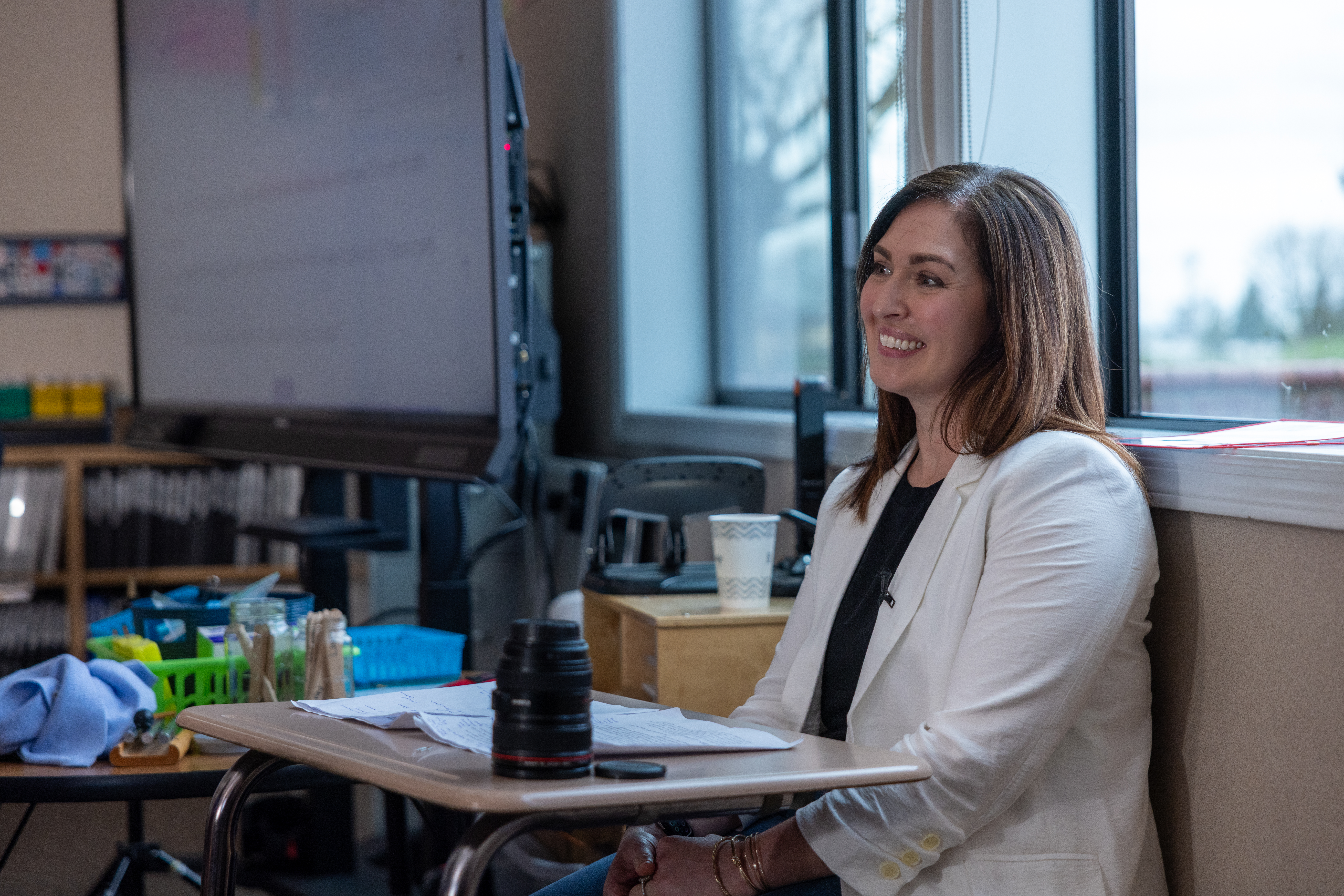
A woman in a white blazer sits at a desk in a classroom, smiling and looking to the side. A camera lens sits on the desk next to her, suggesting she may be involved in photography or videography. The classroom setting implies she could be a teacher or presenter, possibly giving a lecture or demonstration.

Sam observes a math class in Ceres Unified School District.

Sam: Hey, my friends, can I just take a quick little picture of this? Oh, you guys are the best. Hi, I’m Sam, by the way. 

One that emphasizes curiosity and real-world connections, with a focus on conceptual understanding.  

Teacher: OK, ladies and gentlemen, take a big, deep breath. Let it go. Alright, guys, come on in. 

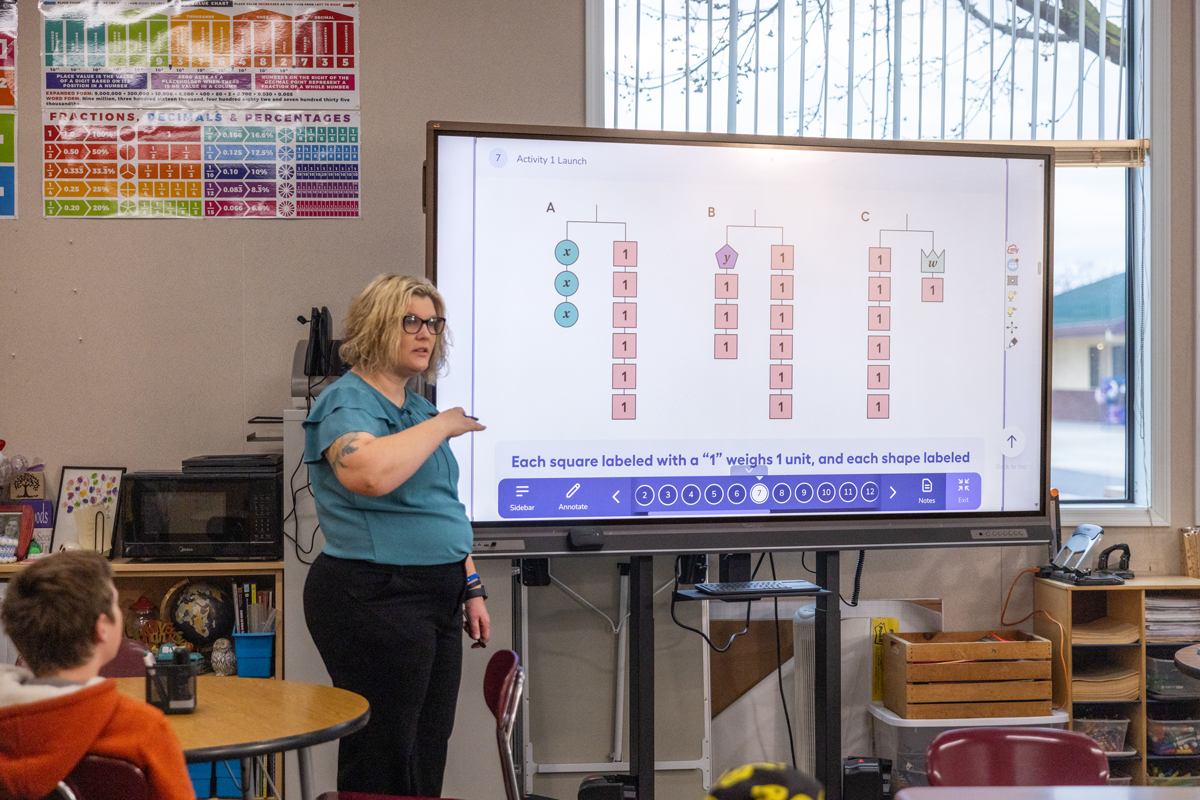
Female teacher in front of young students teaching from a smart board

Grade 6 teacher, Mrs. Woods, introduces the day’s lesson.

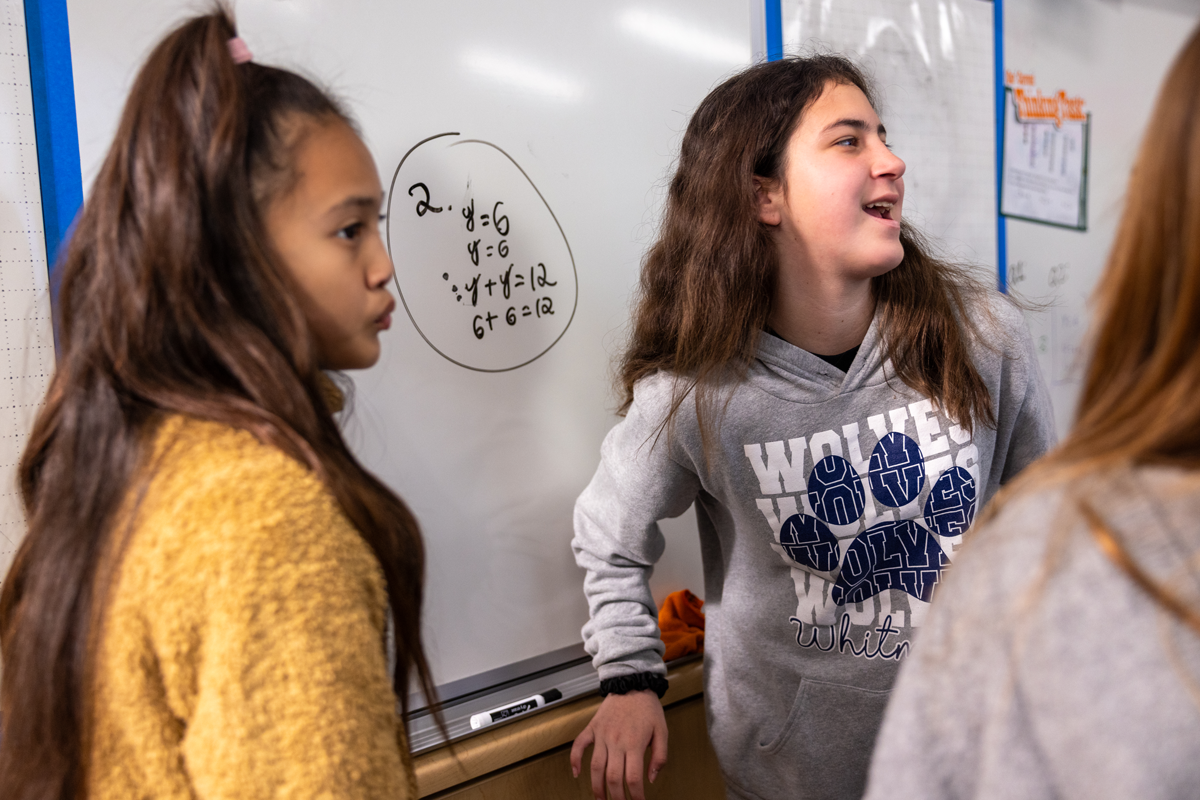
A group of female students solving a math equation on white board

A group of students solve equations at a vertical whiteboard.

Sam spends time in a 6th-grade classroom. Today, they’re solving equations using balanced hangers.  

Teacher: OK, ladies and gents, are you guys ready? If you get group 7…  

Lauren (to Peter): Which practices are most helpful in taking a student from anxiety to feeling like “I can do this”?  

Peter: Ironically, I think it’s random groups, but it can’t just be random on its own. It has to be random groups coupled with the teacher’s work to make sure that the groups are functional and that there’s respect, empathy, and so on and so forth. 

Another one that actually really works well at reducing anxiety is what’s called “thin slicing.” So thin slicing is how I start with a task that every single student can do, right? So that when they’re walking away from the launch, they’re already feeling like, “I got this,” right? And then we work our way up. 

The task gets a little bit harder and a little bit harder, and they’re still feeling in control. “Yeah, this is good. I got this, I got this, I got this.” And then on question number six or seven, they’re kind of like, “OK, here it is.” 

They know it’s coming, right? But in the meantime, they’re enjoying the experience. “Yeah, we’re high-fiving each other, we got this,” and then, all of a sudden, you hear the students go, “OK, here it is. Been waiting for this. OK, let’s roll up our sleeves. Let’s get to it.” 

And then they enter into a state that we call productive struggle. So it’s not, “Challenge them!” It’s, “I’m going to have you have some success, success, success, success. Here comes a challenge!” 

And in that guided way, they’re feeling really safe so that by the time they’re actually working hard and actually thinking and collaborating because they need each other, they are so full of confidence. 

We’re not just throwing these kids to the wolves. We are completely present, making sure that these experiences are positive. But the best thing that we could ever achieve in a classroom is when the students have walked out and they feel like they succeeded and they figured it out on their own. And our fingerprints are all over that, right? Like, we manufactured this completely, but they feel like they’re on top of the world because they did it, right? 

One of the things I always say is, “I want to create learning without footprints of teaching.” 

Sam: I absolutely love that because you really hit a couple of things really hard. It’s not just about making sure that the kids are thinking, but really changing how they feel about mathematics, which sometimes I think it’s more important, because when you feel like you’re capable of doing something, you at least go at attempting it. 

This kind of resilience and willingness to try was evident to Sam in the classroom, with students working through anxieties that might once have stopped them. 

Sam (to students): Do you guys ever get nervous about speaking out loud in front of your whole class?  

 Student: A little. 

Sam: What would make you nervous about talking about this problem?  

Student: It wouldn’t make me nervous talking about the problem. It just makes me nervous talking in front of everybody, and then everybody’s eyes are on me.  

Sam: But what great practice, because you’re going to do that like the rest of your life, right? 

I think back to some of those educators Sam and I spoke to at NCTM — people who’d grown up with math anxiety, but then turned it around to become successful, confident math instructors.  

Many of them talked about how they were able to make this transformation as adults through exposure to the kinds of practices Peter evangelizes in Building Thinking Classrooms.   

Michelle: Once the shift in mathematics happened, I started feeling more confident. When I first started, the first six, seven years were still rote memorization math. 

And then this new wave started coming in where we would get PD on learning the conceptual background and why we were doing the things we were doing. And I would sit there thinking, “Why didn’t they just say that? I could have figured that out. That I get.” 

I started, more and more, realizing that I did know the math. I just couldn’t memorize the math, and then I wanted to share that. 

For Michelle, going through that process herself — relearning the math — helped her better support her teachers.  

Michelle: So, giving teachers dedicated PD on actual math concepts, taking our math teachers and allowing them to learn the conceptual math, is vital. 

We start with tasks. We have the teachers go through the tasks. We have the teachers grapple with the task and start feeling what it feels like to not know what’s happening, to have that productive struggle, so then they know how the students are feeling. 

Christopher had a similar journey too — starting out believing he didn’t have a quote-unquote math brain, but then he found strategies that worked for him. 

Christopher: I know the strategies that help me, so I can help the students, and it has helped them.   

The process of understanding the problem to get to the answer is fulfilling, right? And because of that, I’m getting grades that are almost 90–100%. 

You don’t have to have a math brain, but if you have the strategies in place, you can achieve this for yourself. 

These stories, and Peter’s work, show what’s possible inside individual classrooms, but classrooms don’t exist in isolation.  

The way math is taught and experienced is shaped by the decisions districts make, the support teachers receive, and the systems students move through every day.  

Hillary Rinaldi is director of the National Math Improvement Project, a network of major school districts across the country working to rethink how math is taught at scale. Its focus is how entire systems can create the conditions for students to experience math differently.  

Math anxiety goes way beyond my own experiences, or Winter’s, or any of the many other people we spoke to for this podcast.  

I ask Hillary how much math anxiety is actually produced by the system that students have to learn in. 

Hillary Rinaldi: Math anxiety is kind of like the elephant in the room anytime you’re talking about math. We are hopeful that as we do all of these things, a byproduct of this work is that math anxiety can disappear. 

When we say, “What does the system produce?” I think what we know now about how brains function and how kids can learn math can both look different than it did when you and I were sitting in desks in rows. 

What I’ve never understood is this idea that, you know, if you say that you hated math in school, then you also want kids now to learn it in the same way that you learned it. 

What if we flip the question and say, “What are the things that are mitigating math anxiety? What are the conditions necessary to make those classrooms deliver on relevance, rigor, and joy?” 

Creating classrooms that reduce anxiety takes intentional design at every level of the system. And that starts with how we support the people at the center of it: teachers and school leaders. 

Hillary: I think the teacher and leader training is one of the things that can’t be missed. In our recent report about year zero in developing high-quality implementation of high-quality instructional materials, this is the first time that they have been focused on narrowing the instructional materials that are being used. Instead of leaving it up to schools to determine what makes sense in their classrooms, they can instead rely on the district to make those decisions. 

And then, of course, the teacher is still the person who knows their classroom best. It doesn’t take away from the individuality of the teacher and those students. It can’t all fall to that third-grade teacher to figure out, all on their own, how to support students in thriving in math. 

What Hillary is advocating is often called inquiry-based — or problem-based — math instruction. It starts with meaningful problems, often grounded in real situations, and asks students to make sense of them, rather than memorize a procedure first. The connection to anxiety is that when math feels connected to something real — something you can reason through — it stops feeling like a set of arbitrary rules you either “get” or you don’t.  

Hillary doesn’t want to abandon basics, but to build them differently, developing fluency and number sense alongside understanding, so procedures don’t just get followed, they make sense.  

I love these ideas. But I think about myself as a kindergarten teacher, when I only knew how to teach the way I was taught. Learning, or unlearning, something new felt so uncertain.

Hillary:  You’re not alone in being, especially as an early grades teacher or an elementary teacher, someone who was not super excited to be teaching math, right? And part of that is also a gap in our educator preparation programs. Very little math practice or pedagogy is baked into our elementary ed coursework. 

Part of this comes from the adoption of high-quality instructional materials, right? As teachers are preparing to actually implement new materials with integrity, we know it takes more than just unboxing, right? 

To me, it’s quite simple. We need teachers to also be doing the math, right? And part of doing the math means that there’s more than one way to do it. And if there’s more than one way to do it, we have to give our students the ability to test and fail and replicate. 

And this idea that, you know, being fearful of making mistakes is the antithesis of math. Doing math inherently means that you are making mistakes. That’s actually the whole point. 

The challenge of the elementary teacher to re-release that cognitive load to their students is challenging because it’s not what you expected to be doing, maybe, as a teacher, and it means you don’t always know exactly where the class is headed. But we know that our students are going to be more successful if we give them that time and space to explore, not to be in an unproductive struggle, but to ask: How do we support all students with the scaffolds that we can bring in to make math both relevant and rigorous, but I think most importantly, enjoyable? 

There’s an idea that keeps coming up in these conversations — with Deborah, Vanessa, Peter, and now Hillary. 

Joy. Enjoyment. 

At the beginning, I would never have connected those words to math, but now I understand what they mean. 

Hillary: The more instances I have conversations with students that say they really enjoy math class, that they’re having fun in math, that they like what they’re doing, or even if it’s not their favorite subject. 

Part of that is because of these shifts in pedagogy and practice where math is more engaging, right? Where it is students working in small groups or working with technology-enabled solutions that are really targeted to either catch them up right or accelerate their learning.  

What LAUSD did last summer with their Algebra 1 courses, they actually used prisms VR and put students into a virtual reality setting to engage in math in a not just procedural and conceptual way, but also in spatial reasoning.  

When you’re connected to your body and seeing what’s happening, predicting the LA fires based on logarithmic functions, it’s both checking those boxes of extremely relevant to the student, maintaining that rigor of aligned to standards, but also making it fun, right?   

Time and again in my math anxiety journey, and yet again listening to Hillary speaking, I keep coming back to something simple.  

These math classrooms I’m discovering are not only more engaging, but they also leave more room for students to be human: to try something and be wrong, to not get it right away without feeling like they’ve already failed. 

Peter: What math anxiety does is it prevents students from stepping into possible identities. If we can reduce the anxiety or eliminate the anxiety, these spaces open up again. And now these students can move forward. But the same is true of teachers, right?  

They can move forward into who they see themselves as, and this is really, really important to remember that a student who sees themselves as mathematical will have a different vision of their future than somebody who sees themselves as math-avoidant, right? So that’s really important.   

Every experience in this series, from my little six-year-old self to the teachers at NCTM, to Vanessa’s students, to Winter – has started with the same feeling: I hate math, math is hard, and it makes you feel alone. 

Hillary: In my opinion, the connection and the community are really all that matter. One of the greatest myths that we’ve told students about math is that math is something that happens while you’re sitting at a desk in silence alone with a paper and pencil, right? That is not how mathematicians or engineers or anyone who’s in STEM works, but more importantly, it’s not how any human works.  
 
When’s the last time that you were grappling with something and you’re like, I know how I’ll solve this. I’m going to sit alone and talk about it to myself. Like, that’s just not how we function. 

But avoiding math put me back on the inside with the not-math people group. 

Hillary: Community can be built around all disliking the same thing, but I actually think it’s much more compelling when we build community around the things that we’re most proud of and the things that can actually help us all grow and learn together. 

I realize now that becoming a “math person” was never really the point. I am a learner of things, and that includes math.  

And I wonder what I would have done differently as a math-anxious kindergarten teacher and elementary principal if I had known how to bring community into the math classroom.  

Not every child is going to love math, and that’s okay, but they deserve to build their own relationship with it — one rooted in joy.  

And not just step into the one that we had. 

This episode of Heart Work is produced by Justyna Welsh, Anise Lee, Danny McPadden, Steven Smithwhite, and me. Editing and mixing by Fraser Allan. Artwork by Kate Clough. Our executive producer is David McGinty. Music is from Universal Production Music. Special thanks to the Ceres Unified School District, the educators who spoke with us for this episode, and to our contributors Sam Murro Shea, Peter Liljedahl, and Hillary Rinaldi for your expertise and passion. And an extra special thanks to my colleague Kallie and her daughter Winter. 

Heart Work is brought to you by Imagine Learning.

Return to Collection

About the Host

Lauren Keeling is a seasoned education professional with a unique blend of experiences. A former broadcast journalist, elementary teacher, and principal, she now combines her passion for education with her love of storytelling at Imagine Learning. Above all, Lauren is a dedicated literacy advocate pursuing a doctorate in Leadership with a focus on Public and Non-Profit Organizations to further her impact on education nationwide.

An image of Lauren Keeling.

Join the Club

May 27, 2026 5:21 pm

Rethinking Screen Time in the Classroom 

How districts are refining the role of technology in instruction 

As conversations around screen time grow louder, educators are being asked to reduce device use while still delivering meaningful, effective instruction. This post explores what actually helps in the classroom and how schools can support teachers with the right mix of tools, curriculum, and flexibility.

If you’ve been in a staff meeting recently, screen time has probably come up.  

Teachers and administrators are grappling with whether classroom devices are helping students focus or pulling them away. In one lesson, technology might support a quick check for understanding before a discussion. In another, it’s a room full of open tabs and drifting attention.

Not all screen time looks the same. There’s a difference between social media outside of school, passive consumption during class, tools designed around engagement alone, and tools that actually support learning. These gaps often get overlooked.

The focus is primarily on what happens during the school day, even though students are spending far more time on screens outside the classroom, usually in ways that have little to do with learning.

All photos are from real Imagine IM® classrooms

That broader context is part of why the conversation keeps coming up in different ways, but it usually lands in the same place: teachers want tech that actually helps, even as they’re being asked to reduce screen time. 

When large districts like Los Angeles Unified start changing policies, it tends to bring those same questions into staff rooms everywhere. But rather than moving away from technology entirely, schools are being more selective about what stays in the lesson. Time is tight, and if something is on a screen, it needs to earn its place. 

What’s actually being asked

At a high level, the debate can sound familiar: not all screen time is the same, and not all tech tools are created equal. But in practice, those differences are often blurred.

In classrooms, though, the distinction is more immediate. Some tools help a teacher reach a student who’s stuck or falling behind. Others keep students occupied but don’t move learning forward, even if they look engaging on the surface. You can see the difference in how students respond: whether they’re thinking, trying again, asking better questions, or simply clicking through.

That’s why the conversation is shifting. Schools are being asked to reduce ineffective screen time while still making room for tools that support instruction in meaningful ways. Part of the challenge is that not all technology brought into classrooms was designed with instruction at the center. In some cases, tools were adopted quickly, without a clear role in the day-to-day learning process.

What hasn’t changed is the importance of strong instruction, high-quality curriculum, and the role educators play in guiding learning every day. When technology works as intended, it fits into that system. When it doesn’t, it competes with it.

So the question isn’t “does technology have a place in the classroom?” It’s “what actually helps, and how does it support teachers in making crucial decisions in real time?”

For us, that comes down to a few things: technology should be purposeful, grounded in high-quality curriculum, and integrated into instruction in a way that supports what teachers are already doing.

What this looks like in practice

Most educators don’t need convincing because they’ve seen both sides of tech firsthand.

They’ve had lessons where a digital tool empowered a student, and others where it fell flat. They’ve seen moments when technology helped a student stay engaged and keep trying, and moments when it became a distraction that stalled the learning process.

That’s why this conversation is about being deliberate, rather than using more or less technology.

In practice, that often means moving between digital and offline work. A teacher might use a digital activity to check understanding, then move into discussion, written work, or small-group instruction. The learning doesn’t stay on the screen, and it isn’t meant to.

What matters is how the pieces work together to support the lesson.

That can (and should) also look different depending on the grade level. In earlier grades, it makes sense to use technology sparingly, focused on building a foundation for durable skills. This will scale up throughout upper elementary and middle school to heavier use in high school, understanding that the closer students get to college or career, the more their command over intentional AI use, virtual collaboration, and analysis of digital sources becomes critical.

How we’re supporting educators at Imagine Learning

At Imagine Learning, our role is to help teachers navigate that reality, not to add to the noise. We start with a simple question: does this solution actually help teachers do their job? That means being intentional about when technology is used, and just as intentional about when it isn’t.

Designing for how classrooms actually function often means giving teachers flexibility to move between digital and offline instruction without losing momentum.

Across our programs, that flexibility is built in. Print and digital components are developed together, not as separate add-ons, so technology supports instruction instead of driving it. In the classroom, that might look like:

Using a digital activity to surface misconceptions in real time

Transitioning into a printed task or collaborative work to deepen understanding

Using insights from digital work to guide small-group instruction or reteaching

This ensures the tool doesn’t drive the lesson. The teacher does.

Grounded in high-quality curriculum

It also means focusing on the quality of what’s being used rather than just the format.

Across our portfolio — from core curriculum like Imagine IM® and StudySync® to courseware like Imagine Edgenuity® — instruction is grounded in research-based, standards-aligned content that stands up to passing fads. Lessons are designed to build understanding over time, whether they’re delivered through print, discussion, or digital interaction.

Technology plays a role in that process, but it isn’t the center of it. High-quality curriculum and proven pedagogy come first, and when those are missing, no amount of technology can compensate.

It’s also important to recognize that not all tech use serves the same purpose in education. In some cases, it’s supporting day-to-day instruction in the classroom, where questions about screen time and engagement tend to come up. In others, it’s making access possible in ways that wouldn’t otherwise exist.

Supporting the full instructional process

Supporting teachers also goes beyond the tool itself. That’s something the broader edtech space hasn’t always fully addressed.

Through Imagine School Services, districts can access certified educators, tutoring, and implementation support that help extend and reinforce instruction, whether learning is happening online, in person, or in a blended model. The same idea is true for courseware. For students who need access to courses their school can’t staff or flexibility to stay on track, digital delivery is the solution.

And through ongoing professional learning and implementation support, we work with educators to ensure digital tools are used in ways that make sense for their classrooms, not in isolation, but as part of a broader instructional approach.

Because even the best tools won’t make a difference if they don’t fit the realities teachers are working in every day.

Built for flexibility, not uniformity

No two classrooms look the same, and they shouldn’t have to.

What works in one setting, subject, or student group may not work in another. Our goal is to support that variability by giving educators options, not prescriptions. We equip them to make informed decisions about when to use digital tools, when to step away from them, and how to connect everything in between.

Where the work continues

The debate around screen time isn’t going away. But the work ahead is becoming clearer: supporting teachers with the tools, materials, and flexibility they need to make the right call in each moment. Because in the end, it’s not about more screen time or less. It’s about what actually helps students learn and making sure teachers have what they need to get them there.

If your team is working through these questions, it’s worth taking a closer look at what’s making a difference in classrooms and how your tools and materials are supporting that work.

Kinsey Rawe 

Executive Vice President & Chief Product Officer at Imagine Learning 

Kinsey leads product innovation at Imagine Learning, leading the development of digital tools that empower educators and students. His vision is shaped by a deep understanding of how technology and AI can enhance learning across diverse environments. Before joining Imagine Learning, Kinsey developed content management, learning management, and student information systems. 

Introducing IL On Demand 

Imagine Professional Learning

A unified experience for professional learning and product fulfillment 

IL On Demand is a new portal designed to give customers greater flexibility, visibility, and control in one connected experience. Access professional learning through annual subscriptions, standalone courses, and flexible token-based options — all within a single platform that supports both live and on-demand learning. Customers can also manage how physical and digital products are fulfilled and shipped, creating a more seamless experience across Imagine Learning services.   

IL On Demand

Clever Integrations Now Available in Imagine Sonday System 

Imagine Sonday System

Streamlined sign-in and automated rostering help educators and students get started faster

Educators can now access Imagine Sonday System digital accounts through Clever. Streamlined sign-in and automated rostering reduce time spent managing access, help your students enter sessions sooner, and keep data accurate. Full ClassLink integrations are planned for July 2026. 

Learn More

Imagine+ Math K–8 Solution Coming Back to School ’26

Imagine Plus Math

Personalized math practice, intervention, enrichment, and live tutoring in English and Spanish 

Imagine+ Math is a new K–8 supplemental solution designed to help your students build grade-level math skills and extend their learning. Assessment-driven pathways, customizable assignments, and On-Demand Tutoring in English and Spanish support targeted instruction and real-time help. Preview the Implementation Guide to plan for successful use. 

Learn More
Imagine Plus Math Implementation Guide

Breaking the Cycle of Math Anxiety

Listen on Spotify
Listen on Apple Podcasts

Part 2

In the second episode, Lauren heads to Toronto for
math therapy with the Math Guru herself, Vanessa Vakharia.
As she analyzes where her relationship with math went wrong and why it left her so anxious, she begins to realize that math itself was never the problem. So where does the anxiety really come from? Featuring Vanessa Vakharia, My Mathematical Mind founder Dr. Deborah Peart Crayton, and cognitive behavioral therapist Emma Fogel. 

Lauren Keeling: I’m nervous.

Vanessa Vakharia: What are you nervous about? 

Lauren: Feel my palms. 

Vanessa: You are like the guy in Love is Blind who has sweaty palms the entire time.   

Also, for the listeners who can’t see, she has handed me her palms, which are very sweaty, and in one of them she is clasping a little glass unicorn that she took from my Christmas tree. 

Welcome to the Math Guru mini chalkboard sign

Welcome to the Math Guru sign

Lauren Keeling and Vanessa Vakharia sitting on a crushed velvet couch

Lauren Keeling and Vanessa Vakharia sitting on a crushed velvet couch

So this is how I find myself in Toronto, sitting next to Vanessa Vakharia.   

Vanessa is known in the math education world as the Math Guru. She does math therapy — a phrase that, frankly, terrifies me. As far as my own math anxiety goes, avoidance is working very nicely for me. It certainly wasn’t in my plans to confront it head-on.  

But Vanessa’s studio doesn’t feel like a math space. There are plants, a piano, vintage furniture. We’re reclining on matching pink velvet sofas, beneath a crystal chandelier. The vibe is bohemian and tastefully glam.   

Oh yeah, and there’s a Christmas tree — even though it’s February. She says it’s common in Toronto for people not to take their trees down until winter starts to lift.  

At the center of everything sits Vanessa in flowing turquoise satin pants and a rust-colored velvet duster, her jewellery jangling as she moves. She looks like a rock star. She looks like she’s never been afraid of anything. I start to tell her what’s making me afraid right now.

Lauren: Failure. Terrified that you’re going to ask me to do math today, and my entire body is going to lock up, and my brain is going to freeze, and I’m not going to be able to produce anything for you.

Vanessa: I’m not going to whip out a time test.  

Lauren: OK (laughs). 

In the first episode, I learned that many people feel shame because of math. That they’re not really smart. They’re limited. Certain doors are just closed to them.   

I’m one of them, and I want to understand where those feelings came from and what can be done to turn math into a joyful experience, one that breaks the cycle of math anxiety passed down across generations. 

Vanessa: So when is the first time you felt this way?   

Lauren:  In first grade. I can very clearly pinpoint my beautiful, wonderful, and soft teacher, Mrs. B. 

In Vanessa’s studio, I repeat the memory I shared in episode one. Sweet Mrs. B. walking in her denim skirt to set my finished paper down on my desk. My shame and bewilderment to see all those red Xs. Big, giant, thick Sharpie-marker red Xs.   

That detail gets me every time I think about it, not because it’s dramatic — it’s not — but because it takes me back to being that child discovering, for the first time, that there is a thing everyone else seems able to do more easily than I can. 

Vanessa: This is decades later.  

Lauren: Decades later!   

Vanessa: Decades later, and your body remembers that experience. It does. And actually, with math trauma and any sort of microtrauma, our bodies do go back into the state we were in when we had the first traumatic incident. Every time you’re faced with math, you are back to being that six-year-old. 

That might sound overstated, but sitting here in Toronto as an adult, after all this time, gripping a tiny unicorn, I can feel something in my body responding. 

Vanessa: Your anxiety that you think you’re walking in here with is around math. You keep mentioning the time test, but you’re not actually talking about content. Can we talk about the mathematics content? Were you able to, in a non-time situation, do what was on the paper?   

Lauren:  I could, and perhaps not perfectly or well, but I felt like I had the time to be able to count on my fingers. 

Vanessa: The world’s OG manipulative, everyone.

Lauren:   So when we were sitting at our tables and learning in our classroom — which was a very individualized experience, it was not collaborative — I could use the strategy that worked best for me at the time, which was, “I’m going to count this on my fingers,” or “I’m going to draw it out on my paper.” And I could get to that, given whatever amount of time she was giving us in the classroom. 

So as long as I could actually draw it out or write it out or touch it out on my hands, I could get to the answer eventually. 

Vanessa:  Was there any intervention? Did you have a tutor? Because it kind of sounds like you were like getting away with it, in a way.  

Lauren: I was absolutely getting away with it. I was a good student. Yeah, in general, I did my homework. I did my work every day in class.   

Vanessa: You’re not failing math?   

Lauren: I’m not failing math.   

Vanessa: Like, are you actually doing kind of OK?    

Lauren: I’m doing OK. 

Vanessa: Oh, wow. 

“Getting away with it” is an odd phrase to use about learning. It sounds almost underhand, like I wasn’t doing math so much as avoiding being exposed as someone who couldn’t. But the moment where that falls apart is when the work becomes public. 

Vanessa:  Is your stumbling block in your mind? Is your core memory every time you have a time test or every time you have to do anything mathematically?   

Lauren: Anytime that I had to do, what I remember in my mind as performance math, so time tests were performance math. 

Vanessa: I love this term also.  

Lauren: Because it feels like what it is, right?  

Vanessa: Totally.    

Lauren: And then also, as I was a learner growing up, the practice was to solve things at the board by yourself. And then there was a competitive edge to that over time as well. So the teacher would call out a problem, you had to write the problem on the board, and solve it as fast as you could against the person standing beside you. 

Performance math. I realise that what I’m describing isn’t necessarily about a deficit in understanding. It’s a mismatch between ability and the conditions under which that ability is measured. In so many classrooms, math becomes less about reasoning and more about showing off speed of recall against the pressure of the clock.   

On top of the anxiety around performance, I realize there’s another fear for me: that letting go of math anxiety might mean letting go of a long-held identity that, in some ways, actually helps me. That in some ways I might actually… like. 

Vanessa: I did math therapy with someone last year. She had this moment where, after our first session, she came back the next session, and she was like, “Oh my God, it’s so crazy. I’m starting to notice all this math I am doing and, you know, starting to really rethink my story.” 

And then she goes, “I’m really nervous.” And I was like, “Oh, are you nervous about doing math?” And she was like, “No, I’m scared that I’m going to start seeing myself as a math person. It’s been such a core part of my identity. It’s like a loss.” Does that resonate? 

Lauren: That resonates so deeply. I made myself not a math person in a way. I chose it. It’s not a badge of honor, but it’s a club.   

Vanessa: It’s definitely a club. And if you don’t belong to the “I’m a math person” club, at least you can belong to the “I’m not a math person” club. 

Like, think about every stereotype of what it means to be a math person. You definitely don’t like music and the arts. You’re a logical thinker. You always get the right answer. You sit and study all the time. You can do things really, really quickly. You have quote-unquote natural ability. You never fail. You know, like, there are so many things the term means. So the problem is, I’m not surprised when you’re like, “You know what? Being “not a math person” is part of my core identity.” 

There is, undeniably, a social dimension to this identity. Saying “I’m not a math person” doesn’t surprise people. You don’t have to justify it. More often, it’s met with recognition — even relief. It places you in a category that is widely understood, one that carries its own set of assumptions about who you are and what is expected of you.  

And those expectations matter. If you are “not a math person,” then certain demands fall away. You are no longer expected to be quick, or confident, or even particularly engaged when it comes to math. The identity, in effect, does some of that avoidance work for you.  

But if this identity is offering protection and maybe even a sense of belonging, then anxiety itself may not simply be a problem to eliminate, but a response with a function. 

Not far from Vanessa’s studio in Toronto, her former student Emma Fogel is a social worker and cognitive behavioral therapist specializing in how anxiety develops in learning environments. I speak to Emma to get another perspective on this.   

Emma Fogel: What anxiety is at its core is an irrational fear, meaning that it is unlikely to happen, where a person overestimates the threat and underestimates their ability to cope. 

So, if we’re talking about this in terms of math anxiety, you have a person having an irrational fear: “Oh my God, I’m going to fail,” where they overestimate the threat. “I don’t understand this concept. I don’t feel comfortable raising my hand in class. I don’t want to make a mistake.” And they underestimate their ability to cope: the fact that they were in class, the fact that they did their homework, the fact that they may have a tutor, and the fact that they can go to the teacher. 

And when this becomes more of a chronic, long-standing issue or problem is typically when I say the anxiety starts to interrupt activities of daily life. 

Lauren: So the feeling is real, but what that feeling is preparing you for is distorted? 

Emma: Yes, when we’re talking about anxiety, it’s very normal for everyone to have stress, positive stress, and discomfort around homework, right? Or around having to write a test. But when it becomes more of an anxiety concern is that with studying or at the end of the day, with homework, there’s a high amount of avoidance.  

The child doesn’t want to do their homework. The child is not able to fall asleep or eat dinner, or wants to go to extracurricular activities, because they have to study. So it can present in sometimes over-studying and getting lost in the content of, “Oh my gosh, I can’t do this.” It’s too much. Do they study too much?  

It can present as a lack of studying, which both are sort of interruptions of activities of daily life. And also when you’re sort of seeing and interacting like I said, sleep, appetite, if they want to cancel activities or plans, if they want to avoid going to school on the day of a test, or can’t fall asleep and then sleep in the next day, that’s when I would say, we’ve got a feeling that is interrupting a child’s ability to cope or function in the world. 

Lauren: What does that lead to over time? 

Emma: A longstanding belief of: I can’t do this. It can build and manifest through a child’s years in school.  

Anxiety, what it looks for is, it wants things to be easy. It wants things to be comfortable. It wants things to be certain, right? So anxiety is a problem, and it presents in that it feels uncomfortable when things are difficult and uncertain. And so it will come up when subject matters become more difficult, when things don’t come as easily, and then it will build into this sense of, “Oh, I’m bad at math” or “I can’t do this.” 

When that sense of this feels hard in grade one, this feels hard in grade three, this feels way overwhelming in grade five or grade six. What that results in, again, is that anxiety is built sort of at the surface from encountering moments of discomfort over and over and not knowing how to cope or how to problem solve.   

And so if that happens in a chronic, long-standing way, and you know, the way that I present this to parents or educators is that every time a child encounters a situation of difficulty or discomfort, what the anxiety will do, is that voice in their head, it will say, “I can’t do this. I’m not good at this. This is too hard. I can’t cope.” And that plants a seed in that student or that child year after year. And so when we have multiple planted seeds, then those seeds turn into a bed or a garden that makes someone deep inside feel, “Oh well then maybe I’m stupid,” or “Something is wrong with me,” or “I’m not smart.” 

And that is sort of what results in that feeling of shame. Shame is often connected to there’s something wrong with me. 

Back in Vanessa’s studio, that idea surfaces in a more personal way. 

Vanessa: I think math is bringing out a side of you that clearly exists, where you feel like you have — if you’re not the best at something and doing something within expectations, then you are not good at it. And math just happens to be the medium for the message in a way.  

Lauren: Math was my first failure.  

Vanessa: It was your first failure.   

Vanessa: It feels like you felt like you were good at everything up to that.  

Lauren: I was six years old — I thought I was amazing.  

Vanessa: Which you are, but that has formed this childhood protector part that now lives within you and wants to make sure you never feel that way again.   

 But the core story is untrue because your core story is, “Unless I do math in this specific, exact way, I can’t be good at it, and if I’m not good at it, I’m a failure.” What’s the real core story? If you’re a failure, then what?  

Lauren: That’s such a deep question, and I don’t know what the outcome today for me is in that statement because I do not reflect on myself as a failure. I’ve tried tons of things and done tons of things and failed forward, as we like to say in the educational world. So that has become a part of my identity everywhere except for math.   

Vanessa: Do you only do things that you know you’re going to be good at?  

Lauren: No, I’m a terrible cook.  

Vanessa: And you’ll do it? 

Lauren: It’s not very good. And then we eat another meal, or my husband valiantly sweeps in and makes something delicious. Or we go get Sonic and have cheeseburgers and fries for dinner.  

Vanessa: And like, do you feel bad about yourself?  

Lauren: I don’t feel personally invested in cooking, I think maybe, but because I wanted to be so good at school, I felt so personally invested in my success in math.   

Vanessa: There is so much pressure on math because in our society, math is the thing we associate with intelligence. Like, we don’t call Picasso smart. We don’t call LeBron James smart.  When you’re good at math, you are smart. It’s obvious when we’re at school that the kids who are good at math are the smart kids, like the kids who are great at drama, who are the most incredibly skilled actors; we’re not calling them smart. You’re just not getting the clout from that. 

Vanessa puts into words a thought often taught indirectly: the smart kids are the math kids.   

That perceived hierarchy of intelligence was something that came up again and again in my conversation with Deborah Peart Crayton. She’s spent years listening to how the line gets drawn and how differently it holds in reading and in math. 

Dr. Deborah Peart Crayton: It was really interesting to interview folks and ask them about their learning journey with reading and mathematics, and to hear what the differences were in their experiences as learners.  

And oftentimes, the most common thing that actually became one of my themes was belonging or non-belonging. So in reading spaces, they all felt like they belonged, even when it was a struggle for them; teachers found ways to support them, even if they weren’t strong readers, they enjoyed listening to stories.  

So there were ways to continue to engage with reading, even when it was tough. But with mathematics, there is this idea that you get to opt out of math if it’s hard. You’re just not a math person, so you don’t need to keep going. You’re done. Math is over for you. The problem with that is it’s never over. 

Lauren: You said so many things that I am just reflecting on and thinking about. When I say I’m not a math person, people automatically let me off the hook and will do the math for me, which was wonderful. I never had to think about it. Like letting anyone else calculate the tip at the end of the meal. 

Deborah: The next time you go out to eat with those friends who say, “Just calculate the tip and tell me what I owe,” what I want you to do is take the total bill, add a generous tip, then divide it by the number of people at dinner minus yourself, and tell everyone what they owe. And you are going to have a free meal every time, because no one’s going to check your math. They’re just going to throw their credit cards in the middle of the table, and they’re just going to be so glad that you calculated the tip and they didn’t have to think about it. 

But let’s go to the beginning of the meal. How odd would it be if I, “the math person,” said, “Oh goodness, can someone please read this menu? My God, there are so many words. Ugh. I don’t really do words. I’m not a word person.” That would be ridiculous. Either we laugh, or you judge me, but either way, you wouldn’t let me off the hook and read the menu. 

Math is everywhere. It’s a part of life, and we eat, breathe, drink, sleep mathematically. And the crazy thing to me was that we are literally born “mathers,” and we can recognize patterns. We can recognize differences in quantity even as infants and toddlers. 

And you have to be taught to read in a way that you don’t have to be taught to math because even animals in nature are mathematical. So it’s just interesting that the thing that should feel most intuitive to us is kind of taken away by our experiences with others, with environments, and with failure. 

If we want people to start to feel more confident about their math ability and heal their relationship with mathematics, it starts with comfort. And we build comfort by having fun, by experiencing math in joyful ways, by recognizing the way that we’re already “mathing.” 

If math starts off being part of how we make sense of the world, then something must be getting in the way. Math hasn’t changed, but our experience of it did. 

Vanessa: Kids and adults are not afraid of math. We’ve kind of figured that out here, right? We — the things we’re afraid of are not being good at something, and being embarrassed, shamed, or feeling stupid. And then also, if you think about it, math in schools is entirely transactional. It’s like you need math to get somewhere. 

Vanessa: So there are some myths that go along with that. What makes somebody good at math? Like what are the things that make someone good at math? I’ll give you the first one. They’re fast. 

Lauren: They just always seem to know.  

Vanessa: They just knew calculus somehow.  

Lauren: They were born with it.  

Vanessa: But we don’t hold that in any other subject or area of life. If you were playing a sport, it’s like — think about the way these people train, like, it’s not easy, right? So there’s all of these myths. So one of my favorite things to do is to bust these myths. The biggest predictor of math ability is nurture. It’s practice.   

So I want to sit with you, and we’re going to actually do a little skills analysis. So I want you to name math skills. 

Lauren: Addition.  

Vanessa: I’m going to say, baking cake.  

Lauren: Oh, you just opened a door for me. Planting my garden.    

Vanessa: I’m going to actually say putting together furniture.  

Lauren: Arranging furniture. 

Vanessa: Packing a suitcase or a car trunk. 

Lauren: I’m thinking about deals. So when I go shopping, 40% off deals. Do you know I can confidently do that math?    

Vanessa: You can? 

Lauren: I can. 

Vanessa: You could do 40% off of something? 

Lauren: As long as it isn’t a weird number. 

Vanessa:  When somebody says they feel bad at math, I often start arguing with them. I’ll be like, “But you’re doing math.” “But you do this, that’s math,” And what I’ll find is, what they actually really mean is I wasn’t good at school math. Like, I wasn’t good at the math that got graded. 

I want you to circle like anything you feel good at. 

Lauren: Planting a garden is first. I’m pretty great at arranging furniture. I do it often. I am circling things that are fun for me. 

Vanessa: In your mind, I bet you’re like, it doesn’t really count. 

Lauren: It doesn’t really count.    

Vanessa:  Why does it not count? Because you were never graded on it. You were never graded at it, and that is where we start seeing that it is not math that’s the problem. It’s the way we are treating math in a school setting. 

Vanessa: Often, the difference between math and not math is simply the language we allow to be used. And there’s a lot of stuff you circled that I wouldn’t be able to circle. Does this change, in any way, the way you feel about your math ability? Looking at all the math things you circled. 

Lauren: It does, because it’s what I think, I don’t think about sneaky math… 

Vanessa: I’m sorry. Pardon? What did you just say?    

Lauren: Sneaky math — where we’re looking at angles and thinking about putting together my garden or arranging my furniture. There’s sneaky math in there. I’m looking at those angles, and I’m looking at those spaces, and I’m thinking about, does this couch fit in this space next to this chair? So I’m not actively working and manipulating numbers.   

Vanessa: So it’s like sneaky because you’re learning math without explicitly learning math. 

Lauren: Yes, and doing math without explicitly doing it.  

Vanessa: As we’ve established on this sheet here, you have so many math superpowers that I don’t have. 

Part of what you were saying earlier is, you felt like you weren’t good at math because you weren’t doing it the way you were supposed to or the way other people do it. And what I want everyone to know is that what is actually your math superpower is that when you’re planning the garden, you’ve made up this whole method. You have all these skills that not everybody in the class has. 

Every single person has these latent math skills, these — sorry, implicit, sneaky math skills that are not necessarily brought to the fore.  

I want you to think of something that you love doing that you feel so good at. What is it?   

Lauren: Reading.  

Vanessa: What are you doing when you’re reading that might be like — what are some of the skills you’re using?  

Lauren: Creativity, imagination. I love to predict what I think is going to happen, so I’m storytelling myself, and I’m thinking about other books I’ve read and similar story and plot lines. 

Vanessa: Okay, so creativity, imagination, predicting, patterning. How can those skills be used when you’re doing math?    

Lauren: Math is patterns. We’re often trying to discover and look for patterns when we’re working through math and problem-solving, whether it’s numbers or even planting a garden, right? So those are patterns that I’m looking for — I’m repeating, I’m finding what works.    

Vanessa: Yeah. You’re using creativity, I think, and imagination to see where those patterns might end up.  

Lauren: We’re talking about pattern recognition which is so valuable. 

Vanessa: So valuable, and there is no difference. You’re already doing it, and you feel so strong about it. You feel so good at it. And this is translating that exact same skill. This is a superpower you have that most people don’t have. 

That’s why it all ties back to the identity thing, to be like, that’s why these identities aren’t separate. What makes you a great mathematician and a great doer of math, or whatever you want to call it, is the fact that you have these other skills that you’re bringing into pattern recognition, that you’re bringing into mathematics.   

It’s the Venn diagram that is Lauren that makes you able to do math in a way that nobody else does it, and that is the strength. 

Lauren: I’ve never allowed those two to cross pollinate. I’ve never allowed those two spaces to overlap. 

Vanessa: But how can they not? 

I’d never really considered that the Lauren who’s creative and the Lauren who has to do math could overlap — that one could shape the other.  For such a long time, being not a math person was both a limitation and a refuge for me. But sitting with Vanessa, that idea is beginning to fall apart. And while I definitely don’t leave suddenly eager to do algebra. I do leave questioning the idea that there are “math people” and “not math people” at all. 

I wonder how my attitude to teaching math would have been different if I realised this then. 

Deborah: When it was time for reading, there isn’t a child who ever was in my presence who didn’t love being told a story by me. I do all the voices. I am very animated, and we have a good time. 

And then I taught math from the place of, “And now it’s time for math. Open the book to page 35. Today’s lesson is…” I couldn’t even be myself because it wasn’t spilling over. I sometimes say the joy oozes. It wasn’t oozing out because there was no joy. 

I didn’t love mathematics. I didn’t understand why things happened or how they worked. I just did them. 

The problem is, not everyone gets to do math therapy with Vanessa, and we can’t fix this one student at a time. Something has to change on a much bigger scale. 

But first, I think we — as educators — have to look inward and find joy in math for ourselves. What is our own relationship with math? Where did it come from? And how does our experience shape what students experience in the classroom? 

After all, how can we expect students to find joy in it if we don’t? 

Next time on Heart Work, my colleague Sam Murro Shea is in a rural district in Northern California. And she’s visiting two schools eight months into adopting a new approach to math. 

This episode of Heart Work is produced by Justyna Welsh, Anise Lee, Danny McPadden, Steven Smithwhite, and me. Editing and mixing by Fraser Allan. Artwork by Kate Clough. Our executive producer is David McGinty. Music is from Universal Production Music. Special thanks to our contributors Vanessa Vakharia, Dr. Deborah Peart Crayton, and Emma Fogel. 

Heart Work is brought to you by Imagine Learning.

Return to Collection

About the Host

Lauren Keeling is a seasoned education professional with a unique blend of experiences. A former broadcast journalist, elementary teacher, and principal, she now combines her passion for education with her love of storytelling at Imagine Learning. Above all, Lauren is a dedicated literacy advocate pursuing a doctorate in Leadership with a focus on Public and Non-Profit Organizations to further her impact on education nationwide. 

An image of Lauren Keeling.

Join the Club

Breaking the Cycle of Math Anxiety

Listen on Spotify
Listen on Apple Podcasts

Part 1

In this first episode, Lauren finds herself in an unlikely situation that forces her to confront a belief she’s carried for as long as she can remember: that she’s not a math person. But what does that actually mean, and where does that belief begin? Join her as she starts the journey to find out. Featuring My Mathematical Mind founder Dr. Deborah Peart Crayton and curriculum specialist Sam Murro Shea. 

From Imagine Learning, I’m Lauren Keeling and you’re listening to Heart Work — an honest profile of America’s educators. 

Michelle: It made me question how I was an A student for so long. Why would I be struggling now? 

There’s five words that almost every educator has heard. 

Christopher: I felt that I wasn’t good enough.

I’m not a math person.

Karen: I hated it. You should know this, or you’re not going to move from the kitchen table until you get it. 

Five words that reflect a belief passed from one generation to the next: that they’re incapable. 

Hillary: I did not feel like I was coming into a space where I could succeed.  I was just wrong 

But once that belief sets in, it has the power to shape an entire life. 

Michelle: Maybe I wasn’t as good as I thought I was. 

And the only way to make a difference for the next generation… 

Winter:  I’d get upset when I wouldn’t understand it. I’m just behind everybody else. 

Is to break the cycle of math anxiety once and for all. 

Student: I want to be a teacher when I grow up. If you don’t know math, you won’t be able to teach students how to understand math. 

It’s October of 2025, and I’m standing in the middle of a convention center in Atlanta, Georgia. Thousands of teachers have flown here for the annual National Council of Teachers of Mathematics conference. NCTM. The biggest math conference in the country. 

Colorful sign out front of school.

Centennial Olympic Park, Atlanta, GA

Garden Lakes Elementary School building.

NCTM 2025 Annual Meeting and Exposition

I’m Lauren Keeling, former broadcast journalist, elementary teacher and principal. Today, I work as a curriculum consultant, and I also happen to be a lifelong sufferer of math anxiety, which makes me a slightly unlikely person to find here. I’m here to promote the first collection of this series. But even so, this is pretty much the last place I ever expected to be — and then I meet Sam Murro Shea. 

Sam Murro Shea: Hi! It’s so nice to meet you.

Lauren Keeling: So nice to meet you! 

Someone who would become both my invitation and my guide into this world. 

Sam: I love conferences like this because it just, like, fills up your whole math heart, right? Or your literacy heart for NCTE, right?  

Lauren: Absolutely. 

Sam and I feel like two sides of the same coin. Where I’m a reader. Sam is a mather. Where language feels like home to me, math is where she comes to life. 

Sam: Well, tell me about you, how did you completely switch careers? 

Lauren: Listen, I’ve been everywhere and all the things, so… 

She, too, has lived several professional lives, now as a curriculum expert and previously as an elementary teacher and math coach in a district of nearly 100,000 students. But her path to education wasn’t exactly conventional. She actually started out in medicine.  

Sam: I was part of a mayoral initiative, where he wanted people in the community to go read to kids. Well, this then turned into, like, my first day of, “Here are two kids, teach them to read.” So I was like, “I don’t know if I’m qualified for this, but I definitely could read to them” and they were like, “No, no, no, go teach them to read.” 

And it was my first aha moment, I knew I needed more of those, and what I was doing in my other job was not providing that.   

I was always good at understanding facts, but also at being creative and problem-solving. And I think that’s why I fell in love with math, but that’s not everybody’s experience, right? 

 I went in teaching fourth grade that first year, and I remember, like, I didn’t know anything about teaching yet. And I’m like, okay, well, I’ll pass out these timed tests, and we’ll see how this goes. I turn on the timer, so excited, standing at the front, and I’m just, like, tapping my foot. And I started looking around, and everybody was miserable. Every kid is, like, struggling with this idea of this timed test.  

So I stopped the timer, and I was like, “OK, time’s up.” And everybody, like, oh, you know, that big moan in the class. And I said, “Who feels good about doing this?” And there were zero hands. And I was like, cool, cool, cool, “Who feels good about math?” I had one hand — one hand out of 30 kids. 

And it was like this magical moment where I’m like, everything that we’re doing is not okay. 

Math instruction in the US has a long and complex history. For more than a century, competing beliefs about what content should be taught — and how it should be taught — have led to periodic shifts in instructional approach.   

A major effort to advance and unify math education came in 1920, with the formation of the National Council of Teachers of Mathematics, an organization dedicated to giving math teachers a voice in educational decision-making and improving math education overall.  

Yet even as NCTM called for a greater emphasis on conceptual understanding, classroom instruction often prioritized procedure.  

Then, in 1957, the stakes changed. 

Radio Audio Archive: 1957, and the world’s press announces a miracle of the age. The Russian’s have successfully launched the first satellite ever to circle the Earth, and Sputnik hurtles its way into space to make a date with history that heralds the dawn of a new era.  

The Soviet Union’s launch of Sputnik 1 sent shockwaves across the US, spurring the public, educators, and politicians alike to ask if American schools were doing enough to prepare students in math and science. If not, how could the nation remain competitive in a new technological age?  

In response, a movement known as “New Math” took hold, pushing instruction toward conceptual understanding and abstract structures. Now the goal wasn’t just to get the answer right, but to understand why it was right — and apply that learning to different contexts.  

But implementing such a radical shift in real classrooms proved difficult. Teachers were often asked to deliver a new approach without the training needed to make it work, among other challenges. The movement faced growing backlash, and by the late 1970s through the 1990s, instruction swung back toward procedures and drills, with a strong emphasis on computational skills.   

Paired with a growing focus on testing and accountability, this shift seemed to cement math’s reputation as the “most-hated subject.” 

And many of today’s teachers were taught that way — with timed tests, drills, memorization. I was one of them. So when I hear Sam describe despondent students who just don’t feel good about math, I see myself. 

I recall a conversation I had with our Heart Work producer as we were preparing for this collection, where I, for the first time, really unpacked where my feelings about math came from. Luckily for us, we record everything. 

Lauren:  If you’ve seen the movie Inside Out. You’ll know that there’s this conversation around core memories and the things that we hold on to in our brains that ultimately shape who we are. And if we’re trailing out that movie experience, one of my islands was probably related to math in some capacity.  

I have a lot of really distinct and specific core memories tied to what I have always labeled as just my failure as a math student. 

And the very first one is actually in first grade. I had the most lovely, soft teacher, and she was just absolutely a dream first-grade teacher without question. I have such warm memories of her. So my math experience has not impacted how I feel about her as a human. But what I remember very distinctly is having taken a timed test where there are 50 questions on the page, and she sets a timer up at the front of the classroom,  and you had to answer as many as you could, as fast as you could.  

And that is also the very first time that I ever got a paper back in my possession that had more red Xs on it than I had ever seen in my life because I had gotten so many of those wrong. It’s the first moment of my life where I felt like I was really bad at something — actually feeling the shame of like, this is not good. I don’t, what do I do here? 

So I over-compensated. I worked really hard, and to be honest, I got OK grades. But I hated every moment of every math class I was in. Math had stopped being a safe space for me in first grade, and it stayed this way, forever.  

During my talk with Sam, she tells me about Deborah Peart Crayton, author of Reader’s Read, Mather’s Math. Like me, she switched off to math early and fell into the language pattern of “I’m not a math person.” 

Lauren: Alright, Deborah, hey!  

I connect with her and realise just how closely her story echoes my own. 

Dr. Deborah Peart Crayton: I loved learning. I loved everything about learning. I was super curious. I wanted to read everything. I was trying to read the dictionary from cover to cover — the big blue one with the speckled tabs that some may not even know about — but I was devouring knowledge, information, and the world.   

So then I go to school, and I’m celebrated when I’m writing stories. My favorite thing was personification. I made everything come to life. 

Deborah shares that by fourth grade, her curiosity drove her to question everything in an effort to understand how things really worked – and why. 

Deborah: So one example I could give would be multi-digit multiplication. And I remember the teacher saying, “Well, first you put one zero, and then you put two zeros, and then you put three zeros.” What? Like, but why? “Because I said so.” Oh, okay. But what if we keep going? Like, will we just keep adding zeros, and why do we do that? And what did the zeros even mean? 

And the teacher became very annoyed with me and told me to stop asking so many questions, and every time I had a question, she wanted to shut me down, and she started to get mean with it.  

It gave me the message that the only place you cannot ask questions, or be creative, or have any fun at all, really, is math class,  and I got that message because she was the same person who celebrated me when I was writing these creative stories. 

There was a study carried out in 2022 that found that as students progress through K–12, they slowly start to perceive themselves as either a math person or a language person, and that this perception can shape what they believe they can do later in life. 

I had always carried this belief, as a self-proclaimed reading person, but being at NCTM is showing me that those identities are not permanent. 

Michelle: My math story’s really unique and kind of hilarious because I was never a great math student growing up. 

That’s Michelle, a math coach located in Pennsylvania who supports elementary teachers with math instruction. 

Michelle: It made me question how I was an “A” student for so long, and then like, why would I be struggling now? Maybe I wasn’t as good as I thought I was, and then I really just, I started to be turned off by math. I didn’t want to take the more difficult lessons. When I got to high school level and could opt out of taking math, I did. 

Michelle’s experiences as a child battling a fear of math gave her a unique perspective when it came to her career as a math coach — a position, she said, was earned through her deep knowledge of standards and skill as a relationship builder rather than her mathematical ability. 

Michelle:  Most elementary teachers do not have fluency in math. They were taught to memorize, or they don’t have the conceptual understanding.   

So that right there is bringing anxiety, and then the measurements of these state tests — like making sure you get the proficiency that you need — is also bringing math anxiety, but then we’re tying their evaluations to that performance, which is more anxiety on them. All of it ultimately is affecting their math teaching and making them go against things that they know are probably best practice, but short-term effects have become more important. 

But Michelle’s experience isn’t isolated. Like myself, many teachers today were taught math this way and experienced long-term anxiety because of it. 

Christopher: My high school teacher said to me, “Chris, math is not for you.” 

Christopher now teaches fifth-grade math and science, but he knows just how easily a student can start to believe this subject is not for them. 

Christopher: When I did math, I felt that I wasn’t good enough. I felt that a lot of the peers that were in my class were ahead of me. 

He tells me he believed he just didn’t have a math brain and found the subject extremely difficult. 

Christopher: It was the comprehension of it all. So, for example, jargony words, like total and each. I had to really dig deep and figure out, well, what do those mean? What are they asking me to do? I needed extra help. 

I used to think of math as a dry subject. Boring and uninspired. But the more people I speak to, the more I realize just how much feeling it actually carries.  

For better or for worse, we’re all extremely passionate about math. So much so that it has the power to shape how we see ourselves: whether we feel capable, or like we belong. And for a lot of us, those experiences don’t fade.  

And I don’t think we can afford not to confront how we teach math — not when the consequences of getting it wrong can last a lifetime.  

In her dissertation, Deborah asks what it means when those consequences don’t just linger as anxiety but take root as something much more sinister. 

Deborah: I open with my personal story of being an elementary educator who, unbeknownst to me, could have been creating traumas for my students every time I started that time test, and that I was a cog in the wheel. 

It’s like, then having to also understand what trauma is, and people say, “Aren’t you being dramatic?” No, because there are microtraumas that compound and become big traumas. And trauma is not the time test; the trauma is how I respond to the time test — and the person next to me might respond differently, which is why a teacher doesn’t realize that they are doing that. 

More recently, there’s been growing conversation around the idea of math trauma — that for some students, anxiety around math is much more than ordinary discomfort. It’s deep and debilitating and follows an individual throughout their whole life. 

The thinking is that negative experiences with math can teach us to see it as a source of threat. And once that association takes hold, even routine encounters with math can set off a trauma response, like panic or avoidance — or both. 

Deborah:  I had no idea that I could have been playing a role in creating microtraumas for my students, but that was just what we were told we were supposed to do. 

I think of my teacher again and that page full of red Xs. She was just teaching math the way that she was taught to teach math. The way she had been told was good practice at the time. But that experience rewrote my story. I abandoned math as soon as I could, and my entire career has been based around my preference for words — as a journalist, as a teacher, principal. 

Who knows who I would have been if not for the ticking timers and red Xs. 

Deborah: Dr. Maya Angelou says that people will remember how you make them feel over what you do. 

But I’ve also learned that there is a way through. There is a way to become a math person. At NCTM, I saw evidence of a new possibility in the stories of Christopher, Michelle, and countless other educators who told me of their own math traumas, and yet, became passionate math educators. In Ms. Johnson’s seventh-grade class, everything comes together.

Deborah: We have to replace the narrative that says that math is awful, terrible, and I just need to get through it with, oh, I guess math is okay, oh, math isn’t scary, oh, I think I kind of like it sometimes. And that comes with, if you understand it, you like it more. If you make sense of it, it feels better. And then how do we leverage language to support literacy lovers? 

For a long time, I thought my math story was already written. That whatever had happened between me and math was permanent.  

For the first time, I found myself open to the possibility that my story could change. Not just so I could better understand my own relationship with math, but what it might take to help change that story for students and teachers. 

So in taking my first step toward healing my own relationship with math, I reached out to Vanessa Vakharia — also known the Math Guru.

Next time on Heart Work… 

Lauren: Vanessa, it is a delight to meet you. I’m so glad that you were able to take a few minutes with me today. I have to just freely confess to you my heart, and it is that I have the worst math-itude. I hate it. It gives me such anxiety. I’m actually sweating talking about it right in this moment. Can you fix me? Is there a fix? Am I fixable? 

Vanessa: First of all, there’s nothing wrong with you. You’re not broken. So that’s like, I think, number one. But I would love to know if you might be open to coming. And giving me a little visit in Toronto for a math therapy sesh, IRL. 

Lauren: Yes, 100%. Absolutely. I’m there. 

Vanessa: Pack your winter coat. Pack your beanie!

This episode of Heart Work is produced by Justyna Welsh, Anise Lee, Danny McPadden, Steven Smithwhite, and me. Editing and mixing by Fraser Allan. Artwork by Ellen Forsyth and Kate Clough. Our executive producer is David McGinty. Music is from Universal Production Music. Special thanks to the educators who spoke with us for this episode, and to our contributors Sam Murro Shea and Deborah Peart Crayton for your expertise and passion. 

Heart Work is brought to you by Imagine Learning.

Return to Collection

About the Host

Lauren Keeling is a seasoned education professional with a unique blend of experiences. A former broadcast journalist, elementary teacher, and principal, she now combines her passion for education with her love of storytelling at Imagine Learning. Above all, Lauren is a dedicated literacy advocate pursuing a doctorate in Leadership with a focus on Public and Non-Profit Organizations to further her impact on education nationwide.

An image of Lauren Keeling.

Join the Club

May 7, 2026 8:00 am

Imagine Learning’s Imagine IM Earns Top Recommendation in Utah K–8 Math Adoption 

Problem-based curriculum approved statewide, expanding access to high-quality math instruction.

Tempe, AZ — May 7, 2026 — Imagine Learning today announced that Imagine IM®, its problem-based math curriculum powered by Illustrative Mathematics®, has been approved for Utah’s state adoption list for grades K–8. The program received a “Recommended Primary” designation across K–5 and 6–8, reflecting strong alignment with Utah’s standards for high-quality instructional materials (HQIM).  

“Utah educators want math instruction that builds real understanding,” said Kinsey Rawe, EVP & Chief Product Officer at Imagine Learning. “Imagine IM helps teachers lead meaningful math learning while giving students the confidence to think, explain, and apply what they know.” 

Aligned to Utah’s Math Priorities 

Imagine IM supports Utah’s focus on rigorous, student-centered instruction through a problem-based approach that emphasizes reasoning, discussion, and real-world application. The curriculum offers: 

  • A coherent K–8 progression aligned to state standards  
  • Clear instructional routines that support daily teaching  
  • Built-in supports for diverse and multilingual learners  
  • Flexible print and digital delivery options

Ready for District Implementation 

Designed for full core adoption, Imagine IM provides educators with embedded supports that streamline planning and strengthen instruction. Districts can also extend learning through Imagine Learning’s supplemental math solutions to support intervention and acceleration. 

With this approval, Utah districts can adopt Imagine IM using state curriculum funding, expanding access to high-quality math instruction statewide. 

About Imagine Learning

 
About Imagine Learning 
Imagine Learning supports educators with curriculum and learning solutions designed to improve student outcomes. Serving students in more than half the districts nationwide, the company delivers a portfolio of core curriculum, courseware, supplemental solutions, assessment, and school services, combining high-quality curriculum, actionable insights, and instructional support to help districts make measurable progress. Nationwide, the company partners with school systems to meet the needs of each learner.

Learn More

May 4, 2026 8:00 am

Imagine Learning Recognizes Top Schools in 2026 Imagine Nation Awards

Annual Awards Celebrate Innovation, Dedication, and Exemplary Implementation of Imagine Learning Solutions.

Tempe, Arizona — May 4, 2026 — Imagine Learning, the nation’s leading provider of PreK–12 curriculum solutions, today announced the winners of the 2025–2026 Imagine Nation Awards. These annual awards recognize schools and districts across the country for their exceptional use of Imagine Learning programs and their commitment to supporting student growth. 

More than 42,000 schools and districts were eligible for this year’s Imagine Nation Awards. Of those, 293 schools and districts have been honored as Imagine Nation Schools of Excellence or Districts of Distinction, representing best-in-class implementation and meaningful engagement with Imagine Learning solutions. 

New this year, Imagine Learning has introduced the Apex District Award, recognizing a select group of districts that demonstrate the highest level of success across multiple schools and Imagine Learning programs. Apex districts represent the pinnacle of implementation and impact — either having three or more Imagine Learning products earn Imagine Nation Award recognition or five or more schools achieve the School of Excellence Award — reflecting exceptional program implementation, strong usage, and measurable student success. Six districts will receive an Imagine Nation Apex District Award.  

“What stands out most about this year’s honorees is not just what they’re using, but how they’re using it,” said Kinsey Rawe, Executive Vice President and Chief Product Officer at Imagine Learning. “We’re incredibly proud to celebrate these schools and districts — they’ve put in the work to implement with intention and consistency, and it’s making a real difference for students. Their success shows what’s possible when strong instruction, high-quality curriculum, and actionable insight come together in the classroom.” 

Based on extensive research, Imagine Learning has found that consistent program use and strong implementation practices link directly to gains in student achievement. The Imagine Nation Awards highlight the schools and districts that have gone above and beyond to ensure students gain the full benefit of the digital solutions they’ve adopted. 

Each recognized school or district will receive a banner to commemorate its achievement and inspire continued momentum in the year ahead. 

IMAGINE NATION AWARDS 

2025–2026 Apex District Award

  • Nogales Unified School District 1, AZ
  • Charter Schools USA, FL
  • Acadia Parish Schools, LA
  • Jefferson Parish Schools, LA
  • The School District of Philadelphia, PA
  • Corpus Christi ISD, TX

2025–2026 Schools of Excellence, Imagine Edgenuity®

  • Citronelle High School – Credit Bearing (Tutor), Mobile County Public Schools, AL
  • Audeo – Mission Valley, Altus Schools, CA
  • Audeo – Sorrento Mesa, Altus Schools, CA
  • Audeo – Virtual, Altus Schools, CA
  • Orange Cove High School (Tutor), Kings Canyon USD, CA
  • Altamont Elementary, Lammersville USD, CA
  • Bethany Elementary, Lammersville USD, CA
  • Evelyn Costa Elementary, Lammersville USD, CA
  • Vaughn Next Century Learning Center (IS), CA
  • Mater Academy Charter Middle/High, Academica, FL
  • Lennard Adult Day Gap, Hillsborough County, FL
  • Dr. Rolando Espinosa K-8 Center – BL, Miami-Dade County Public Schools – Blended Learning, FL
  • G Holmes Braddock Senior High, Miami-Dade County Public Schools – Blended Learning, FL
  • MAST@FIU Biscayne Bay Campus, Miami-Dade County Public Schools – Blended Learning, FL
  • Baker School, Okaloosa County School District, FL
  • Buffalo Creek Middle, School District of Manatee County, FL
  • Alternative Program, Southeast Valley Schools, IA
  • Aspira Antonia Pantoja High, Aspira Inc of Illinois, IL
  • Minooka Community High, Minooka Community High School District 111, IL
  • Alternative Learning Opportunities Program, Mundelein Consolidated High School District 120, IL
  • Muhlenberg County Career and Technical Center, Muhlenberg County Public Schools, KY
  • Ava High School, Global Educational Excellence, MI
  • GEE Compass Academy, Global Educational Excellence, MI
  • Corunna Innovations Academy, Shiawassee ISD, MI
  • Cross Creek Early College High, Cumberland County School District, NC
  • Gaston College – Adult High School, Gaston College, NC
  • Bristol Township Crossroads/Credit Recovery (IS), Bucks County Intermediate Unit 22, PA
  • Genesis High School (Tutor), Bastrop ISD, TX
  • Endeavor High, Channelview ISD, TX
  • Davenport High School Comal Academy Campus, Comal ISD, TX
  • Pieper High School Comal Academy Campus, Comal ISD, TX
  • Crosby Crossroads Academy, Crosby ISD, TX
  • Seagoville Evening Academy, Dallas ISD (EA), TX
  • Skyline Evening Academy, Dallas ISD (EA), TX
  • El Paso Academy-East (Tutor), El Paso Academy School District, TX
  • Everman Academy High (Tutor), Everman ISD, TX
  • Early College High, Galena Park ISD, TX
  • Falls Career High, Marble Falls ISD, TX
  • Memorial Park Academy, Richardson ISD, TX
  • Fred Edwards Academy, Temple ISD, TX
  • Quest, Spotsylvania County Public Schools, VA
  • Westwood High, Campbell County School District, WY

2025–2026 Schools of Excellence, Imagine Español®

  • Meadows Elementary, Franklin-McKinley School District, CA
  • Valley Oaks Elementary, Galt Joint Union School District, CA
  • Pueblo Vista Magnet School, Napa Valley USD, CA
  • James Monroe Elementary, Santa Ana USD, CA
  • Stony Creek Elementary, Alsip Hazelgreen Oak Lawn School District 126, IL
  • Thomas G. Connors Elementary, Hoboken Public School District, NJ
  • Travis Elementary, Mercedes ISD, TX
  • Finley Elementary, United ISD, TX
  • Veterans Memorial Elementary, United ISD, TX
  • Cannan Elementary, Willis ISD, TX

2025–2026 Districts of Distinction, Imagine IM

  • Fort Smith Public Schools, AR
  • Archdiocese of Los Angeles, CA
  • Desert Sands USD, CA
  • Earlimart School District, CA
  • Equitas Academy Charter Schools, CA
  • Hawthorne School District, CA
  • Redwood City School District, CA
  • River Islands Academies, CA
  • Westside Union School District, CA
  • Aspen School District, CO
  • Greeley-Evans School District 6, CO
  • JeffCo School District, CO
  • KIPP DC Public Schools, DC
  • Denison Community Schools, IA
  • Linn-Mar Community School District, IA
  • Blaine County School District, ID
  • Community Consolidated School District 46, IL
  • Kankakee School District 111, IL
  • Schaumburg School District 54, IL
  • Jefferson County Public Schools, KY
  • Owensboro Public Schools, KY
  • DeSoto Parish Schools, LA
  • Jefferson Parish Schools, LA
  • West Baton Rouge Schools, LA
  • Southwick-Tolland-Granville Regional School District, MA
  • Charles County Public Schools, MD
  • Dorchester County Public Schools, MD
  • Montgomery County Public Schools, MD
  • Washington County Public Schools, MD
  • Farmington Public Schools, MI
  • Flat Rock Community Schools, MI
  • Hmong College Prep Academy, MN
  • Guilford County Schools, NC
  • Passaic Schools, NJ
  • KIPP Capital Region Public Schools, NY
  • Rochester City School District, NY
  • Hilliard City School District, OH
  • Lebanon City Schools, OH
  • Youngstown City School District, OH
  • Pittsburgh Public Schools, PA
  • The School District of Philadelphia, PA
  • Jordan School District, UT
  • Maple Run USD, VT
  • Milwaukee Public Schools, WI

2025–2026 Schools of Excellence, Imagine Language & Literacy®

  • Brewbaker Primary, Montgomery Public Schools, AL
  • Halcyon Elementary, Montgomery Public Schools, AL
  • Mary Welty Elementary, Nogales Unified School District 1, AZ
  • Bridgeprep Academy of Hollywood Hills, Broward County Charter Schools, FL
  • Endeavour Primary Learning Center, Broward County Schools, FL
  • Ensley Elementary, Escambia School District, FL
  • Scenic Heights Elementary, Escambia School District, FL
  • Citrus Park Elementary, Hillsborough County Public Schools, FL
  • Mintz Elementary, Hillsborough County Public Schools, FL
  • Summerfield Elementary, Hillsborough County Public Schools, FL
  • Town and Country Elementary, Hillsborough County Public Schools, FL
  • Griffin Middle, Leon County School Board, FL
  • Hialeah Gardens Middle, Miami-Dade County Public Schools, FL
  • Miami Edison Senior High, Miami-Dade County Public Schools, FL
  • Miami Southridge Senior High, Miami-Dade County Public Schools, FL
  • Somerset Arts Academy, Miami-Dade County Public Schools, FL
  • Bartow Middle, Polk County Public Schools, FL
  • Fred G. Garner Elementary, Polk County Public Schools, FL
  • Lake Marion Creek Middle, Polk County Public Schools, FL
  • Winston Academy-Technology-Engineering, Polk County Public Schools, FL
  • Mt. Zion Elementary, Clayton County Public Schools, GA
  • Hendricks Elementary, Cobb County School District, GA
  • Willie J. Williams Middle, Colquitt County School District, GA
  • American School of Haiti, IMG Haiti, Haiti
  • Burr Oak Elementary, Calumet Public School District 132, IL
  • Fairfax English, ChatENG Central, Korea
  • Hwasan Sungmin Primary School, Sungmin Educational Institute, Korea
  • Suji Premier School, Sungmin Educational Institute, Korea
  • Suwon Sungmin Premier School, Sungmin Educational Institute, Korea
  • Prairie Elementary, Guymon Public Schools, OK
  • McKinley Elementary, Tulsa Public Schools, OK
  • Salk Elementary, Tulsa Public Schools, OK
  • Castle Heights Elementary, Lebanon Special School District, TN
  • Elsa England Elementary, Round Rock ISD, TX
  • Idaho, Venture Upward, LLC, WY

2025–2026 Districts of Distinction, Imagine Learning EL Education

  • Pendergast Elementary School District, AZ
  • Growth Public Schools, CA
  • Newtown Public Schools, CT
  • Kaala Elementary, Hawaii Department of Education, HI
  • Homewood School District 153, IL
  • Nelson County Schools, KY
  • DeSoto Parish Schools, LA
  • Natchitoches Parish School Board, LA
  • Detroit Public Schools Community District, MI
  • Mineral County School District, NV
  • Richard Allen Schools, OH
  • The School District of Philadelphia, PA
  • Oak Ridge Schools, TN
  • Rhea County School District, TN

2025-2026 Schools of Excellence, Imagine Math® 3+

  • Downtown Miami Charter School, Charter Schools USA, FL
  • Hollywood Academy of Arts and Science-Elementary, Charter Schools USA, FL
  • Hollywood Academy of Arts and Science-Middle, Charter Schools USA, FL
  • North Broward Academy of Excellence-Middle, Charter Schools USA, FL
  • Renaissance Charter School at West Palm Beach, Charter Schools USA, FL
  • Park Ridge School, Nampa School District, ID
  • School Street Elementary, Bradford Area School District, PA
  • Carver High School of Engineering and Science, The School District of Philadelphia, PA
  • Crockett Elementary, Bryan ISD, TX
  • Creekside Elementary, Corpus Christi ISD, TX
  • Hicks Elementary, Corpus Christi ISD, TX
  • Los Encinos Elementary, Corpus Christi ISD, TX
  • Windsor Park Elementary, Corpus Christi ISD, TX
  • IDEA Round Rock Tech Middle, IDEA Public Schools, TX
  • Velma Penny Elementary, Lindale ISD, TX
  • Lopez Riggins Elementary, Los Fresnos CISD, TX
  • Rancho Verde Elementary, Los Fresnos CISD, TX
  • Haslet Elementary, Northwest ISD, TX
  • Lakeview Elementary, Northwest ISD, TX
  • Burton Elementary, Davis School District, UT
  • Pioneer Valley Elementary, Bethel School District 403, WA
  • Francisco Vasquez De Coronado Elementary, Nogales Unified School District 1, AZ
  • North Broward Academy of Excellence-Elementary, Charter Schools USA, FL
  • Winthrop Charter School, Charter Schools USA, FL
  • Armando Cerna Elementary, Eagle Pass ISD, TX
  • Ray H. Darr Elementary, Eagle Pass ISD, TX
  • Sheppard AFB Elementary, Wichita Falls ISD, TX

2025-2026 Schools of Excellence, Imagine Math Facts®

  • Winter Gardens Elementary, Lakeside Union School District, CA
  • Los Tules Middle, Tulare City School District, CA
  • Aberdeen Elementary, Aberdeen School District 58, ID
  • Fruitland Elementary, Fruitland School District #373, ID
  • Nampa Online Virtual Academy, Nampa School District, ID
  • Valley Middle, Valley School District 262, ID
  • McMillan Elementary, West Ada School District, ID
  • Dexter Elementary, Dexter Unified School District 471, KS
  • Lesterville Elementary, Lesterville R-IV School District, MO
  • Millcreek of Pontotoc School, Millcreek of Pontotoc, MS
  • My Tech High, OpenEd, UT
  • Springdale Elementary, Washington County School District, UT
  • Colter Elementary, Teton County School District, WY
  • Solano Christian Academy, CA
  • Priest River Elementary, West Bonner County School District #83, ID

2025–2026 Schools of Excellence, Imagine Math PreK–2

  • Bonita Springs Charter School, Charter Schools USA, FL
  • Gateway Charter School, Charter Schools USA, FL
  • Innovation Preparatory Academy of South Fort Myers, Charter Schools USA, FL
  • Mid Cape Global Academy, Charter Schools USA, FL
  • Renaissance Charter School at Plantation, Charter Schools USA, FL
  • Renaissance Charter School at Tradition, Charter Schools USA, FL
  • Renaissance Charter School at Wellington, Charter Schools USA, FL
  • Renaissance Charter School of St. Lucie, Charter Schools USA, FL
  • Renaissance Elementary Charter School, Charter Schools USA, FL
  • Gem Prep: Online, Gem Innovation Schools, ID
  • Central Elementary, Yukon School District I-27, OK
  • Shedeck Elementary, Yukon School District I-27, OK
  • Surrey Hills Elementary, Yukon School District I-27, OK
  • Onida Elementary, Agar-Blunt-Onida SD 58-3, SD
  • Kostoryz Elementary, Corpus Christi ISD, TX
  • Rosita Valley Elementary, Eagle Pass ISD, TX
  • Sally Mauro Elementary, Carbon County School District, UT
  • Francisco Vasquez De Coronado Elementary, Nogales Unified School District 1, AZ
  • North Broward Academy of Excellence-Elementary, Charter Schools USA, FL
  • Winthrop Charter School, Charter Schools USA, FL
  • Armando Cerna Elementary, Eagle Pass ISD, TX
  • Ray H. Darr Elementary, Eagle Pass ISD, TX
  • Sheppard AFB Elementary, Wichita Falls ISD, TX
  • Priest River Elementary, West Bonner County School District #83, ID

2025–2026 Schools of Excellence, Imagine MyPath®

  • Solano Christian Academy, CA
  • Ascension Leadership Academy, AL
  • Valley View Elementary, Valley View School District, AR
  • Discovery Bay Elementary, Byron Union School District, CA
  • Haxtun Elementary, Haxtun School District RE-2J, CO
  • Praise Temple Christian Academy, FL
  • Fickett Elementary, Atlanta Public Schools, GA
  • Hills Academy, GA
  • Horizon Elementary, Jerome School District, ID
  • Jefferson Elementary, Jerome School District, ID
  • Jefferson Elementary, Henderson County Schools, KY
  • Old Redford Academy-Elementary, Old Redford Academy Charter Office, MI
  • Holly Springs High, Holly Springs School District, MS
  • Shepherd Elementary, Shepherd School District 37, MT
  • Wayne Community College, NC
  • Mullen Elementary, Mullen Public Schools, NE
  • Jersey City Golden Door Charter School, NJ
  • The Great Academy, NM
  • Schurz Elementary, Mineral County School District, NV
  • Saint Stephen of Hungary School, Archdiocese of New York Catholic Schools, NY
  • James A. Farley Elementary, North Rockland Central School District, NY
  • Center for Knowledge, Richland School District 2, SC
  • Lake Carolina Elementary – Lower, Richland School District 2, SC
  • Balmorhea School, Balmorhea ISD, TX
  • Adelton Elementary, Bastrop ISD, TX
  • Mina Elementary, Bastrop ISD, TX
  • Clyde Intermediate, Clyde CISD, TX
  • Stem Academy at Enis Elementary, Decatur ISD, TX
  • Young Elementary, Decatur ISD, TX

2025–2026 Districts of Distinction, Imagine School Services

  • Mountain View Los Altos High School District, CA
  • Orange County Department of Education, CA
  • Summit School District, CO
  • Bay Virtual School, FL
  • Cherokee County School District, GA
  • Mount Ayr Community Schools District, IA
  • Grosse Ile Township School District, MI
  • Midland Public Schools, MI
  • Northville Public Schools, MI
  • Royal Oak Schools, MI
  • Saline Area Schools, MI
  • Park Hill School District MO K-12 (IS), MO
  • Bridgeway Academy (IS), PA
  • YSC Academy, PA
  • Allegiance Academy, TX
  • Islamic School of Irving, TX
  • Quest Academy, UT
  • Loudoun County Public Schools (VSS), VA
  • Snoqualmie Valley School District, WA

2025–2025 Schools of Excellence, Small Group Targeted Instruction

  • Dumas Middle, Dumas School District, AR
  • Edith Teter Elementary, Park County School District RE-28, CO
  • Excelsior Prep, FL
  • Advance Learning Academy, GA
  • Valerius Elementary, Urbandale Community School District, IA
  • Branch Elementary, Acadia Parish Schools, LA
  • Martin Petitjean Elementary, Acadia Parish Schools, LA
  • Mermentau Elementary, Acadia Parish Schools, LA
  • North Crowley Elementary, Acadia Parish Schools, LA
  • South Crowley Elementary, Acadia Parish Schools, LA
  • Baskin School, Franklin Parish, LA
  • Crowville School, Franklin Parish, LA
  • Fort Necessity School, Franklin Parish, LA
  • Gilbert School, Franklin Parish, LA
  • Alice Birney Elementary, Jefferson Parish Schools, LA
  • Bridgedale Elementary, Jefferson Parish Schools, LA
  • Chateau Estates School, Jefferson Parish Schools, LA
  • J.C. Ellis School, Jefferson Parish Schools, LA
  • Ray St. Pierre Academy for Advanced Studies, Jefferson Parish Schools, LA
  • Ruppel Academie Francaise, Jefferson Parish Schools, LA
  • Henry J. Skala School, South Hadley School District, MA
  • Southampton Road Elementary, Westfield Public Schools, MA
  • Clifton Public Schools, NJ
  • Oak Tree Road Elementary, Woodbridge Township School District, NJ
  • Academy Elementary, Guymon Public Schools, OK
  • He Dog School, Todd County School District 66-1, SD

2025–2026 Districts of Distinction, Traverse

  • Muscatine Community School District, IA
  • McGregor Independent School District #4, MN
  • Green Bay Area Public School District, WI

2025–2026 Districts of Distinction, Twig Science

  • Peoria Public Schools District 150, IL
  • Geary County USD 475, KS
  • Anoka-Hennepin Public School District, MN
  • Minneapolis Public Schools, MN
  • Laurel School District 7 and 7-70-Elem, MT
  • Carteret Public Schools, NJ
  • Las Cruces Public Schools, NM
  • Coral Academy of Science Las Vegas, NV
  • Oklahoma City Public Schools, OK
  • Bethel School District, OR
  • David Douglas School District, OR
  • Eugene School District 4J, OR
  • Salem-Keizer Public School, OR
  • Northampton Area School District, PA
  • Upper Darby School District, PA

About Imagine Learning

Imagine Learning supports educators with curriculum and learning solutions designed to improve student outcomes. Serving students in more than half the districts nationwide, the company delivers a portfolio of core curriculum, courseware, supplemental solutions, assessment, and school services, combining high-quality curriculum, actionable insights, and instructional support to help districts make measurable progress.

Learn More